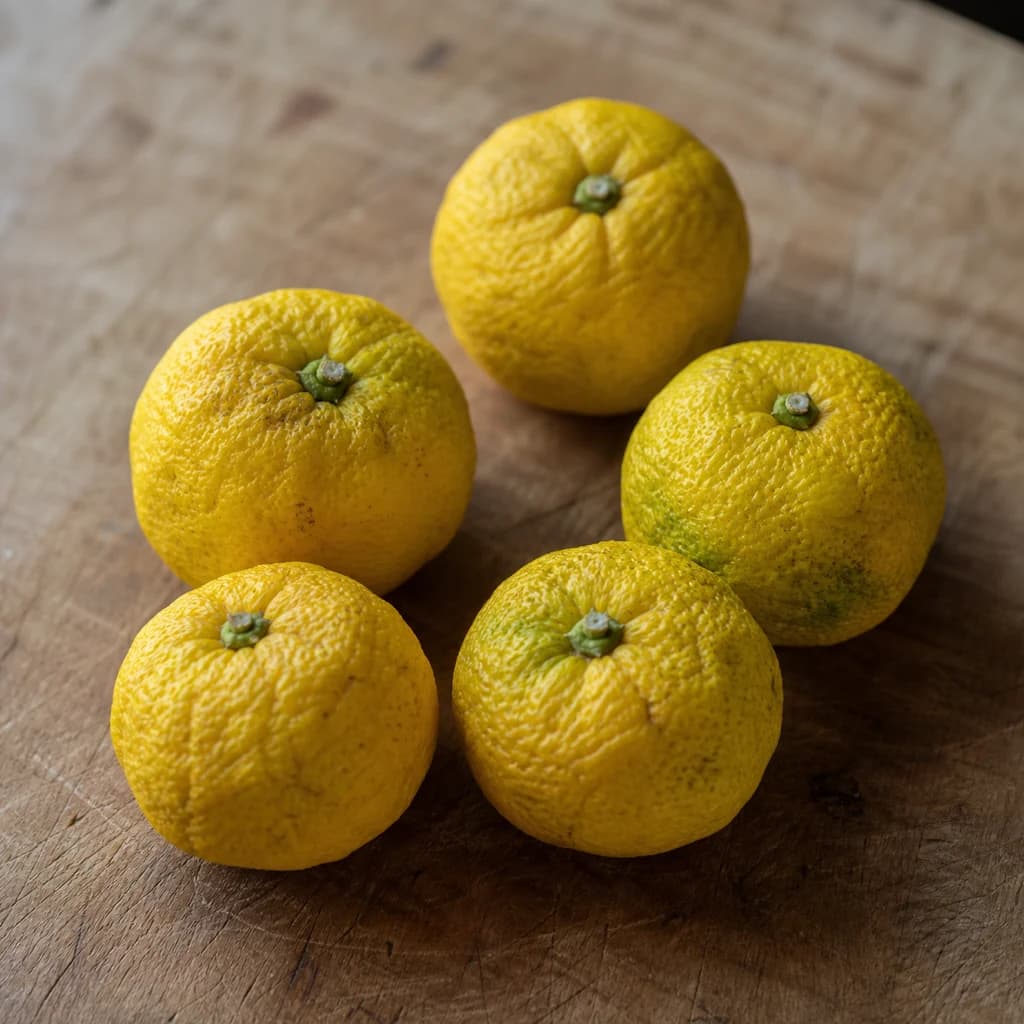
Natural form
Whole yuzu fruit showing its knobbly, bright yellow-green skin and small size.
Shows the fruit's distinctive bumpy rind, coloring, and scale relative to a familiar surface — the primary recognition signal.
Produce
Yuzu
Aromatic East Asian citrus prized for its fragrant zest and tart juice in sauces and dressings.
Yuzu is a knobbly, fragrant East Asian citrus whose flavor sits between a lemon, mandarin, and grapefruit. The zest and juice are central to Japanese and Korean cooking, used in ponzu, dressings, marmalades, and the seasoning yuzu kosho. It is rarely eaten as a fruit because it is very seedy and sour; the intensely aromatic rind is its most prized part.
Yuzu is a fragrant East Asian citrus fruit (Citrus junos) native to the Yangtze River valley in China, now naturalized in Japan and Korea. It is a hybrid of mandarin orange (C. reticulata) and Ichang papeda (C. ichangensis), combining the bright acidity of its mandarin parent with the bold aromatics of the papeda. The fruit ranges 5–8 cm in diameter with a thick, bumpy, deeply fragrant rind that resists standard citrus tools. Its yellow-orange flesh is juicy and seedy, yielding approximately 30% juice by weight.
Yuzu matters because its flavor is genuinely complex—grapefruit's tartness, mandarin's sweetness, and lime's floral lift combined into something none of those fruits achieves alone. The aroma is its defining characteristic, more volatile and intense than most Western citrus. This makes yuzu particularly valuable as a finishing element: add it near the end of cooking or use it raw to preserve its fragrance. The fruit is rarely eaten out of hand due to its seedy flesh and thick rind, but it is indispensable as a flavoring agent across Japanese, Korean, and increasingly global cuisines. In Japan, yuzu is also associated with winter solstice traditions (Fuyū Shū), where yuzu baths are taken for warmth and good fortune.
When working with fresh yuzu, plan your sequence carefully: zest before juicing, because once the fruit is pressed, the rind softens and becomes difficult to work with. One medium fruit yields roughly 1 tablespoon of juice, so factor this into your purchasing. The essential oil (used sparingly in flavoring) contains limonene, linalool, and citral, which are known allergens—be aware when using concentrated forms.
- Measured in
- piece
- Storage
- Fridge
Types & varieties
Fully mature, December–February; peak flavor with the best balance of sweetness and acidity
Harvested in autumn; more acidic and intensely floral; prized for yuzu kosho
Named cultivar from Ehime Prefecture, Japan; larger fruit with milder acidity
Common uses
Tips & pitfalls
- Select firm, heavy fruits for maximum juice content; avoid any soft spots or browning on the rind.
- Zest before juicing—once the fruit is pressed, the rind softens and becomes flaccid, making zest nearly impossible to grate.
- Use a microplane grater or fine vegetable peeler; the thick, bumpy rind resists standard citrus zesters and box graters.
- If a recipe calls for both zest and juice, zest first, then juice; plan that one medium fruit yields roughly 1 tablespoon of juice.
- Freeze excess juice in ice cube trays for convenient portions—yuzu juice freezes well and keeps for months.
- Yuzu kosho is perishable; refrigerate and use within 2–3 weeks, or freeze in small portions to extend shelf life.
- When substituting yuzu juice for lemon or lime, reduce other acids in the recipe since yuzu is less acidic than its Western counterparts.
- The essential oil is highly concentrated—a little goes a very long way; use sparingly for flavoring or aroma only, never directly on food.
Nutrition
Nutrition
No USDA FoodData Central match for Yuzu yet. We surface a per-100 g profile once a generic whole-food entry is matched and verified.
In the shops
Matched grocery products
No matched grocery products for Yuzu yet.
Good to know
- Botanical name
- Citrus junos
- Parentage
- Mandarin (C. reticulata) × Ichang papeda (C. ichangensis)
- Origin
- Yangtze River valley, China; naturalized in Japan and Korea
- Peak season
- December–February (Northern Hemisphere)
- Typical size
- 5–8 cm diameter
- Flavor profile
- Complex: grapefruit, mandarin, and lime notes; intensely aromatic
- Yield
- ~30% juice by weight; one medium fruit ≈ 1 tbsp juice
- Shelf life
- Refrigerated 1–2 weeks fresh; juice freezes well; use zest immediately or freeze
Substitutes
- Sudachi — Smaller Japanese citrus with very similar floral acidity; the closest substitute in both flavor and application
- Calamansi — Filipino citrus with comparable tartness and aromatics; usable in both raw and cooked preparations
- Grapefruit juice + lime juice + dash of mandarin — An improvised blend that approximates yuzu's complex layered flavor; not an equal substitute in intensity
- Meyer lemon — Softer acidity and sweeter; acceptable for zest, weaker for juice; the aromatic lift will be noticeably absent
- Yuzu concentrate or paste — Reconstitute or use directly for both zest and juice needs; check labels for added salt or preservatives
Pairs with
Appears in these dishes

Related

Tomato
Juicy, sun-sweet fruit for sauces, salads, and slow-cooked depth

Yellow Onion
The aromatic backbone of soups, sofritos, and braises

Garlic
Pungent cloves that perfume nearly every savory dish

Lemon
Bright, acidic citrus that wakes up almost any dish

Potato
Humble, hearty staple — roast, mash, fry, or boil

Carrot
Sweet, crunchy root — raw, roasted, or the base of a sofrito

Cucumber
Cool, crisp, and watery — for salads, pickles, and tzatziki

Lettuce
Crisp leaves for salads, wraps, and a fresh crunch