 Mediterranean
Medium · Hot
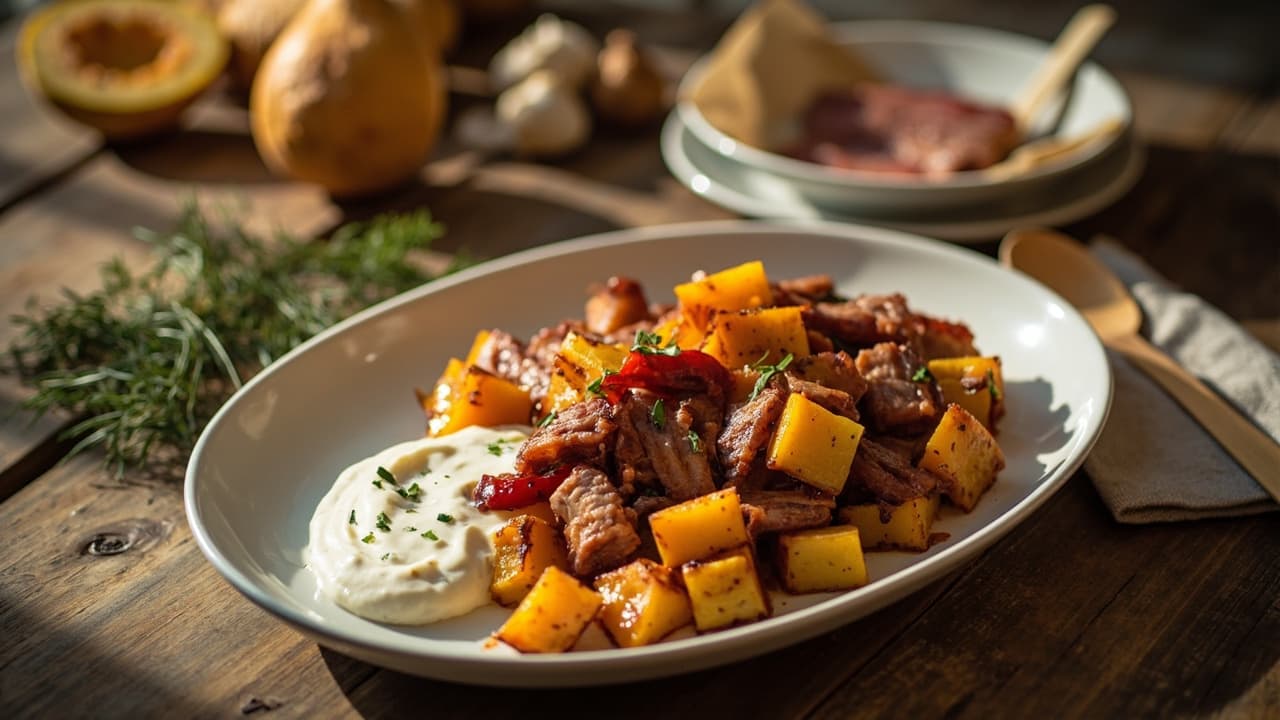
Roasted Butternut Squash Bites with Paprika Pork Belly
Cubes of sweet butternut squash roasted until golden, nestled alongside rich pork belly crisped with bloomed paprika and garlic — a hearty, nostalgic bite that balances autumn sweetness with savory depth, finished with a cooling swirl of yogurt.

Prep
20 min
Cook
28 min
Total
48 min
Method
1
Preheat your oven to 200°C (400°F) with a rack in the center. Line a large baking sheet with parchment paper.
2
Peel the butternut squash, halve it lengthwise, and scoop out the seeds. Cut into 2-cm cubes. Peel and finely dice the yellow onion. Mince the garlic cloves. Set aside.
3
Toss the squash cubes with 3 tbsp olive oil, 1 tsp salt, and 0.5 tsp black pepper on the prepared baking sheet. Spread in a single layer — do not crowd, or they steam instead of roast.
4
Roast at 200°C for 22-25 minutes, flipping halfway through, until the edges are golden-brown and a fork slides in with no resistance. Remove and set aside.
5
While the squash roasts, slice the pork belly into 1-cm lardons. Place a large heavy skillet over medium-high heat and add 2 tbsp olive oil.
6
Lay the pork belly pieces in a single layer and sear undisturbed for 4 minutes, until deeply browned on the bottom. Flip and cook another 3 minutes until the second side caramelizes. If the pan looks dry, add a splash more oil.
7
Push the pork belly to the side and add the diced onion to the rendered fat. Cook 4-5 minutes, stirring occasionally, until softened and translucent.
8
9
Season with 0.5 tsp salt, toss well, and remove from heat.
10
Add the roasted squash cubes directly to the skillet with the paprika pork belly. Fold gently to combine while everything is still hot.
11
12
Spoon the squash and pork belly onto a large platter or divide among plates. Drizzle or dollop the yogurt dill sauce alongside — the cool tang cuts right through the richness.
C
Nutri-Score
Fair balance
A–E · lower is better · score 7
Calories
730
per serving
High in saturated fat · 23gLow sugar · 10g
Protein
15g
Carbs
28g
Fat
64g
Sat. fat
23g
Fiber
8g
Sugar
10g
Sodium
1174mg
Gluten FreeHigh ProteinLow CarbAnti InflammatoryDiabetesHeart HealthyBalanced Fat
Nutri-Score is a general nutritional-balance guide, not medical or dietary advice.
C
Environmental impact
Moderate impact
A–E · lower is better · includes estimates
kg CO2e
1.4
per serving
CCarbonAEU all-round· carbon sets the grade
Water
1.1m³
Land
49Pt
Runoff
0.1g P
Pork Belly drives 76% of this recipe’s estimated footprint.
Carbon from Poore & Nemecek 2018; water, land & runoff from Agribalyse — modelled averages for comparing recipes, not a measurement of your groceries.
Flavor Profile
7
Umami
5
Sweet
4
Salty
3
Sour
1
Bitter
1
Spicy
Textures
CreamyCrispySilkyTender
Aromas
BrightHerbalSavorySmoky
Kitchen Equipment
Safety & Storage
High Risk Population
Raw pork belly is a high-risk ingredient. Elderly, immunocompromised, pregnant individuals, and young children should ensure pork is cooked to an internal temperature of at least 63°C (145°F) with a 3-minute rest time.
Cooking Temperature
Pork belly lardons must be seared until deeply browned on both sides (approximately 4 minutes per side at medium-high heat) to ensure adequate pathogen elimination before consumption.
The rendered pork fat in the skillet remains extremely hot after cooking. Allow the skillet to cool before handling, and exercise caution when adding squash cubes to avoid oil splatter burns.
Handling
Use separate cutting boards and utensils for raw pork belly and vegetables to prevent cross-contamination. Wash all surfaces and tools thoroughly with hot, soapy water after handling raw pork.
Storage
Refrigerate leftover pork belly and roasted squash separately within 2 hours of cooking. Store yogurt dill sauce in a sealed container and use within 24-48 hours. Reheat pork belly to 74°C (165°F) before serving leftovers.
Cross Contamination
Do not use the same spoon for both the yogurt sauce and raw pork drippings. Keep the yogurt dill sauce refrigerated until serving to prevent bacterial growth.
Shelf Life
Cooked pork belly can be refrigerated for 3-4 days or frozen for 2-3 months. The yogurt dill sauce has a shorter shelf life of 1-2 days due to dairy content.
Allergen Warning
This dish contains milk (yogurt). Individuals with milk allergies or lactose intolerance should avoid the yogurt dill sauce or use a dairy-free alternative.
Pro Tips
Technique
Do not rush the pork belly — when you lay those lardons in the hot pan, leave them alone for the full four minutes. That undisturbed sear is what builds the crust that holds all that paprika warmth inside. My grandmother used to say impatience ruins the fat.
Substitution
If pork belly is not easy to find, thick-cut bacon or pancetta works in its place — still render it slow, still bloom the paprika in that beautiful fat.
From the chef
Sweet butternut squash and paprika pork belly belong together on the same plate. The squash goes into a hot oven — 200°C, single layer, no crowding — and comes out golden and bursting at the edges after about 25 minutes. While that roasts, pork belly lardons get seared in olive oil until caramelized, then onion and garlic soften in the rendered fat before the paprika blooms in for 30 seconds, turning everything a deep warm orange. Fold the squash into the skillet, and finish with a yogurt dill sauce — lemon-bright and cooling — drizzled over the top or served alongside for each person to dose themselves.
TagsHeartyRoasted VegetablesPork BellyAutumnMediterraneanYogurt SaucePaprika
AllergensMilk
Source: generated · June 13, 2026