 British
Medium · Hot
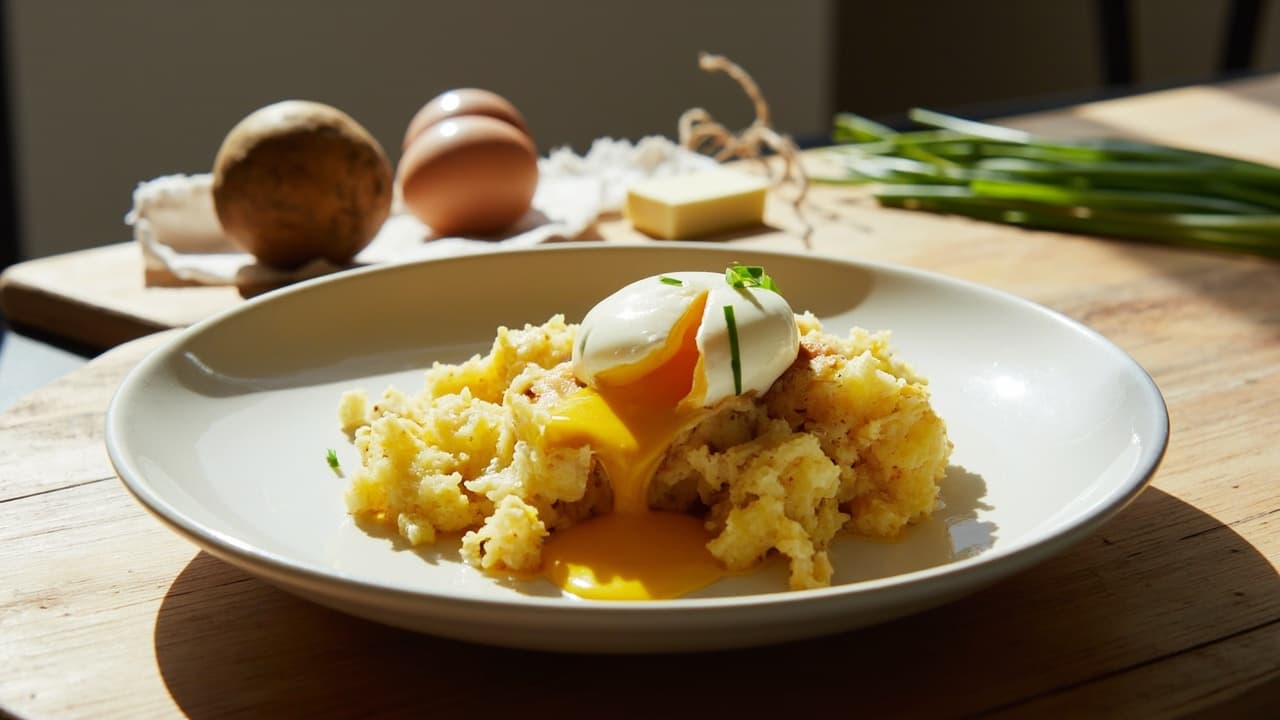
Poached Egg with Mustard Butter and Crushed Potato
A proper breakfast plate: a perfectly poached egg with a runny yolk draped over rough-crushed potatoes, finished with sharp mustard butter that pools into the crevices. No towers. No queues. Just breakfast.

Prep
10 min
Cook
30 min
Total
40 min
Method
Crush the Potato
2
Drain thoroughly and return to the warm pot for 30 seconds to evaporate excess moisture.
3
Add 30g butter, 1/2 tsp salt, and 1/4 tsp black pepper. Crush with a fork into rough, uneven pieces — not mash, not coins. Keep some texture. Set aside.
Poach the Eggs
4
Bring a saucepan of water to a gentle simmer. Add 1 tbsp white vinegar and 1/4 tsp salt.
5
Crack each egg into a small cup. Stir the water to create a gentle vortex, then slide in the eggs one at a time.
6
Poach for exactly 3 minutes for a set white with a runny yolk. Remove with a slotted spoon and blot dry on a paper towel.
Make the Mustard Butter
7
Assemble
9
10
11
Snip fresh chives directly over the plates. Serve immediately. Breakfast waits for no one.
C
Nutri-Score
Fair balance
A–E · lower is better · score 4
Calories
487
per serving
High in saturated fat · 21gLow sugar · 3g
Protein
11g
Carbs
36g
Fat
34g
Sat. fat
21g
Fiber
5g
Sugar
3g
Sodium
1072mg
High ProteinBalanced Breakfast
Nutri-Score is a general nutritional-balance guide, not medical or dietary advice.
B
Environmental impact
Low impact
A–E · lower is better · includes estimates
kg CO2e
0.7
per serving
BCarbonAEU all-round· carbon sets the grade
Water
0.1m³
Land
29Pt
Runoff
0.08g P
egg drives 34% of this recipe’s estimated footprint.
Carbon from Poore & Nemecek 2018; water, land & runoff from Agribalyse — modelled averages for comparing recipes, not a measurement of your groceries.
Flavor Profile
6
Umami
3
Sweet
5
Salty
2
Sour
1
Bitter
3
Spicy
Textures
TenderCreamyCrispySaucy
Aromas
ButterySharpHerbalSmoky
Kitchen Equipment
Primary Tool
SaucepanCounter FootprintMedium
Techniques
Safety & Storage
Cooking Temperature
Poach eggs in simmering water (180-190°F/82-88°C) for exactly 3 minutes. Butter should be heated until golden at edges but not burned.
High Risk Population
Runny yolk may pose Salmonella risk for elderly, pregnant women, infants, and immunocompromised individuals. Consider cooking yolk to firm consistency for these populations.
Cross Contamination
Use dedicated utensils for raw eggs. Clean and sanitize all surfaces, pots, and spoons that contact raw eggs before using for other ingredients.
Handling
Crack eggs into clean cups before poaching to check for shell fragments and verify freshness. Avoid letting raw eggs sit at room temperature for more than 2 hours.
Storage
Refrigerate potatoes and eggs at 40°F (4°C) or below before cooking. Prepared dish should be served immediately and not left at room temperature for more than 2 hours.
Shelf Life
This dish is best consumed immediately after preparation. Do not store leftover poached eggs as texture deteriorates rapidly. Potatoes may be stored separately for up to 3-4 days refrigerated.
Equipment Safety
Use slotted spoon with adequate drainage when removing poached eggs to prevent burns from hot water. Dry eggs on paper towel before plating.
Pro Tips
Technique
That swirl of vinegar in the poaching water isn't superstition — it helps the egg whites coil inward around the yolk. But keep it gentle. You're poaching an egg, not starting a hurricane.
Substitution
Whole grain mustard gives you texture, but a sharp Dijon melts into the butter more smoothly. Either works, but don't reach for anything sweet or honeyed — this sauce has standards.
From the chef
Rough-crushed potatoes are the only honest base for a poached egg. The crevices catch the mustard butter, the yolk pools into the cracks when you break it, and the whole plate costs you twenty-five minutes and a single saucepan. The mustard is not subtle — it should taste like mustard, sharp and real, cut through by the butter going glossy as it emulsifies. Poach the egg for exactly three minutes. Any more and the yolk sets. Any less and you have a different dish entirely. Serve it while everything is still warm enough to matter.
TagsPoached EggBreakfastPotatoMustard ButterChives
AllergensMilkEggsMustard
Source: generated · June 10, 2026