 French
Medium · Hot
Steak Frites with Garlic Parsley Butter
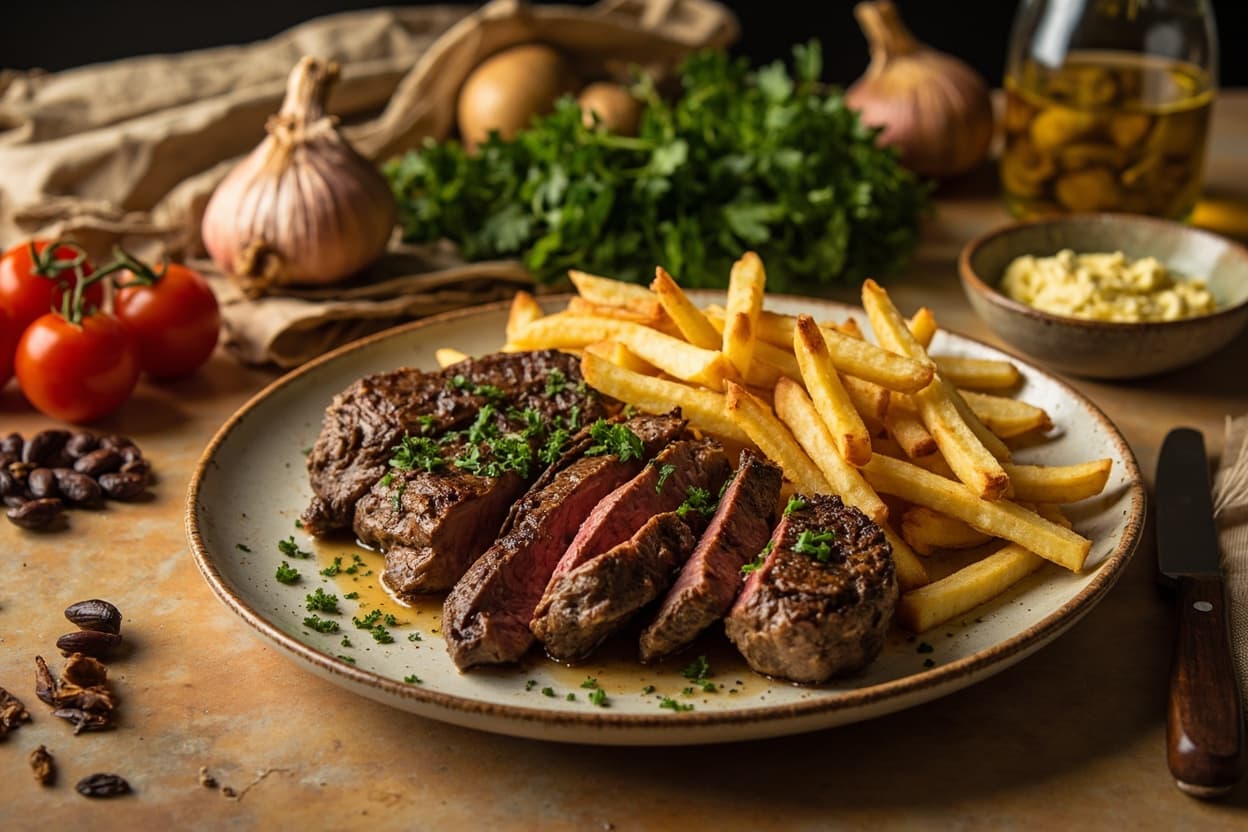
The steak rests while a compound butter — soft, heavy with garlic and parsley — begins to melt into the scored surface, pooling at the edges. Potatoes, cut carefully and fried twice to achieve that particular crunch, arrive alongside as both contrast and complement. Nothing about this plate is accidental; every element has been coaxed to its best self.

Prep
45 min
Cook
20 min
Rest
5 min
Total
1h 10m
Method
Prepare the Garlic Parsley Butter
1
2
Spoon the compound butter onto a sheet of parchment paper. Roll it into a neat log and twist the ends to seal. Refrigerate until firm enough to slice into medallions, about 30 minutes.
Prepare the Frites
3
Drain and thoroughly pat the potatoes completely dry with clean kitchen towels. Any residual moisture will cause violent splattering when they hit the hot oil.
4
Heat the sunflower oil in a heavy-bottomed pot or deep fryer to exactly 325°F. Use a thermometer — this temperature is critical for the first pass.
5
Fry the dried potatoes in batches, being careful not to overcrowd the pot. The oil temperature will drop dramatically with too many potatoes at once. Fry for 4-5 minutes until they are pale and just beginning to turn golden at the edges. They should still be soft internally. Remove with a spider or slotted spoon and drain on a wire rack.
Cook the Steaks
6
Season generously on all sides with salt and black pepper. Press the seasoning firmly into the meat so it adheres.
7
Use a food thermometer to verify internal temperature reaches 145°F (63°C) for medium-rare, then rest for exactly 3 minutes.
Rest and Finish
8
Transfer the seared steaks to a cutting board or plate. Scatter a few garlic parsley butter medallions on top of each steak. Do not cover — steam will ruin the crust. Rest for exactly 5 minutes. The carryover heat will continue cooking the interior while the juices redistribute throughout the meat.
9
While the steaks rest, bring the frying oil up to 375°F for the second fry. Fry the par-cooked frites again in fresh batches until they are deeply golden and gloriously crisp, about 2-3 minutes. Season immediately with salt.
D
Nutri-Score
Needs balance
A–E · lower is better · score 17
Calories
2778
per serving
High in saturated fat · 42gCalorie-dense · 2778 kcalLow sugar · 2g
Protein
33g
Carbs
20g
Fat
290g
Sat. fat
42g
Fiber
3g
Sugar
2g
Sodium
1548mg
High Protein
Nutri-Score is a general nutritional-balance guide, not medical or dietary advice.
E
Environmental impact
Very high impact
A–E · lower is better · includes estimates
kg CO2e
24
per serving
ECarbonCEU all-round· carbon sets the grade
Water
1.0m³
Land
572Pt
Runoff
0.6g P
Beef Steaks drives 95% of this recipe’s estimated footprint.
Carbon from Poore & Nemecek 2018; water, land & runoff from Agribalyse — modelled averages for comparing recipes, not a measurement of your groceries.
Flavor Profile
8
Umami
3
Sweet
6
Salty
1
Sour
2
Bitter
4
Spicy
Textures
CrispyTenderRichSilky
Aromas
HerbalGarlickySmokyButterySavory
Kitchen Equipment
Primary Tool
Dutch OvenDutch OvenHeavy Bottom PotDeep FryerThermometerSpider StrainerSauté PanChef KnifeCutting BoardMixing BowlWooden SpoonMeasuring SpoonsRolling PinWire RackParchment PaperKitchen TowelsPlastic Wrap
Counter FootprintMedium
Techniques
Safety & Storage
Equipment Safety
Hot oil at 325°F and 375°F poses severe burn risk. Use long-handled tools, heavy-bottomed pot, and never leave oil unattended during frying.
Cooking Temperature
Critical temperature control required: first fry at 325°F, second fry at 375°F. Use thermometer to verify. Oil temperature drops dramatically with potato batches.
Cross Contamination
Raw beef steaks harbor pathogenic bacteria. Use separate cutting boards and utensils for raw meat. Sanitize all surfaces and tools with hot soapy water after handling.
Handling
Never add wet potatoes to hot oil—residual moisture causes violent splattering. Ensure potatoes are thoroughly dried and at room temperature before frying.
Storage
Compound butter must be refrigerated within 2 hours of preparation. Store leftovers in airtight container in refrigerator for up to 3 days. Reheat frites in oven at 400°F to restore crispness.
High Risk Population
Undercooked beef poses infection risk to children, elderly, pregnant individuals, and immunocompromised persons. Use food thermometer to ensure minimum internal temperature of 145°F.
Allow steaks to rest uncovered for exactly 5 minutes after cooking. Covering causes steam which ruins the seared crust and promotes bacterial growth.
Pro Tips
Technique
The double-fry method for the frites is non-negotiable if you want that ethereal crunch. First at 325°F to cook through without color, then resting while the steaks sear, then again at 375°F to develop that golden, shatteringly crisp exterior. I've watched home cooks try to shortcut this and the difference is immediately evident—the interior remains tender while the outside shatters.
Substitution
If fresh flat-leaf parsley isn't available in your market, fresh chervil makes a lovely substitute with its delicate anise notes, or you could blend in a few sprigs of fresh thyme for earthiness. The garlic parsley butter is forgiving—adjust to what grows in your garden or what you can source fresh.
From the chef
There's something deeply satisfying about a dish that demands your full presence. Steak Frites is not a meal to rush—it asks for patience at the fryer, attention at the cast iron, and a quiet reverence as the butter melts into the resting meat. I first encountered this in a small Parisian bistro where the chef refused to rush a single element, and I understood then that good cooking is simply an act of respect: for the ingredient, for the process, for the person who will sit down to eat it.
TagsFrenchBistroSteakFriesButterGarlicClassic
AllergensMilk
Source: generated · May 30, 2026