Transform & Preserve
Cold Storage
Holding food at controlled low temperatures to slow spoilage and extend shelf life.
Cold storage keeps perishables in refrigeration (around 0 to 4 degrees Celsius) or freezing to slow microbial growth and enzymatic decay. It is foundational to food safety, preserving meat, dairy, produce, and prepped components until use. Proper storage means consistent temperature, good airflow, and separating raw from ready-to-eat foods to avoid cross-contamination.
Cold storage is the spectrum of techniques that hold food below ambient temperature to slow microbial growth, retard enzymatic activity, and — at the lower end — suspend decay almost entirely. Two parameters govern everything else: temperature and humidity. A refrigerator running at 1–3°C slows bacteria but never stops them; a freezer at −18°C or below halts microbial and enzymatic action but does not kill organisms, so any food that warms back into the danger zone (4–60°C) after thawing is once again vulnerable. Humidity is the quieter partner: leafy produce keeps its crispness at 85–95% relative humidity, while a dry-aging chamber deliberately drops to 75–80% so the surface of a beef primal can dehydrate and form a protective rind.
What makes cold storage a true technique, rather than just a piece of equipment, is that cooks now use it as a flavor-development tool as much as a preservation method. A 48-hour retarded bread dough develops deeper malt and tang; a 40-day dry-aged ribeye loses 15–25% of its moisture while concentrating beefy, nutty, almost cheesy flavor; cold-extracted coffee smooths out bitter compounds by steeping grounds in a refrigerator overnight. Treating cold storage as a deliberate process — with the right target temperature, the right humidity, the right packaging, and a rotation system — is what separates a working kitchen from one that simply has a fridge.
The history stretches from Persian yakhchāls (evaporative ice houses documented by at least 400 BC) through the 19th-century Norwegian and American ice trade, into Carl von Linde's 1876 ammonia compressor, and finally Clarence Birdseye's 1924 quick-freezing patents — the moment frozen food stopped being a luxury and became an industry. Home cooks today inherit all of that: a domestic refrigerator and a chest freezer, ideally paired with a vacuum sealer, outperform anything available to a 19th-century chef by an order of magnitude.
- Difficulty
- Easy
Types & varieties
0–4°C; slows but never stops bacterial growth; the workhorse for most perishables
−18°C and below; suspends microbial and enzymatic activity; long-term preservation
−30 to −40°C with forced air; forms small ice crystals that minimize cell damage in fish, raw proteins, and prepared dishes
Liquid nitrogen (−196°C) or food-grade CO₂; near-instantaneous; haute cuisine for purées, foams, and delicate items
Commercial cold room at 1–2°C for bulk storage, high-volume prep, and large cured meats
Standard upright commercial unit; tightly controlled 1–3°C
Adjusts O₂, CO₂, and humidity to extend apple, pear, and kiwifruit life 6–12 months
Replaces package air with a custom gas mix; standard for fresh meat, cut salads, prepared produce
Reduces pressure to flash-evaporate water and cool in minutes; used for leafy vegetables and bakery crumb
Uncovered beef held at 0–3°C, 75–80% humidity for 14–60 days; concentrates flavor and tenderizes via natural proteolysis with 5–35% moisture loss
Vacuum-sealed beef aged at 0–1°C for 14–28 days; tenderizes with minimal moisture loss, but little flavor concentration
Crushed-ice slurry for rapid cooling and short-term holding of fish, shellfish, and dairy
12–30°C smoke exposure; curing and preservation (salmon, ham, cheese) without cooking the food
Bread dough held at 2–5°C for 12–72 hours to develop flavor through slow yeast and enzymatic activity
How to do it
- 1
Cool food to a safe temperature before storing
If the food is hot, drop its temperature below 21°C (70°F) within 2 hours and below 4°C (40°F) within 4 more hours. Use an ice bath, divide into shallow containers (≤10 cm deep), or stir frequently. Do not put large volumes of steaming food in the fridge — it raises the interior into the danger zone for hours.
- 2
Choose the right cold storage method
Refrigerate for short-term holding (days to weeks). Freeze for long-term storage (months to a year or more). Use a blast freezer for anything you want to freeze with minimal cell damage — fish, raw proteins, and prepared dishes meant to be served rare. Use a walk-in or controlled-atmosphere room for produce destined for long holding.
- 3
Package to exclude air and moisture loss
Use airtight containers, vacuum bags, or tightly wrapped freezer paper with all air pressed out. For freezer storage, double-wrap or use a vacuum sealer to prevent freezer burn. For refrigerator storage, leave lids slightly vented on hot food until cool, then seal.
- 4
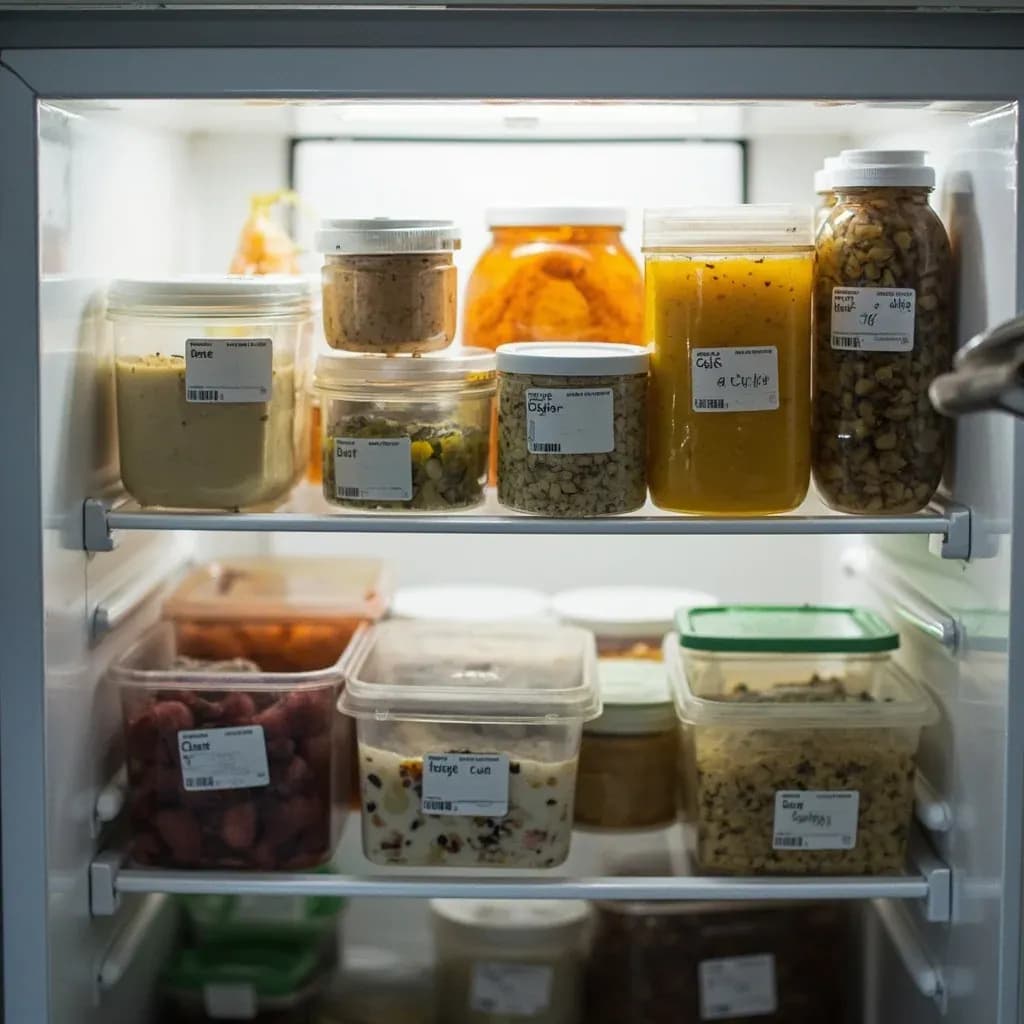
Label every container
Write the contents, the date stored, and (if freezing) a use-by date. Masking tape and a marker is the kitchen standard. Without labels, food gets forgotten and wasted.
- 5
Place food in the correct zone
Cold air sinks; the back of the lower shelf is the coldest spot. Store raw proteins on the bottom to prevent cross-contamination. Keep ready-to-eat foods above. Doors are the warmest area — reserve for condiments, sauces, and items with natural preservatives.
- 6
Maintain consistent temperature
Refrigerator: 1–3°C (34–38°F). Freezer: −18°C (0°F) or colder. Use a thermometer — built-in dials are often inaccurate. Avoid opening the door frequently or for long periods; every 10 seconds of door-open can raise the interior 2–3°C temporarily.
- 7
Rotate stock with First-In, First-Out
Place newer items behind or under older ones. Check all stock weekly and use or discard anything past its date. FIFO is how professional kitchens cut waste by 30–50%.
- 8
Monitor, clean, and maintain equipment
Wipe spills immediately, deep-clean the interior monthly, and defrost freezers when ice builds beyond 6 mm. Check door seals yearly; a worn gasket can leak 20–30% of cooling capacity and silently raise internal temperature.
The temperature spectrum
Cold storage is not one temperature but a graduated ladder, and each rung suits different ingredients.
- Cool room (10–15°C): wine cellars, banana ripening, tomato holding — anything that suffers chilling injury below 10°C
- Refrigerator (0–4°C): dairy, raw meats, most vegetables, prepared foods; the daily workhorse
- Freezer (−18°C and below): long-term preservation of proteins, prepared dishes, bread, stock, and produce
- Blast freezer (−30 to −40°C): the gold standard for preserving texture in fish, raw proteins, and items you intend to serve rare or just-seared after thawing
Temperature × humidity × time
The three variables multiply rather than add. A 4°C fridge at 95% humidity keeps parsley weeks; the same fridge at 40% humidity wilts it in three days. A −18°C freezer in a vacuum bag holds a steak a year in prime condition; the same cut wrapped loosely is freezer-burned in eight weeks.
- Produce prefers 85–95% relative humidity to stay crisp — line crisper drawers with paper towels and avoid opening them often
- Dry aging requires 75–80% humidity to dry the surface while keeping the interior from case-hardening
- Freezer storage is essentially indifferent to humidity provided food is sealed — the enemy is sublimation, not air moisture
- Refrigerated dairy and raw meat prefer lower humidity (around 60–70%) so surfaces don't get slimy
Common uses
Tips & pitfalls
- Cool hot food to 21°C within 2 hours, then to 4°C within 4 more hours — a 5-litre pot of stew at 90°C put straight in the fridge can hold the interior above 7°C for several hours, endangering everything else in it.
- Use shallow pans under 10 cm deep for refrigerating liquids; this often cuts cooling time by more than half compared to a deep stockpot.
- An ice bath with regular stirring drops 1 litre of stock from 80°C to 4°C in 15–25 minutes — far faster than air cooling and the single best habit for safe hot-holding leftovers.
- Don't crowd the fridge; oversized pots blocking vents can raise the internal temperature 5–10°C and shorten the life of all contents.
- Store raw meats on the lowest shelf to prevent drips contaminating ready-to-eat food — a leading cause of home foodborne illness.
- The door is the warmest part of a fridge; keep condiments there, not milk or eggs.
- Vacuum-sealing before freezing removes oxygen, the main driver of freezer burn, and typically extends useful freezer life 2–3× — arguably the biggest single upgrade for a home kitchen.
- Do not refreeze raw protein that has fully thawed above 4°C for more than 2 hours — Staphylococcus aureus produces heat-stable toxins that survive recooking.
- Tomatoes, basil, unripe avocados, bananas, and mangoes suffer chilling injury below 10–13°C and should be stored at cool room temperature instead.
- Wrap cheese in parchment then loosely in plastic or beeswax; fully sealed plastic suffocates the rind and traps ammonia.
- Keep a refrigerator thermometer — built-in dials are routinely off by 3–5°C, and anything above 5°C cuts dairy life in half.
- Do not freeze raw eggs in shell, lettuce, high-water-content vegetables, mayonnaise-based salads, or dairy sauces — they tend to separate or become unpleasantly watery on thawing.
- Honey, salt, dried beans, hard liquor above 40% ABV, and white rice are essentially shelf-stable and do not need cold storage.
- Defrost freezers when ice builds beyond 6 mm — frost insulates the evaporator, forces the compressor to work harder, and raises internal temperature.
Good to know
- Refrigerator range
- 1–4°C (34–40°F); aim for 1–3°C
- Freezer standard
- −18°C (0°F) or colder
- Blast freezer
- −30 to −40°C (−22 to −40°F) with high-velocity air
- Danger zone
- 4–60°C (40–140°F) per FDA Food Code
- FDA cooling rule
- Cool 57°C to 21°C within 2 hours, then to 4°C within 4 more hours (6 hours total)
- Freezer burn
- White or grey dry patches from sublimation; food stays safe but quality suffers — trim before cooking
- Vacuum-sealed extension
- Typically 2–3× the freezer life of standard wrapping by excluding oxygen
- Whole eggs in shell
- 3–5 weeks refrigerated (in the US, eggs are washed and must be refrigerated; in much of Europe the cuticle is left intact and room storage is fine)
Also called
Controlled-Temperature Storage
Related

Confit
Cook slowly submerged in fat for silky tenderness and keeping

Cure
Draw out moisture with salt and time to preserve and concentrate

Pickle
Steep in acidic brine for bright, tangy, crunchy preservation

Ferment
Let friendly microbes transform food into tangy, complex flavor

Marinate
Soak in a seasoned mix to flavor and tenderize before cooking

Brine
Soak in salt water so meat stays juicy and seasoned throughout

Dehydrate
Slowly dry out moisture to concentrate flavor and extend shelf life

Cold-Smoke
Perfume cured food with smoke without cooking it through