Prep & Assembly
Tea Brewing
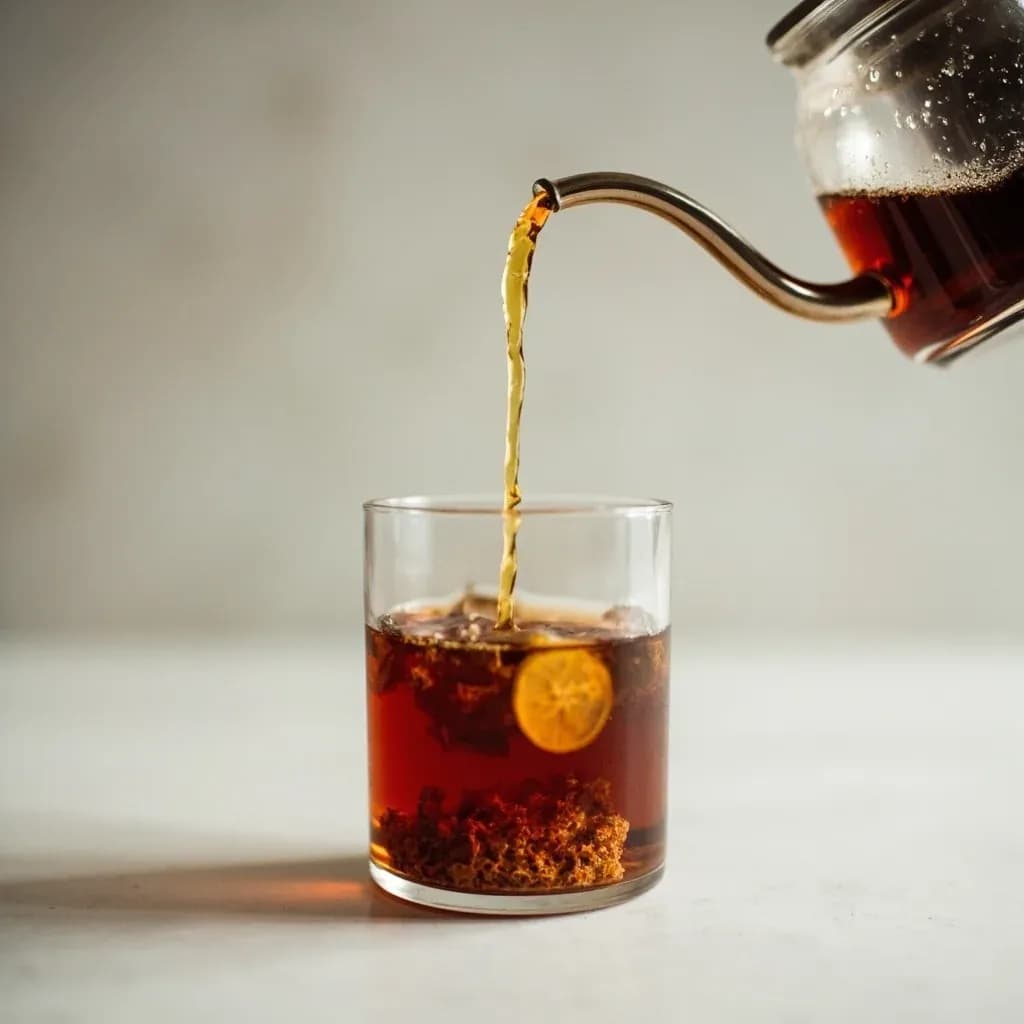
Steeping and pouring tea, often aerated from height, into a flavorful, foamy drink.
Tea brewing steeps leaves in hot water and, in many traditions, repeatedly pours the tea from height to aerate and foam it, as in West African attaya or pulled milk tea. Methods range from triple-brewing and samovar steeping to churning milk tea or cold-brewing terere. The pouring ritual both cools and froths the tea while concentrating and balancing its strength across servings.
Tea brewing is the controlled extraction of flavor from Camellia sinensis (or, for herbal drinks, from herbs, flowers, and fruit) into water. The technique looks deceptively simple — hot water over leaves — but the distance between a serviceable cup and a great one is set by four variables working together: water quality, leaf-to-water ratio, temperature, and steep time. The same leaves, brewed differently, taste like entirely different drinks, which is why a gongfu oolong and a Western black tea share almost no flavor language despite starting from the same plant.
Beyond the cup, brewed tea is a serious kitchen liquid. It functions as a smoking medium, a braising and poaching liquid, and a base for syrups, sorbets, and custards — closer in role to wine or dashi than to coffee. The foam the one-liner alludes to is mechanical, not chemical: it comes from pouring from height, whisking, or churning with butter, not from the steep itself. Treated as a foundational technique, the rest of the savory kitchen opens up.
- Difficulty
- Medium
Types & varieties
Single longer steep in a large pot or mug; forgiving, low leaf ratio, usually one cup from the leaf.
Fujian and Chaozhou practice with a small gaiwan or clay pot, a high leaf ratio, and many short infusions (often 5–15 seconds to start, lengthening 5–10 seconds per round). Surfaces aroma, body, and how the tea changes across steeps.
Short steeps at low temperatures — sencha at 60–80°C for 30–60 sec, gyokuro near 50°C for 1–2 min. Tuned for sweetness and umami rather than briskness.
Loose gunpowder or green tea with fresh mint and sugar, brewed strong and poured from height between vessels to aerate and form a pale foam.
Black tea (usually Assam) simmered with water, milk, and sugar plus whole spices — cardamom, ginger, cinnamon, cloves, black pepper. Foam is built by pouring back and forth.
Brewed in a stacked çaydanlık: a strong concentrate in the lower pot, plain water above, then diluted glass-by-glass to taste.
Pu'er or other strong tea churned with yak butter and salt until emulsified into a savory, frothy, high-fat drink.
Powdered shaded green tea whisked with hot (not boiling) water in a chawan with a bamboo chasen; the whole leaf is consumed as a foamy concentrate rather than a steeped infusion.
Tea steeped in cold or room-temperature water for 6–12+ hours. Lower bitterness, rounder body, and less caffeine extraction — especially effective for green and white teas.
A double-strength hot concentrate chilled and poured over ice, or cooled and poured over ice and diluted — a route to a clean, non-astringent iced cup.
How to do it
- 1
Choose and weigh the tea
Decide on style — Western or gongfu — and weigh leaf accordingly: about 2–3 g per 240 ml for Western, 5–8 g per 100 ml for gongfu. Use whole leaf where possible; fannings and bag tea extract faster and are easier to oversteep.
- 2
Heat water to the right temperature
Set a variable-temperature kettle to the temperature suited to the category: 70–80°C for green, 75–85°C for white, 85–95°C for oolong, 95–100°C for black, pu'er, and herbal tisanes. Without a variable kettle, boil and cool — roughly 2 minutes off the boil gives about 90°C, longer for green teas.
- 3
Preheat the vessel
Pour hot water into the teapot, gaiwan, or cup, swirl, and discard. A cold porcelain wall pulls 10–15°C out of a small infusion and dulls the first steep.
- 4
Add the leaf
Place the measured tea into the empty, preheated vessel. For tightly rolled oolongs and pu'er, the leaves need room to expand — fill the pot no more than about a third full of dry leaf.
- 5
Pour and start the clock
Pour water in a steady, even stream from a low height so all of the leaf is saturated. Start the timer the moment water hits the leaves, not when you finish pouring.
- 6
Steep to time, then taste
In Western style: green 1–3 min, white 4–5 min, oolong 2–4 min, black 3–5 min, herbal 5–7 min. For gongfu, start at 10–20 seconds and add 5–10 seconds per infusion. Sample at the early end of the range and adjust.
- 7
Separate leaf from liquor
Decant fully through a strainer, or, with a gaiwan, pour off every drop. Leaving leaves sitting in the liquor is the most common cause of a harsh, hollow cup.
- 8
Re-steep or store, and serve
For oolong, pu'er, and most green teas, re-flash with fresh hot water for the next infusion. Serve hot teas immediately. For iced tea, brew a hot double-strength concentrate and pour it over ice so the chilling is fast — steeping hot over ice overextracts and chills too slowly.
Why a longer steep does not mean a stronger cup
The single most common mistake in tea brewing is the assumption that a longer steep yields a stronger cup. It doesn't — it yields a bitter one. The molecules that read as 'strength' in tea (catechins, theaflavins, caffeine) extract quickly and plateau; the molecules that read as 'bitter' (tannins and degraded catechins) keep accumulating long after the first cup reaches its peak. If a cup tastes weak, the fix is more leaf or hotter water, not more time. If a cup tastes harsh, the fix is less time, cooler water, or both. The gongfu method makes this visible: each successive infusion of the same leaves gets longer because the soluble material is genuinely being used up, not because the tea is 'getting stronger.'
Building foam and body
Foam in tea is not produced by the steep itself. It is produced by mechanical agitation of liquids that contain dissolved proteins and saponins — compounds the leaf releases into the water. Three traditions exploit this:
- Moroccan mint tea is poured from a height of roughly 30–50 cm into a metal-rimmed glass, then back into the pot, repeating until a pale green foam forms on top.
- South Asian chai builds foam by pouring the finished liquid from one vessel to another in a long arc, then back. Milk proteins and tea solids trap air into a fine, dense froth.
- Matcha is whisked briskly in a zig-zag with a bamboo chasen, and Tibetan butter tea is churned in a tall wooden churn until butterfat emulsifies into a stable, creamy foam.
Common uses
Tips & pitfalls
- Use filtered, freshly drawn water; reboiled water loses dissolved oxygen and reads flat.
- Match water temperature to the leaf — boiling water on green or white tea extracts catechins and tannins that read as harsh and bitter.
- Weigh leaf instead of measuring by spoon. Whole-leaf oolong and pu'er occupy far more volume per gram than broken black tea, so teaspoon measures are unreliable.
- Preheat the pot, gaiwan, or cup with hot water and discard it before brewing — a cold vessel pulls 10–15°C out of a small infusion and mutes the first steep.
- Cover the vessel while steeping; the volatile top notes of oolong and green tea escape within 30 seconds in an open pot.
- Taste at the low end of the recommended time and add 30-second increments. Steep time, not water temperature, is usually what needs adjusting.
- Decant fully — leaves left in the cup continue to extract and turn a clean cup acrid.
- Store tea in airtight, opaque tins, away from the stove and spice rack. Tea absorbs volatile aromatics — coffee, spices, curry, soap — faster than almost any other pantry item.
Good to know
- Source plant
- Camellia sinensis for true teas; herbal 'teas' are tisanes brewed from herbs, flowers, fruit, or other plants
- Main categories
- White, green, yellow, oolong, black (called 'red tea' 紅茶 in China), and post-fermented dark/pu'er
- Green tea water
- 70–80°C / 158–176°F for most Chinese greens; 50–60°C for shaded Japanese gyokuro; 60–70°C for sencha
- Oolong tea water
- 85–95°C / 185–203°F, lighter styles at the low end, heavily roasted at the high end
- Black tea water
- 95–100°C / 203–212°F, fully boiling
- Western steep times
- Green 1–3 min, white 4–5 min, oolong 2–4 min, black 3–5 min, herbal 5–7 min — starting points only
- Leaf-to-water ratio
- About 2–3 g per 240 ml / 8 oz for Western; 5–8 g per 100 ml for gongfu
- Caffeine range
- Roughly 20–60 mg per 240 ml cup; matcha and shaded Japanese greens run higher (70+ mg) because the whole leaf is consumed
Also called
Tea Pouring · Attaya · Steeping Tea · Tea Pulling · Mate Steeping
Dishes that rely on it
Related

Whisk
Beat ingredients smooth and aerated with a looping wire motion

Sift
Pass dry ingredients through mesh to aerate and remove lumps

Strain
Pour through mesh to separate solids from liquid for a smooth result

Filter
Pass liquid through fine material to clarify out the smallest particles

Rice
Press cooked potatoes through small holes for fluffy, lump-free texture

Mash
Crush soft cooked food into a rustic, creamy purée

Grind
Crush food into a coarse to fine texture, from spices to meat

Grate
Shred food into fine bits against a sharp-toothed surface