Baking
Agar-Agar
Seaweed-derived gelling agent that sets firmer than gelatin and holds at room temperature; the plant-based route to panna cotta and aspic.
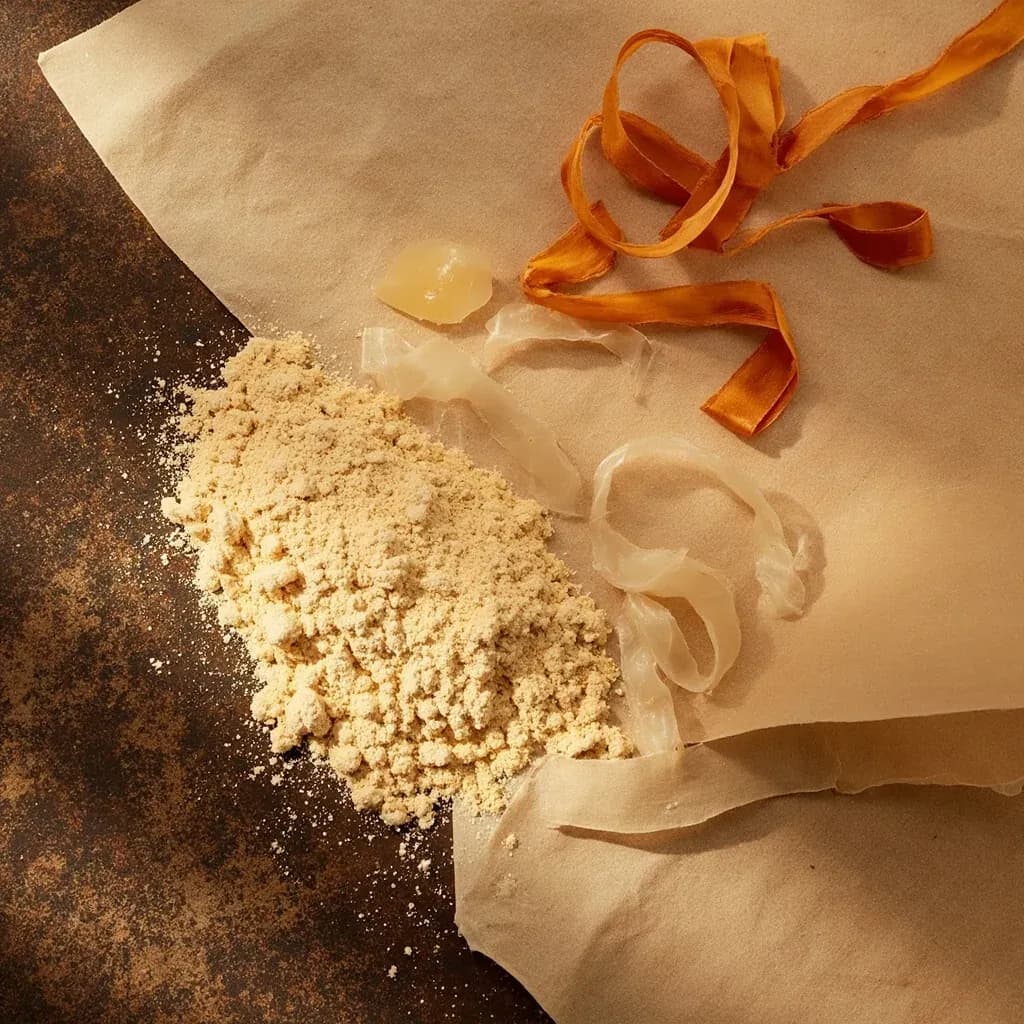
Agar-agar is a gelling agent extracted from red algae — primarily Gelidium and Gracilaria species — and refined into a near-flavorless powder, flake, or dried bar. It is composed of two polysaccharides, agarose and agaropectin, which form a rigid, three-dimensional network when hydrated and boiled. Unlike gelatin, agar needs no cold bloom and no refrigeration to set: it gels as it cools past roughly 38°C (100°F) and will not slump again until it is reheated to about 85°C (185°F), giving it a much wider working window than any other common gelling agent.
In the kitchen, agar behaves differently from gelatin in three ways that matter immediately to a cook. First, the texture it produces is cleaner and slightly brittle rather than a soft wobble — think of a clean slice that holds its edge, not a trembling quenelle. Second, it tolerates a wider pH range than animal gelatin, though strong acids will still soften the gel. Third, it must be boiled in its liquid for one to two full minutes to fully hydrate; merely simmering produces a weak or unset gel. That combination of firm set, neutral flavor, and vegan status is what makes agar the standard gelling agent in serious vegetarian and pastry kitchens.
- Measured in
- g
- Storage
- Pantry
Find it in
Suits
Types & varieties
Finely ground, dissolves fastest, easiest to dose for precise gels; the form most commonly sold in Western grocery stores.
Coarser cut; needs a longer simmer to dissolve fully. Roughly 1 tbsp flakes ≈ 1 tsp powder in gelling power.
Traditional Japanese form — dried, semi-translucent blocks or noodles. Soak before using; prized for the cleanest, most neutral flavor.
Firmer, crisper gel; preferred for traditional wagashi such as yokan and mizu-yokan.
Slightly softer gel; commonly sold as thin, brittle translucent noodles.
How agar actually sets
When agar is boiled, the agarose component dissolves and the long polymer chains separate. As the liquid cools below about 40°C, those chains reorganize into a double-helix network that traps water inside a rigid lattice. That is why the resulting gel is firm and clean rather than soft and elastic like gelatin, whose proteins form a looser, more fragile mesh. The flip side of that rigidity is that agar does not melt in the mouth the way gelatin does; over-dose it and the texture turns rubbery. The practical range for a sliceable, spoonable set is roughly 0.5–1.5% agar by weight of liquid, depending on what you are making.
Working with agar versus gelatin
Agar is not a drop-in replacement for gelatin, and the differences show up the first time you use it. Gelatin is bloomed in cold water, melted gently, and sets in the fridge; agar is whisked into liquid, brought to a full boil, and sets on the counter. Gelatin gives a soft, yielding wobble that melts at body temperature; agar gives a cleaner, slightly brittle set that holds at room temperature and can be remelted and re-set repeatedly by reheating to ~90°C. For plated desserts, vegan menus, or anything that has to travel or sit out, agar wins. For a soft, quivering panna cotta eaten straight from the fridge, many cooks still prefer gelatin.
Sourcing and storage
Buy agar powder from a reliable supplier — old or poorly stored powder loses gelling power and is the single most common cause of "my agar didn't set." Keep it in a sealed jar away from steam and humidity; it will keep indefinitely if dry. Japanese kanten bars are worth ordering for refined wagashi work because the flavor is noticeably cleaner than lower-grade powders. Chinese dongfen noodles are the cheapest option and work well for everyday jellies and savory aspics, though the gel tends to be slightly softer.
Common uses
Tips & pitfalls
- Always bring agar to a full rolling boil for at least 1–2 minutes after dispersing it; under-hydrated agar will not set, and the failure is invisible until it cools.
- Whisk powder into cold or warm liquid before heating to prevent lumps; flakes and bars should be soaked in cold liquid for 5–10 minutes first.
- Too much agar produces a rubbery, brittle texture that snaps rather than melts — start at the low end of the recipe's range and build up.
- Strong acids (lemon juice, vinegar, wine) soften the gel; compensate with 10–20% extra agar or a pinch of calcium lactate to buffer.
- Sugar firms the gel slightly; alcohol softens it. Keep total alcohol below about 25% of the finished liquid or the set will collapse.
- For sparkling-clear jellies, clarify the flavored liquid first with a raft or egg-white strain before adding agar — any cloudiness will be locked in permanently.
- Agar sets around 38°C and gives almost no working window once cooled below 40°C; pour into molds while still hot, not after it has begun to thicken.
- Do not freeze agar gels — ice crystals rupture the matrix and the gel will weep and collapse on thaw. Plan for chilled service, not frozen.
Nutrition
Energy
109 kJ · per 100 g
Where the calories come from
Protein
0.5g
1% DV
Carbs
6.8g
2% DV
Fat
0g
0% DV
Fiber
0.5g
2% DV
Sugars
0.3g
of which
Sodium
9mg
0% DV
Source · USDA FoodData Central · Seaweed, agar, raw
View on FDC →In the shops
Matched grocery products
No matched grocery products for Agar-Agar yet.
Good to know
- Source
- Red algae, principally Gelidium (Japanese agar) and Gracilaria (Chinese agar) species
- Composition
- Two polysaccharides: agarose (the gelling fraction) and agaropectin
- Setting temperature
- ~32–40°C (90–104°F); sets at room temperature without refrigeration
- Melting temperature
- ~85°C (185°F); holds at warm serving temperatures
- Activation
- Must be boiled 1–2 minutes in liquid to fully hydrate — no cold bloom required
- Strength vs. gelatin
- About 1 tsp agar powder ≈ 8 tsp (8 g) gelatin in gelling power; roughly 1:8 by weight
- Vegan status
- Plant-based; suitable for vegetarian and vegan cooking
- Shelf life
- Indefinite in a cool, dry, airtight container; moisture clumps and degrades it
Substitutes
- Gelatin — Animal-derived; sets softer, melts at body temperature, must be bloomed in cold water. Use about 8× the weight of agar powder. Not suitable for vegetarians or vegans.
- Carrageenan (kappa or iota) — Also seaweed-derived and vegan. Kappa gives a firm, brittle gel closest to agar; iota gives a softer, more elastic gel and needs calcium to set properly. Different hydration rules apply.
- Pectin (high-methoxyl) — Works only in high-sugar, high-acid systems like jams and jellies; not a 1:1 swap for agar in neutral or savory applications.
- Konjac (glucomannan) — Plant-based gum that forms very firm, elastic gels with calcium; used in konjac-jelly candies. Texture is bouncier and chewier than agar.
- Locust bean gum + xanthan blend — Can mimic soft gels in some applications but will not produce the clean, sliceable set that agar gives.
Pairs with
Also called
agar · kanten · china grass · vegetable gelatin · agar agar
Appears in these dishes
Related

All-Purpose Flour
The do-anything flour for bread, cakes, sauces, and dredging

Bread Flour
High-protein flour for chewy, well-risen breads
Whole Wheat Flour
Nutty, whole-grain flour for hearty breads and bakes
Cake Flour
Fine, low-protein flour for tender, delicate cakes
Almond Flour
Nutty, gluten-free flour for macarons and tender bakes

Baking Powder
All-in-one leavener for fluffy cakes, pancakes, and biscuits

Baking Soda
Pure leavener that needs acid to lift — and tenderize
Yeast
Living leaven that makes bread rise and dough come alive