Natural form
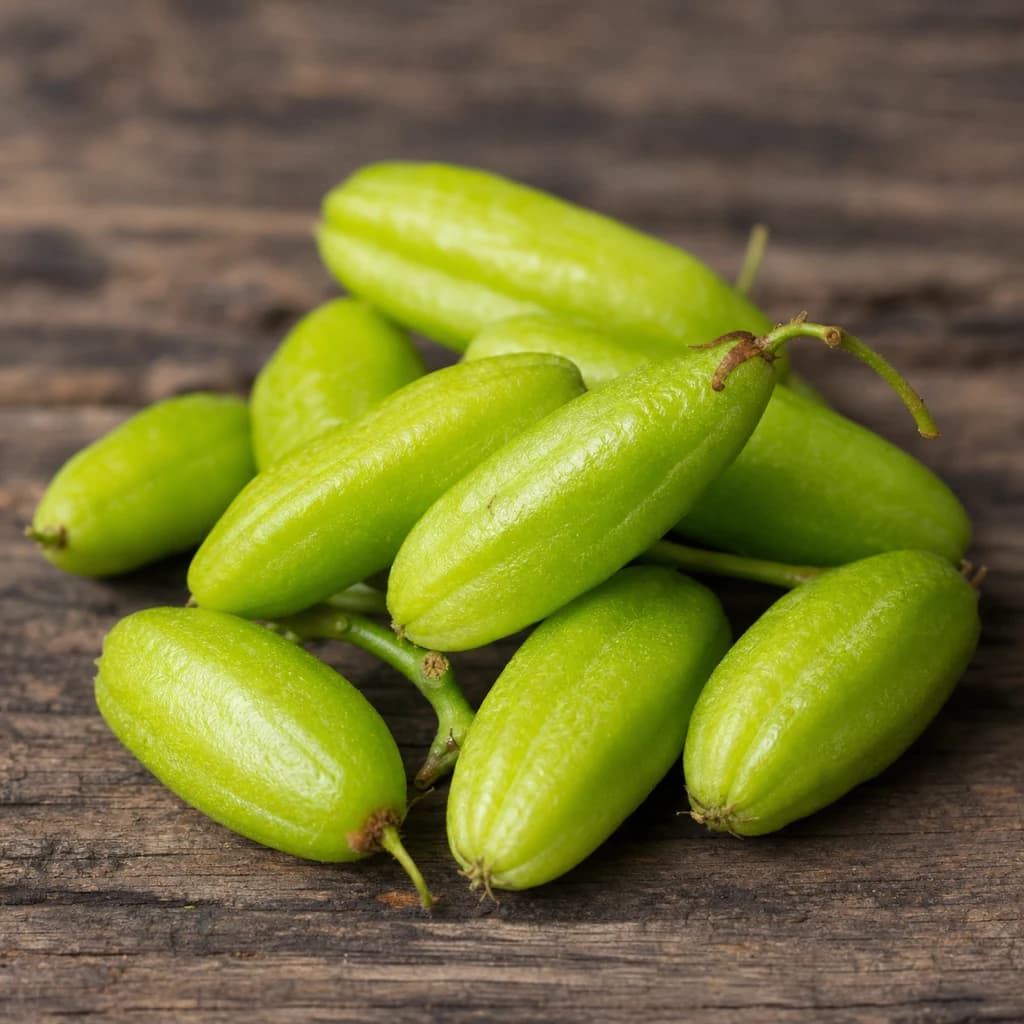
Fresh bilimbi fruits on a wooden surface, showing their ridged cucumber-like shape and green skin.
Shows the reader the whole fruit's distinctive elongated ridged form and characteristic bright green color so it can be recognized at a market.
Produce
Bilimbi
Intensely sour cucumber-shaped tropical fruit used as a souring agent.
Bilimbi is a small, ridged, cucumber-shaped tropical fruit closely related to starfruit, with an extremely sour green flesh. Across South and Southeast Asia it is used like a souring agent in curries, sambals, pickles, and fish dishes. Too tart to eat raw, it brightens and cuts richness in cooked preparations.
Bilimbi (Averrhoa bilimbi) is an intensely sour, cucumber-shaped tropical fruit native to Southeast Asia, likely originating in Indonesia and the Philippines. Despite belonging to the same family as carambola (Oxalidaceae), bilimbi is a distinct ingredient with a much more aggressive sourness—it lacks the star-shaped appeal of its relative and delivers a bracing tartness that dominates dishes rather than merely brightening them. The fruit grows on trees up to 10 meters tall and produces ridged, oblong fruits typically 5–10 cm long, with five prominent longitudinal ridges running their length. Because of this extreme acidity, bilimbi functions almost exclusively as a souring agent in cooked preparations; only the fully ripe yellow fruits are mild enough to eat out of hand.
In the kitchen, bilimbi behaves like a more potent, slightly fruitier tamarind—the sourness is immediate and long-lasting in cooking, and unlike citrus juice, it contributes body and a subtle fruity undertone rather than pure acidity. The fruit oxidizes and bruises easily; damaged specimens develop off-flavors rapidly. Its oxalate content is notable, making it an ingredient to use sparingly if you have dietary concerns around oxalates. Across its range—from Indonesian sambals to Filipino kinilaw, from Indian chutneys to Caribbean preparations—bilimbi is prized precisely for this souring power, a reliable backbone of flavor in cuisines that celebrate the interplay of sour, salty, and spicy.
**Distinguishing Bilimbi from Carambola**: These two Averrhoa species are close relatives but behave very differently in cooking. Carambola (Averrhoa carambola) has a mild, slightly sweet-tart flavor and is typically eaten fresh or used as a garnish; when sliced, it forms the recognizable star shape. Bilimbi, by contrast, is cylinder-shaped with longitudinal ridges, and its unripe fruit is so sour it is essentially inedible raw. If a recipe calls for bilimbi, do not substitute carambola—the flavor profile and sour intensity are not comparable.
- Measured in
- g
- Storage
- Fridge
Types & varieties
The common culinary variety; used unripe for maximum acidity in cooked dishes
Rare cultivar with perceptible sweetness; eaten fresh rather than used in cooking
How to Select and Handle Bilimbi
Choose firm, bright green fruits for cooking—the skin should be smooth and unblemished, free of bruises or soft spots. Avoid fruits with any dark discoloration, as this indicates oxidation and off-flavors have developed. Because bilimbi bruises easily, handle gently and transport carefully. For immediate use, select the most acidic (greenest) fruits; for recipes requiring less sourness, allow fruits to ripen to yellow-green. The thin skin is edible in both raw and cooked preparations, though some traditional pickling methods preserve only the skin separately.
- Select firm, bright green fruits with smooth, unblemished skin
- Avoid bruised or softened fruit—oxidized bilimbi develops off-flavors
- Handle gently; the fruit bruises easily and deteriorates rapidly when damaged
- For stronger sourness, use fruit immediately; for milder flavor, allow to ripen
Understanding Bilimbi Acidity
Bilimbi is significantly more acidic than tamarind or lime, which is both its strength and its challenge. The acidity varies considerably between individual fruits depending on growing conditions, tree age, and ripeness—never assume a given quantity without tasting first. When cooking, the sourness intensifies slightly as liquid reduces, so factor this into your seasoning. The fruit also contains natural oxalates, which contribute to its tartness but can be a concern for those with kidney stones or oxalate sensitivity. In long-simmered dishes, overcooking bilimbi causes the flesh to turn mushy and can introduce bitterness—the sourness should be calibrated to arrive in the final minutes of cooking.
- Always taste before adding—acidity varies dramatically by fruit and ripeness
- Bilimbi is more potent than tamarind; use less when substituting
- Do not overcook—add in the final stages of cooking to prevent mushiness and bitterness
- High oxalate content; consume sparingly if you have kidney stone history
Common uses
Tips & pitfalls
- Always taste before using—acidity varies dramatically between individual fruits and ripeness stages
- For cooking, use unripe green fruits; ripe yellow fruits lose much of their sour punch and are better suited to fresh preparations
- The ridged flesh contains small seeds; halve and scoop them out if a smoother texture is desired
- When substituting bilimbi for tamarind paste, use slightly less—bilimbi is more potent and its flavor can dominate
- Do not overcook in acidic preparations—the flesh becomes mushy and bitterness can develop
- Pairs exceptionally well with palm sugar (gula Melaka)—balancing the sourness brings out the subtle fruity notes in the ripe fruit
- Common mistake: using fully ripe bilimbi when a strong souring effect is needed—always use green, unripe fruit for cooked dishes
- The entire fruit is edible, but handle gently—bruised bilimbi oxidizes rapidly and develops off-flavors within hours
Nutrition
Energy
1427 kJ · per 100 g
Where the calories come from
Protein
0g
0% DV
Carbs
85.1g
31% DV
Fat
0g
0% DV
Fiber
0.1g
0% DV
Sugars
53g
of which
Sodium
0mg
0% DV
Source · USDA FoodData Central · approx. Fruit syrup
View on FDC →In the shops
Matched grocery products
No matched grocery products for Bilimbi yet.
Good to know
- Origin
- Southeast Asia (Indonesia, Philippines); now cultivated throughout tropical Asia, India, Caribbean, Africa, and Central America
- Family
- Oxalidaceae (related to carambola/starfruit)
- Botanical name
- Averrhoa bilimbi
- Shape
- Oblong to cucumber-shaped, 5–10 cm long, with 5 prominent longitudinal ridges
- Color
- Bright green (unripe) → Yellow to yellowish-green (ripe)
- Flavor
- Intensely sour and tart when unripe; mildly sour with subtle sweetness when fully ripe
- Storage
- Refrigerate unripe fruits up to 2 weeks; ripe fruits keep 3–5 days
Substitutes
- Tamarind paste — Closest flavor match; use about half the quantity of fresh bilimbi equivalent
- Lime juice — Good substitute for brightness; fresh juice works but lacks the fruity body bilimbi provides
- Calamansi — Southeast Asian citrus with comparable sourness; use juice in similar ratio to lime
- Green mango — Similar sourness and texture; grate or slice unripe mango for cooked dishes
- White wine vinegar — Acceptable for quick-cooking dishes; lacks the fruity complexity and long acidity presence of bilimbi
Pairs with
Also called
Bilenbi · Bilimbi · Cucumber Tree Fruit
Appears in these dishes
Related
Tomato
Juicy, sun-sweet fruit for sauces, salads, and slow-cooked depth
Yellow Onion
The aromatic backbone of soups, sofritos, and braises
Garlic
Pungent cloves that perfume nearly every savory dish
Lemon
Bright, acidic citrus that wakes up almost any dish
Potato
Humble, hearty staple — roast, mash, fry, or boil
Carrot
Sweet, crunchy root — raw, roasted, or the base of a sofrito
Cucumber
Cool, crisp, and watery — for salads, pickles, and tzatziki

Lettuce
Crisp leaves for salads, wraps, and a fresh crunch