Produce
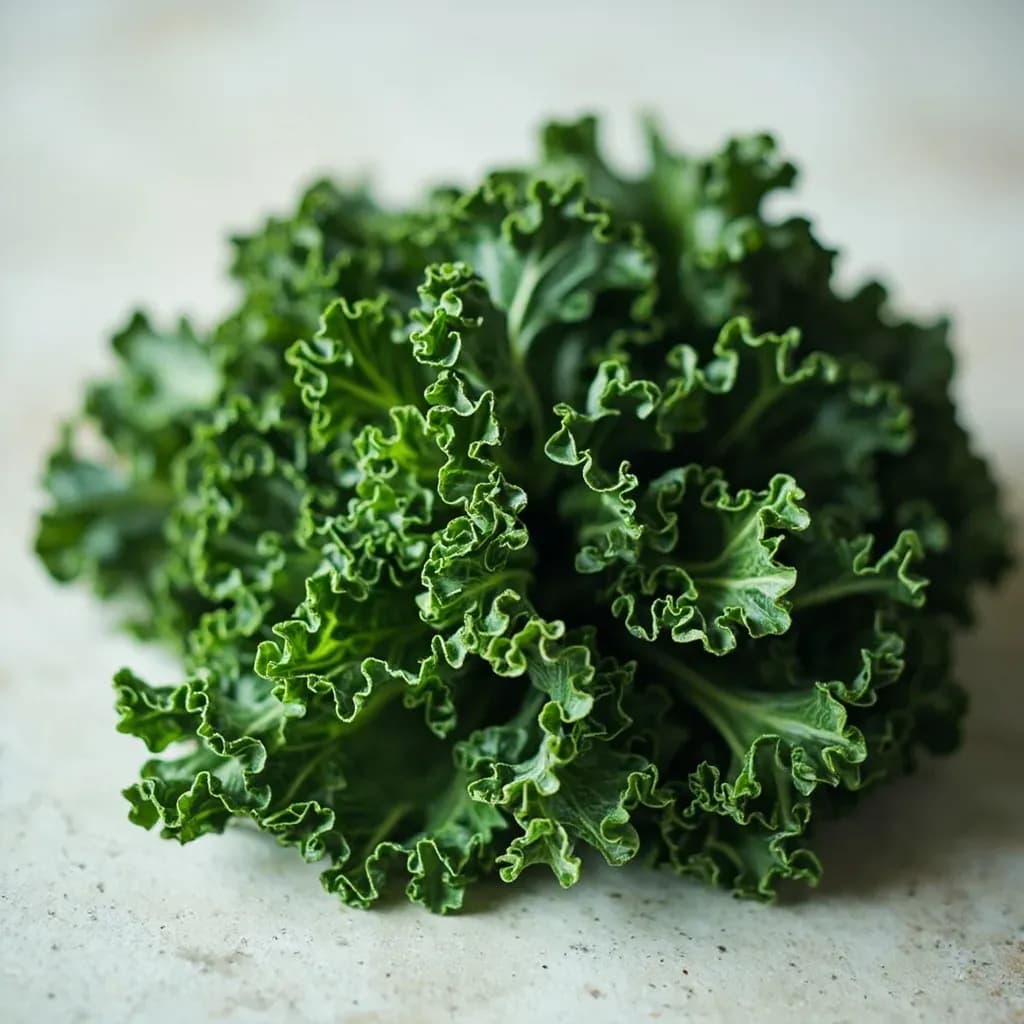
Curly Kale
Ruffled, hardy leafy green with a robust earthy flavor, eaten raw in salads or braised.
Curly kale is a sturdy brassica with tightly ruffled, deep-green leaves and a firm, slightly bitter and peppery taste. It is massaged raw for salads, blended into smoothies, baked into chips, or braised in stews like the Dutch boerenkool. The leaves toughen with age and benefit from removing the fibrous central stem before cooking.
Curly kale (Brassica oleracea var. sabellica) is one of the oldest cultivated members of the cabbage family, descended from wild cabbage native to the Mediterranean. Its characteristically ruffled, frilled leaves grow in a loose rosette from a central stem rather than forming a tight head, and the plant is remarkably cold-hardy—indeed, exposure to frost transforms its flavor, converting starches to sugars and mellowing the natural bitterness into a sweet, earthy complexity that makes winter-harvested kale distinctly superior to summer crops. The fibrous center rib runs the entire length of each leaf and must always be removed before cooking or eating; it remains tough even after prolonged cooking and will make dishes unpleasant.
In the kitchen, curly kale's sturdy constitution is both its strength and its challenge. Raw kale has a substantial, almost chewy texture that benefits from specific preparation: slicing into thin ribbons and massaging with olive oil and salt breaks down the cellular structure enough to make it palatable in salads. When cooked, curly kale holds its shape better than more delicate greens like spinach, requiring actual boiling or sautéing time rather than just wilting—but it demands restraint, as overcooking produces a dull, army-green color and mushy texture. The ruffled surface, while attractive, traps grit and sand more readily than smooth leaves, making thorough washing non-negotiable.
Nutritionally, curly kale is exceptionally dense: vitamin K levels are extraordinary (roughly 550% of daily value per raw cup), vitamin A from beta-carotene is abundant, and vitamin C content rivals citrus. These nutrients are fat-soluble, so pairing kale with oil or fat in cooking enhances absorption. However, kale contains oxalates, compounds that can contribute to kidney stone formation in susceptible individuals, so those with relevant medical concerns should moderate intake.
- Measured in
- g
- Storage
- Fridge
Types & varieties
Most common commercial variety; compact, heavily frilled leaves; mildest flavor of the curly types
Shorter, more compact plant; blue-green leaves; very cold-hardy, ideal for winter gardens
Long-standing British variety; good for repeated harvest over extended period
Purple-tinged stems and veins; slightly sweeter than green varieties; color fades when cooked
Deep purple-bronze coloring; most ornamental variety; color fades significantly when cooked
Common uses
Tips & pitfalls
- Always remove the tough center rib—fold the leaf in half lengthwise, then slice or tear the leafy portion away from the stem. The stem is too fibrous to eat even when fully cooked.
- To wash thoroughly: swish leaves in a large bowl of cold water, then lift them out rather than pouring through a colander (which redeposits sand). Repeat until water runs clear.
- For raw salads, stack leaves, roll tightly, then slice into thin ribbons (chiffonade). Massage with olive oil and salt for 30 seconds—this breaks down cell walls and transforms texture.
- For cooking, do not overcook—kale should retain some structure and vibrant color. 2–4 minutes of active boiling or sautéing is usually sufficient for tender-but-firm results.
- Frost-touched kale is noticeably sweeter; seek it at farmers' markets after the first frost for the best-flavored winter greens.
- Mass-produced grocery-store kale is often shipped from California in summer; local fall and winter kale has vastly better flavor and sweetness.
- Store unwashed—moisture accelerates spoilage. Wrap loosely in paper towel inside a plastic bag for best results.
Nutrition
Energy
146 kJ · per 100 g
Where the calories come from
Protein
2.9g
6% DV
Carbs
4.4g
2% DV
Fat
1.5g
2% DV
Fiber
4.1g
15% DV
Sugars
1g
of which
Sodium
53mg
2% DV
Source · USDA FoodData Central · Kale, raw
View on FDC →In the shops
Matched grocery products
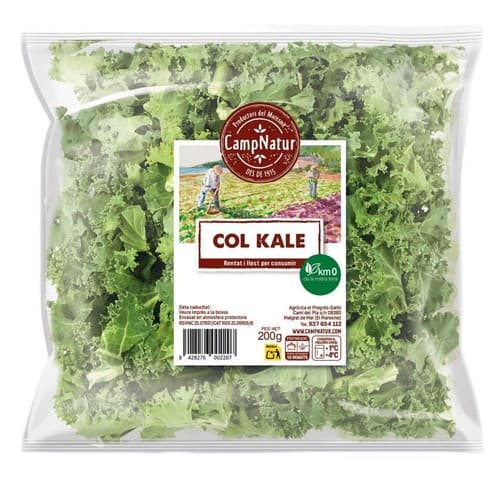 €1.65
€1.65Kale Km0 CampNatur
CAMPNATUR · kg · Bonpreu
Good to know
- Scientific name
- Brassica oleracea var. sabellica
- Family
- Brassicaceae (mustard family)
- Origin
- Mediterranean region; one of the oldest cultivated cabbages
- Peak season
- Late fall through winter; flavor improves significantly after frost
- Flavor profile
- Earthy, slightly bitter, robust; sweetens with cold weather exposure
- Texture
- Crisp when raw; tender but retains structure when properly cooked
- Yield
- About 50–60% edible after stem removal
- Storage
- Refrigerate unwashed in plastic bag for 5–7 days; do not wash until ready to use
Substitutes
- Collard Greens — Milder flavor; larger, smoother leaves; cook 1–2 minutes longer; good 1:1 substitute in cooked dishes, not ideal raw
- Swiss Chard — More delicate texture; milder flavor; cook very briefly as it falls apart faster
- Spinach — More tender; cooks in roughly half the time; use 1.5x quantity as it cooks down significantly more
- Tuscan (Dinosaur) Kale — Different leaf texture (savoyed, not ruffled) but similar earthy flavor; more robust, holds up better in long-simmered soups
Pairs with
Also called
Boerenkool · Borecole
Appears in these dishes
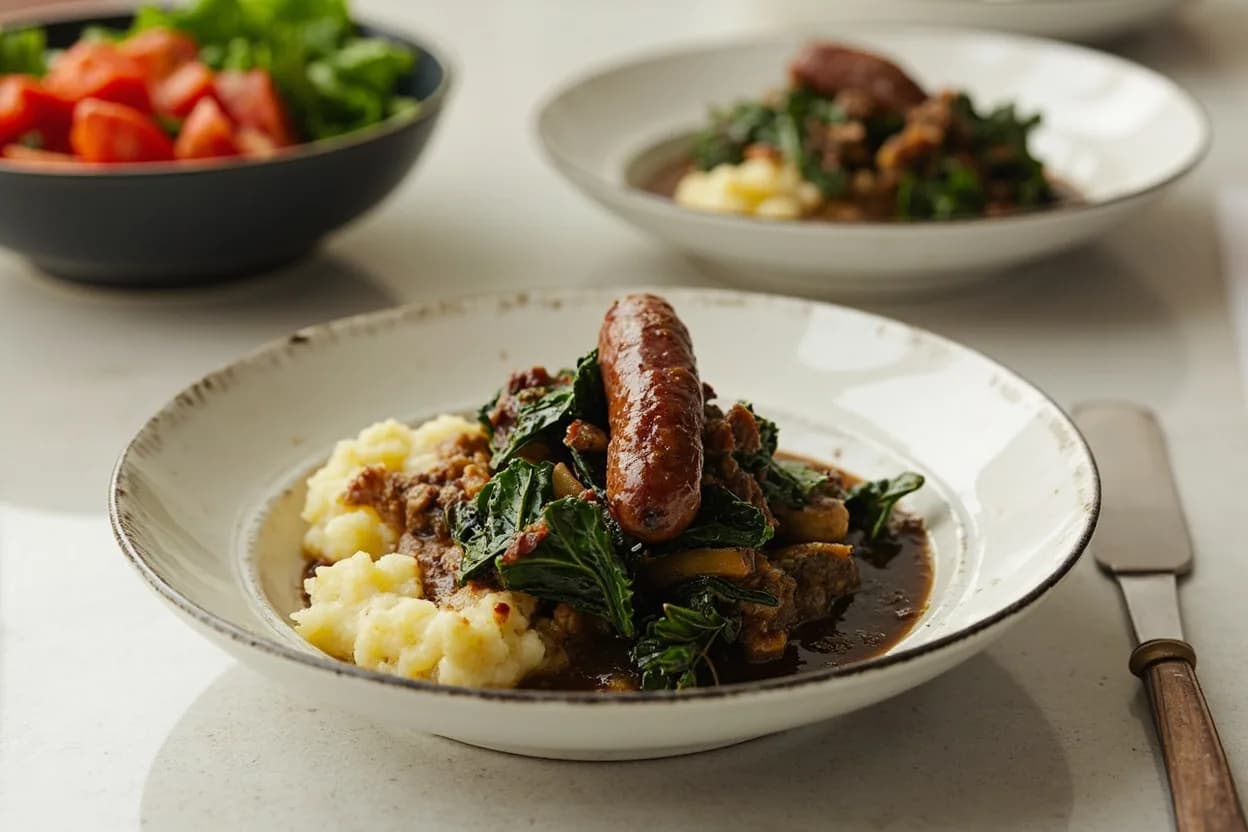

Related

Tomato
Juicy, sun-sweet fruit for sauces, salads, and slow-cooked depth

Yellow Onion
The aromatic backbone of soups, sofritos, and braises

Garlic
Pungent cloves that perfume nearly every savory dish

Lemon
Bright, acidic citrus that wakes up almost any dish

Potato
Humble, hearty staple — roast, mash, fry, or boil

Carrot
Sweet, crunchy root — raw, roasted, or the base of a sofrito

Cucumber
Cool, crisp, and watery — for salads, pickles, and tzatziki

Lettuce
Crisp leaves for salads, wraps, and a fresh crunch