Natural form
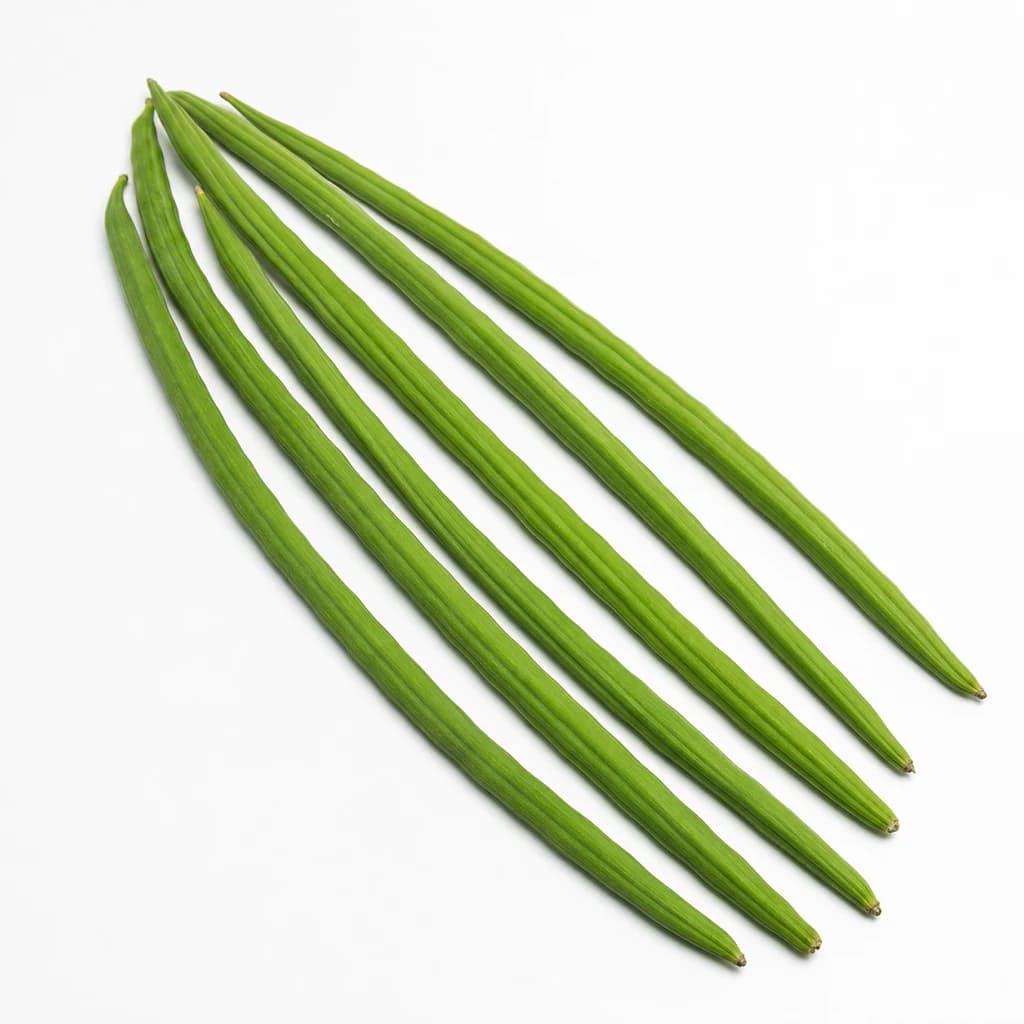
Fresh moringa pods: long, slender, ridged green drumsticks up to 45 cm long.
Shows the unmistakable elongated form, green color, and ridged surface that define the raw ingredient.
Produce
Drumstick (Moringa Pod)
Long green moringa seed pod, simmered in South Indian sambar and curries for its mild, asparagus-like flesh.
The drumstick is the long, slender green seed pod of the moringa tree, central to South Indian and Sri Lankan cooking. Cut into segments and simmered in sambar, curries, and dals, the tough pod is held and the soft inner pulp scraped out with the teeth. It has a mild, faintly asparagus-like flavor and is valued for both taste and nutrition.
The drumstick is the unripe seed pod of Moringa oleifera, a fast-growing deciduous tree native to the Indian subcontinent and now cultivated throughout the tropics. At markets it is sold in bunches, still attached to a portion of the fibrous stem. The pods range from 20 to 45 cm in length and have a distinctive triangular cross-section — a useful identifying feature when buying from bulk bins. The interior holds a single row of round brown-black seeds surrounded by white-to-cream flesh, all encased in a thin but noticeable dark green skin.
In South Indian kitchens the drumstick is indispensable. It goes into the pot of sambar — the canonical lentil-vegetable stew — where it absorbs tamarind sourness and turmeric warmth while contributing its own mild, faintly sweet flesh. It appears in kootu, avial, poriyal, and kuzhambu as readily as tomato or okra might appear in other regional cuisines. The pods also travel well beyond India: Filipino cooks use them in tinola and ginataan, Thai cooks briefly cook them in coconut-milk curries, and in some contexts the very young, tender pods are sliced raw into salads.
The characteristic eating experience is worth understanding before you cook. The outer skin and a thin layer of fibrous strands surrounding the flesh remain chewy even when cooked. In traditional whole-pod preparations — where the pod is simmered in sambar and the diner draws the flesh along their teeth — this is expected and welcome. In more composed preparations, cutting the pod into 2–3 cm segments before cooking eliminates the need for this wrist action and makes the vegetable easier to serve with a spoon. Freshness is the single most critical factor in determining whether a drumstick is worth buying.
- Measured in
- piece
- Storage
- Fridge
Types & varieties
High-yielding commercial cultivar from Tamil Nadu; widely grown for pods.
Improved Tamil Nadu Agricultural University cultivar; longer pods, higher seed count.
Traditional Tamil Nadu variety prized for tender flesh and minimal fiber.
Sri Lankan variety, common in Tamil and Sri Lankan Tamil cooking; noted for intense flavor.
Karnataka variety; shorter pods with fine, tender flesh.
Buying and Prep
Select the slimmest pods available — a narrow diameter reliably indicates youth and tenderness. The outer skin should be a deep, uniform green with no yellowing, soft spots, or visible wrinkles. Test freshness with a gentle bend: a young pod snaps cleanly without bending; an older pod bends without breaking and may ooze moisture from the seed case.
To prepare for cooking, trim and discard the stem and blossom ends. Cut the pod into 2–3 cm segments — this is the most important step for practical cooking, as it removes the need to draw flesh from a whole pod at the table and makes the vegetable easy to serve with a spoon. For very young, slim pods where the whole pod will be served in a dish like sambar, you can cook them whole and leave the eating method to the diner.
Refrigerate unwashed in a loosely closed plastic bag with a few ventilation holes for up to a week. Do not store at room temperature; the pods lose moisture rapidly and the flesh begins to turn mealy within hours. For longer storage, freeze whole in a sealed bag for up to three months; thaw in the refrigerator before cooking.
- Choose narrow-diameter pods — slim means tender flesh and minimal fiber.
- Snap test: a fresh pod breaks cleanly; a bendy pod is past its best.
- Cut into 2–3 cm segments before adding to stews and curries for easier eating.
- Refrigerate in a perforated bag; store at room temperature only if cooking within a few hours.
- Freeze whole for up to 3 months if you have a surplus harvest.
Common Mistakes
The most frequent error is selecting thick, mature pods and then complaining about the fibrous, rubbery texture. Size is the proxy: if the pod is wider than your thumb, treat it with caution. A second common mistake is overcooking. Drumsticks hold their shape well but the flesh turns mushy and the fibrous strands become pronounced if simmered aggressively for too long — add them to sambar or kootu in the last 15–20 minutes of cooking, not at the start. A third mistake is skipping the tamarind or other souring agent in preparations where the pod is a main vegetable: drumstick's mild flavor benefits from acidity and can taste flat without it. Finally, do not discard the flesh that adheres to the seed case after cooking — in whole-pod preparations this is the prize; in cut preparations the seeds are edible and mildly nutty.
Common uses
Tips & pitfalls
- Choose the slimmest pods available — diameter is the most reliable indicator of maturity and tenderness. A thick pod has developed a fibrous outer case that remains rubbery even after prolonged cooking.
- Test freshness before buying: bend the pod gently. A young pod snaps cleanly; an older one bends without breaking and may weep moisture from the seed case.
- Cut into 2–3 cm segments before cooking. This is the single most practical step in Western-style cooking — it lets you serve drumstick with a spoon and avoids the tooth-drawing method traditional in South Indian tables.
- Add cut segments to sambar and kuzhambu in the last 15–20 minutes of cooking. Drumsticks hold their shape but the flesh degrades and turns mushy if simmered from the start of a long cook.
- Store refrigerated in a perforated bag for up to a week. The pods lose moisture rapidly at room temperature and the flesh becomes mealy within hours of harvest.
- When buying whole pods for a dish like sambar, select 3–4 pieces per serving — they shrink noticeably as they cook and absorb liquid.
- Use the snap test after cooking, too: a properly cooked young pod segment should offer slight resistance before yielding, not dissolve into mush.
- The seeds inside are edible and mildly nutty; do not discard them along with the tougher outer case after eating.
Nutrition
Energy
268 kJ · per 100 g
Where the calories come from
Protein
9.4g
19% DV
Carbs
8.3g
3% DV
Fat
1.4g
2% DV
Fiber
2g
7% DV
Sodium
9mg
0% DV
Source · USDA FoodData Central · Drumstick leaves, raw
View on FDC →In the shops
Matched grocery products
No matched grocery products for Drumstick (Moringa Pod) yet.
Good to know
- Scientific name
- Moringa oleifera
- Also called
- Moringa pod, moringa bean, sajjan ki phali (Hindi), murungai (Tamil), mulakkada (Telugu)
- Typical length
- 20–45 cm; some varieties reach 60–90 cm
- Cross-section
- Triangular — a reliable identifying feature
- Flavor
- Mild, faintly sweet; asparagus-like with green-bean and green-pea notes
- Peak season
- Year-round in the tropics; spring and early summer in Indian plains (March–June)
- Shelf life
- Refrigerated, 5–7 days in a perforated bag; freeze whole for up to 3 months
- Yield
- Nearly 100% edible when young; outer skin and fibrous strands reduce mature pods to ~60%
Substitutes
- Green beans — Closest in texture and mild flavor. Cook slightly longer than beans would require. Works well in sambar, poriyal, and stir-fries.
- Asparagus — Similar mild-sweet flavor profile. More fibrous crosswise and behaves differently in long-simmered dishes. Acceptable in stir-fries and light curries.
- Okra — Comparable slippery-slick cooked texture. Different flavor — okra is earthier. Works in South Indian-style preparations but changes the character of the dish.
Pairs with
Also called
Sojne Danta · Moringa Pod · Murungakkai
Appears in these dishes
Related
Tomato
Juicy, sun-sweet fruit for sauces, salads, and slow-cooked depth
Yellow Onion
The aromatic backbone of soups, sofritos, and braises
Garlic
Pungent cloves that perfume nearly every savory dish
Lemon
Bright, acidic citrus that wakes up almost any dish
Potato
Humble, hearty staple — roast, mash, fry, or boil
Carrot
Sweet, crunchy root — raw, roasted, or the base of a sofrito
Cucumber
Cool, crisp, and watery — for salads, pickles, and tzatziki

Lettuce
Crisp leaves for salads, wraps, and a fresh crunch