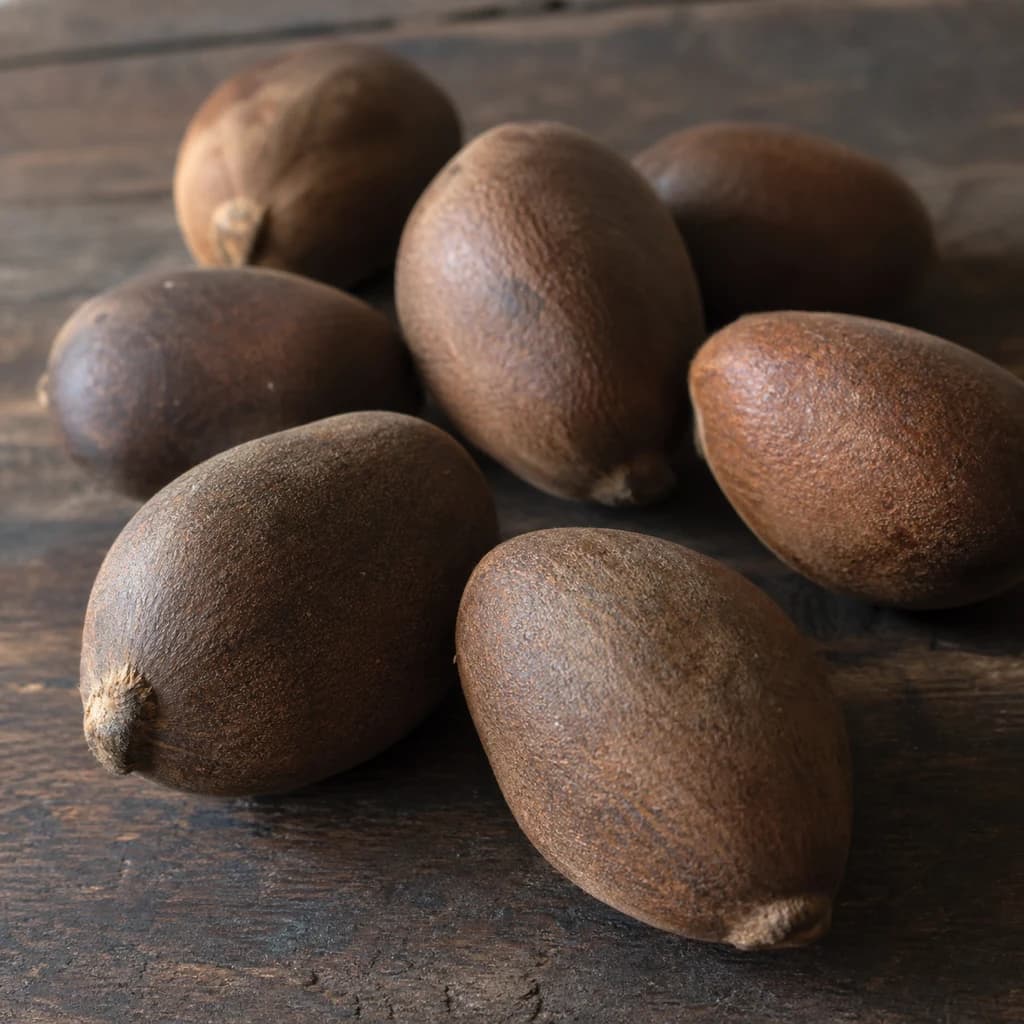
Natural form
Whole pana seeds in their thick, rough brown outer shell, clustered on a wooden surface.
Shows the recognizable exterior — rough, brown, chestnut-like shell — so readers can identify pana at a market or in the wild.
Produce
Pana (Polynesian Chestnut)
Pacific Island chestnut-like seed, boiled or roasted as a starchy snack.
Pana, the Polynesian or Tahitian chestnut, is the seed of a tree native to the Pacific Islands and Southeast Asia. The seeds are boiled or roasted and eaten like chestnuts, with a starchy, mild, nutty flavor. They are a traditional snack and starch source in island cuisines.
Pana, known as mape in Tahiti and Samoa, ifi in Fiji, and hotai in Tonga, is the starchy seed of the Inocarpus fagifer tree, a member of the Fabaceae family native to Polynesia and the broader western Pacific. The tree produces large, canoe-shaped pods each containing a single seed roughly 8–12 cm long. Despite its common name—Polynesian or Tahitian chestnut—it is not a true nut but a leguminous seed, which has important implications for how it must be prepared. The mape tree is deeply woven into Pacific Island food culture: it is evergreen and reliably productive, often planted near settlements as a famine food and ceremonial staple, and it fruits year-round in tropical climates with regional peaks. Its mild, subtly nutty flavor makes it a versatile canvas for coconut, salt, and lime, while its dense, creamy-to-dry texture places it squarely in the starchy side-dish category alongside taro and breadfruit.
The seed's primary culinary appeal lies in its adaptability across cooking methods and its ability to absorb bold flavors. Boiling yields a bland, dense result best served alongside seasoned dishes; roasting in embers or a dry pan caramelizes natural sugars, producing a richer, smokier character. The seed's behavior under heat is predictable once you account for its moisture content: older, lighter seeds that have begun to dry will behave differently in the pot than fresh, heavy ones. Because mape is not widely exported, encountering it usually means shopping in a Pacific Island market or, increasingly, an upscale tropical-produce retailer—and knowing how to select, store, and cook it makes the difference between a memorable dish and a disappointing one.
Raw mape seeds contain trypsin inhibitors and other anti-nutritional factors that can cause gastric distress, so thorough cooking is non-negotiable. This is not a seed you can eat raw in any quantity. The toxicity concern does not end there: mape must not be confused with the seeds of Barringtonia asiatica, commonly called sea mango or fish poison tree—a completely different genus containing toxic saponins that require extensive traditional processing. When you source mape, confirm identification with the vendor if there is any doubt. Properly prepared mape, however, is a wholesome and traditional food that has sustained Pacific communities for generations.
- Measured in
- piece
- Storage
- Pantry
Allergens
Types & varieties
Lower starch content with a slightly sweeter, more delicate flavor; can be eaten with less cooking time than the starchy type.
High starch, dense texture; requires longer cooking; preferred for pounding into pastes and traditional doughs.
Selecting and Storing Mape
Freshness is the single most important factor when choosing mape seeds. A reliable freshness test: place the seed in a bowl of water. Fresh, moisture-rich seeds sink; older, desiccated seeds float. Choose heavy seeds with intact, uncracked coats. Avoid any seed that shows mold, soft spots, or an off smell. Once home, use fresh seeds within two to three days—beyond that, they begin to lose moisture and the texture turns dry and fibrous. For longer storage, slice the cooked or raw seeds thinly and dry them in the sun or a low oven until brittle, then store in an airtight container. Dried slices can be ground into a coarse flour for use months later.
- Fresh seeds sink in water; older seeds float—this is a reliable freshness test
- Use fresh seeds within 2–3 days of purchase for best texture
- Slice and dry for long-term storage; dried mape keeps for several months in airtight containers
- Do not refrigerate fresh seeds—they absorb moisture and deteriorate faster
Cooking Methods Compared
Boiling is the most common and forgiving method. The seed's dense interior requires sustained heat to cook through, typically 30–60 minutes depending on size and freshness. Score the seed coat deeply with a knife before adding it to the pot—this allows steam to escape and prevents the seed from exploding under pressure, a dramatic and messy mistake. Always boil in well-salted water; the salt seasons the interior and improves flavor absorption. Roasting produces a distinctly different result: dry-heat caramelizes the seed's natural sugars, yielding a smokier, slightly sweeter character. Traditionally, mape is roasted in hot embers (like chestnuts), but a dry cast-iron pan over medium-high heat works well in a home kitchen. The exterior will darken and the coat may crack—this is desirable. Fried or sautéed mape is always pre-cooked by boiling first, then sliced and crisped in coconut oil until golden—this yields a textural contrast that works especially well as a side or bar snack.
- Score the seed coat before boiling to prevent exploding
- Boil 30–60 minutes in salted water until the interior is tender throughout
- Roast in embers or a dry pan for a sweeter, smokier flavor profile
- Always parboil before frying—raw mape is not safe and the texture will not crisp
Common uses
Tips & pitfalls
- Score the seed coat deeply with a knife before boiling or roasting—mape seeds can build internal steam pressure and explode if the coat is intact.
- Test freshness before buying: fresh seeds sink in water; older, dried seeds float. Choose heavy, dense specimens.
- The seed darkens slightly in color when fully cooked through. If in doubt, err on the side of longer cooking—the starch must be thoroughly heated to neutralize anti-nutrients.
- Young, freshly fallen seeds have the creamiest texture. Older seeds become fibrous and dry, making them better suited for grinding into flour than eating whole.
- Do not eat mape raw. Even small quantities of uncooked seed can cause gastric distress due to trypsin inhibitors.
- For a smoky, traditional flavor, cook mape in an imu (underground oven) alongside taro and breadfruit—the three staples are often prepared together in Polynesian feasts.
- If using mape in a salad, finish with a squeeze of lime or lemon juice—the acidity brightens the mild starch and prevents it from tasting flat.
Nutrition
Nutrition
No USDA FoodData Central match for Pana (Polynesian Chestnut) yet. We surface a per-100 g profile once a generic whole-food entry is matched and verified.
In the shops
Matched grocery products
No matched grocery products for Pana (Polynesian Chestnut) yet.
Good to know
- Scientific name
- Inocarpus fagifer (also classified as I. edulis)
- Family
- Fabaceae (legume family)
- Also known as
- Mape, Tahitian chestnut, Pacific chestnut, ifi (Fiji), hotai (Tonga)
- Origin
- Polynesia, Malay Peninsula, and western Pacific islands
- Harvest season
- Year-round in tropical climates; peak season varies by region
- Primary preparation
- Boiled 30–60 minutes; dry-roasted or ember-roasted as a snack
- Flavor
- Mild and nutty when roasted; bland when boiled; absorbs seasonings well
- Toxicity
- Raw seeds contain trypsin inhibitors—must be cooked before eating
Substitutes
- Chestnut — Closest in size and starchy, mild character; generally requires longer cooking than mape and has a sweeter flavor when roasted.
- Taro — Comparable starchy, dense texture; widely available in tropical markets; behaves similarly in boiled and fried preparations.
- Sweet potato — Accessible substitute in most markets; different flavor but similar applications in boiled, roasted, and fried dishes.
- Breadfruit — Serves the same culinary role in traditional Polynesian cuisine; softer, spongier texture when cooked but absorbs flavors equally well.
Pairs with
Also called
Polynesian Chestnut · Tahitian Chestnut · Mape
Related

Tomato
Juicy, sun-sweet fruit for sauces, salads, and slow-cooked depth

Yellow Onion
The aromatic backbone of soups, sofritos, and braises

Garlic
Pungent cloves that perfume nearly every savory dish

Lemon
Bright, acidic citrus that wakes up almost any dish

Potato
Humble, hearty staple — roast, mash, fry, or boil

Carrot
Sweet, crunchy root — raw, roasted, or the base of a sofrito

Cucumber
Cool, crisp, and watery — for salads, pickles, and tzatziki

Lettuce
Crisp leaves for salads, wraps, and a fresh crunch