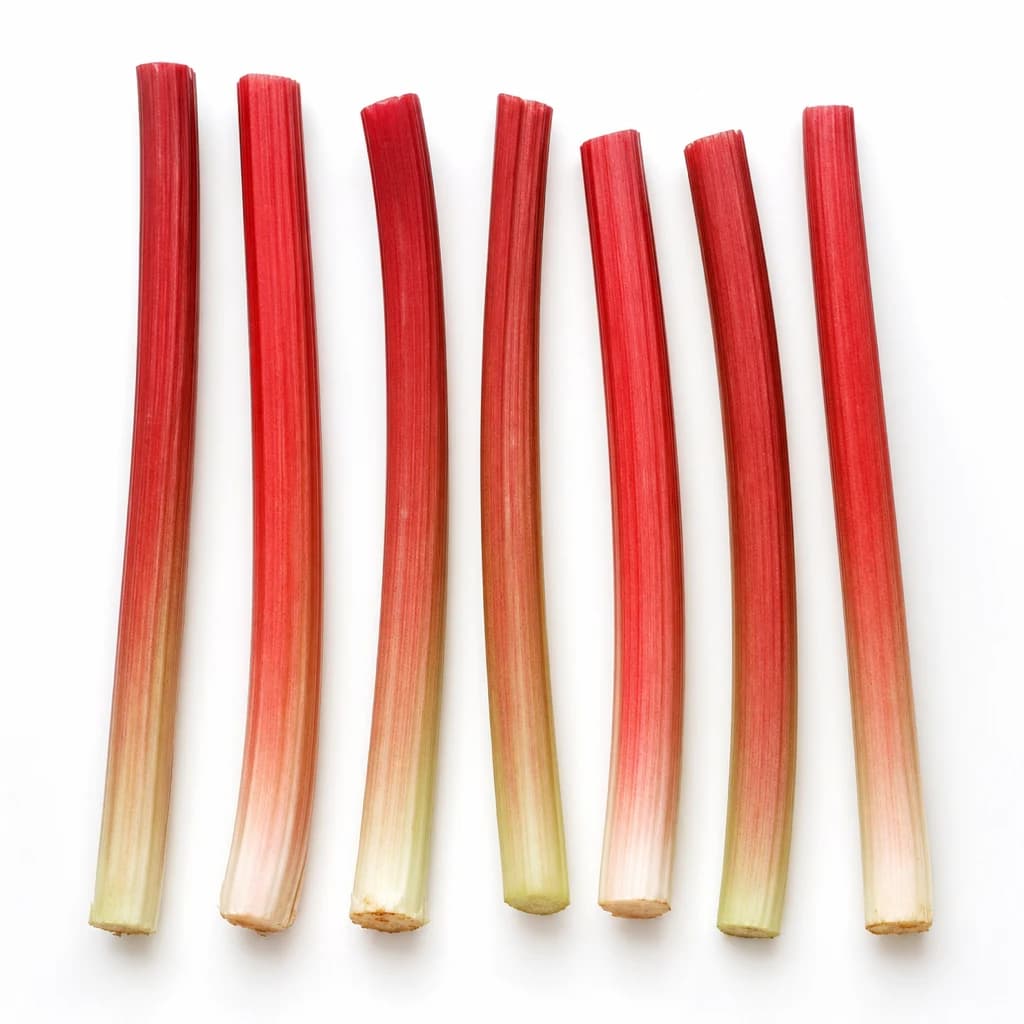
Natural form
Fresh rhubarb stalks showing the full spectrum from pale green to deep crimson red.
Shows the reader the characteristic long celery-like stalks and their distinctive pink-to-red coloration so the ingredient is instantly recognizable in a market.
Produce
Rhubarb
Tart, pink-red stalks cooked with sugar into pies, crumbles, and compotes.
Rhubarb is a vegetable whose long, celery-like stalks are intensely sour and almost always cooked with sugar to be palatable. The pink-to-red stalks are stewed into compotes, baked into pies and crumbles, and made into jams across Europe and North America. The leaves are toxic and must be discarded; only the stalks are eaten.
Rhubarb is a perennial vegetable whose thick, fleshy stalks—never the leaves—have earned it a permanent place in kitchens worldwide despite its botanical classification. Native to Siberia and parts of China and Mongolia, it traveled the Silk Road and arrived in European gardens by the 1600s, eventually crossing the Atlantic to North American gardens by the 18th century. Though technically a vegetable, rhubarb is universally treated as a fruit in culinary practice, prized for the bright, aggressive tartness that defines its character.
The stalks range from pale pink to deep crimson, and color is not an indicator of sweetness—green stalks can taste just as sweet as red ones, and vice versa. What matters is firmness: fresh rhubarb snaps crisply when bent, much like celery. Its flavor sits at an extreme end of the acid spectrum, with a raw pH around 3.1–3.2, making it one of the most tart ingredients in the kitchen. This acidity is not a flaw to mask but a feature to embrace and balance with sugar, which rhubarb demands in generous quantities.
Two cultivation methods produce notably different rhubarbs. Forced rhubarb, grown in darkness under covering pots from January through March, develops pale pink to orange-pink stalks that are more tender and subtly sweeter than their field-grown counterparts. Summer rhubarb, harvested from outdoor plants from April through June, is sturdier, more assertively acidic, and better suited to robust cooking methods. The leaves contain dangerous concentrations of oxalic acid and must always be discarded—only the stalks are edible.
- Measured in
- g
- Storage
- Fridge
Types & varieties
Bright red stalks, very tart; holds shape well when cooked; most common commercial variety
Deep red throughout with sweet-tart balance; vivid color makes it prized for pies and jams
Green-stalked variety with red interior; milder, sweeter flavor than red varieties
Green-stalked with pink interiors; large, productive plants; milder acidity
Very large stalks, green with red tinge; vigorous grower; good for cooking
Bright red interior and exterior; modern variety bred for color and flavor
Common commercial variety; thick stalks, reliable producer
Green stalks, can be harvested later in season; less acidic than red varieties
Grown in darkness under forcing pots; pale pink to orange-pink stalks; more tender and subtly sweeter; winter crop (January–March)
The forced versus field debate
The distinction between forced and field-grown rhubarb is not merely seasonal—it represents a fundamental difference in texture and flavor intensity. Forced rhubarb, covered and grown in darkness, expends less energy developing chlorophyll and structural fibers, resulting in stalks that are more tender, almost fragile, with a subtler tartness. Handle forced rhubarb gently: it needs less sugar and shorter cooking times. Field-grown rhubarb, by contrast, develops thicker cell walls and more assertive acidity through natural photosynthesis. It can withstand longer cooking, holds its shape more stubbornly, and requires more sugar to achieve balance. Use forced rhubarb for elegant compotes and delicate tarts; reserve field-grown rhubarb for pies, crumbles, and chutneys where you want structural integrity and bold flavor.
- Use forced rhubarb within a few days of purchase; it deteriorates faster than field-grown
- If freezing rhubarb becomes necessary, blanch briefly first—raw-frozen rhubarb turns mushy when thawed
- Test doneness by tasting—forced rhubarb turns tender quickly, while field rhubarb needs more time
Cooking rhubarb without a recipe
Rhubarb's behavior in the kitchen is predictable once you understand its chemistry. The high acidity activates pectic enzymes that help thicken sauces naturally, and the acid actually tenderizes gluten in batters—rhubarb pies have better texture than apple pies, all else equal. The key principle is this: rhubarb needs substantial sugar (typically 1/2 to 2/3 cup per pound of stalks) and minimal water. Cook it briefly in its own juices or with just a splash of liquid, and it will release enough water to create its own sauce. Overcooking, however, breaks down cell walls and produces a mushy texture—pull it from the heat while some firmness remains, as residual heat will continue cooking the pieces.
- Always cut stalks into uniform 1/2 to 1-inch pieces for even cooking
- Do not add baking soda to reduce acidity—it will neutralize tartness but turn the rhubarb to mush
- A pinch of salt enhances rhubarb's flavor without making it taste salty
- Stew rhubarb with vanilla bean, orange juice, or a splash of alcohol for complexity beyond basic sweetness
Common uses
Tips & pitfalls
- Always remove and discard the leaves—oxalic acid concentration is dangerously high and can cause illness in humans
- Choose firm, crisp stalks that snap cleanly when bent; avoid limp, rubbery, or split rhubarb
- No need to peel thin to medium stalks; peel thick, fibrous stalks with a vegetable peeler for a smoother texture
- Color ranges from green to bright red, but darker color does not mean sweeter flavor—taste a small piece to judge sweetness
- Rhubarb needs significant sugar to balance its acidity—typically 1/2 to 2/3 cup sugar per 1 lb (450g) rhubarb
- Cook in minimal water or none at all to preserve texture; overcooking produces an unpleasant mush
- Baking soda can reduce acidity but will mush the texture—use sparingly or not at all
- If you must freeze rhubarb, blanch briefly first; cooking directly from frozen produces mushy results
- Force rhubarb at home by covering outdoor crowns with tall pots or boxes in late winter for pale, tender stalks in early spring
Nutrition
Energy
88 kJ · per 100 g
Where the calories come from
Protein
0.9g
2% DV
Carbs
4.5g
2% DV
Fat
0.2g
0% DV
Fiber
1.8g
6% DV
Sugars
1.1g
of which
Sodium
4mg
0% DV
Source · USDA FoodData Central · Rhubarb, raw
View on FDC →In the shops
Matched grocery products
No matched grocery products for Rhubarb yet.
Good to know
- Scientific name
- Rheum rhabarbarum (garden rhubarb); Rheum rhaponticum (true rhubarb)
- Part used
- Stalks (petioles) only; leaves are toxic due to high oxalic acid concentration and must always be discarded
- Origin
- Native to Siberia and parts of China and Mongolia; cultivated in Europe by the 1600s, in North America by the 18th century
- Season
- Spring through early summer (April–June); forced rhubarb available January–March
- Flavor
- Intensely tart and acidic with subtle vegetal notes; stalk color does not indicate sweetness level
- pH
- Approximately 3.1–3.2 when raw, mellowing slightly when cooked
- Composition
- About 95% water, low in sugar, contains vitamin K, calcium, and potassium
- Storage
- Refrigerate unwashed in a plastic bag up to 2 weeks; do not freeze raw stalks
- Yield
- Minimal shrinkage when cooked; 1 lb (450g) yields approximately 2–3 cups chopped
Substitutes
- Cranberries — Similar tartness and texture when cooked; works in pies and sauces but smaller berries and more astringent
- Green apples (Granny Smith) — Acceptable in compotes and pies; will taste more apple-forward than rhubarb's vegetal tartness
- Tart cherries — Comparable tartness; excellent in pies but softer texture; red color similar to cherry rhubarb
- Lingonberries — More intensely tart; less common in North America but excellent substitute in Scandinavian preparations
Related
Tomato
Juicy, sun-sweet fruit for sauces, salads, and slow-cooked depth
Yellow Onion
The aromatic backbone of soups, sofritos, and braises
Garlic
Pungent cloves that perfume nearly every savory dish
Lemon
Bright, acidic citrus that wakes up almost any dish
Potato
Humble, hearty staple — roast, mash, fry, or boil
Carrot
Sweet, crunchy root — raw, roasted, or the base of a sofrito
Cucumber
Cool, crisp, and watery — for salads, pickles, and tzatziki

Lettuce
Crisp leaves for salads, wraps, and a fresh crunch