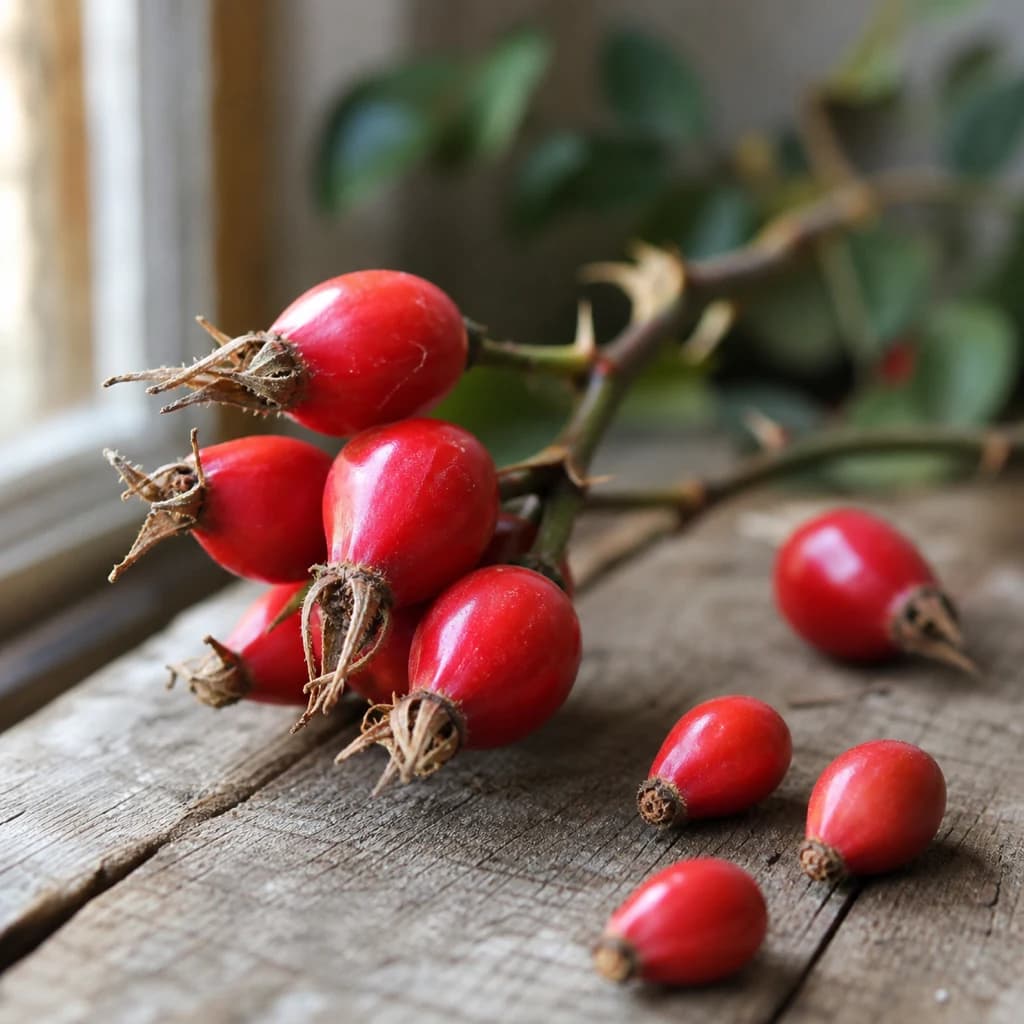
Natural form
Fresh rose hips on the branch: small, oval, ruby-red fruits after the flowers fade.
Shows the reader exactly what rose hips look like in their natural harvest state — still on the thorny rose cane with a few dried sepals attached.
Produce
Rose Hip
The tart red seed-pod of the rose plant, simmered into syrups, jams, teas, and Nordic soups rich in vitamin C.
Rose hips are the small, ruby-red fruits that form on rose bushes after the flowers fade. Tangy and lightly floral, they are cooked down into syrups, jams, and teas, and in Scandinavia into a sweet rose hip soup (nyponsoppa). They are exceptionally high in vitamin C, though the fine inner hairs and seeds must be strained out before use.
Rose hip is the fleshy red fruit, or hypanthium, of wild and cultivated rose plants — the seed pod that develops after the petals fall in late summer. Long valued across Scandinavia, Eastern Europe, and Britain as a survival food and folk remedy, rose hip has earned its place in the serious kitchen for its singular flavor: bright, tart cranberry-like acidity softened by subtle floral and honey notes when cooked. The fruit ranges from pea-sized to nearly cherry-sized depending on species, with a thin skin encasing a mealy flesh and dozens of small, hairy seeds at the center. Its extreme vitamin C content — once harnessed during World War II Britain when citrus was scarce — has faded from primary culinary relevance, since heat and storage degrade it substantially; today rose hip is prized for flavor and tradition. Beyond the familiar Nordic soup and syrup, the hip lends itself to vinegars, liqueurs, jams, and even savory applications where its acidity cuts through richness. The entire culinary enterprise hinges on one non-negotiable step: complete removal of the seeds and fine irritating hairs from the interior. This is not optional — it is the difference between a refined preserve and a painful experience.
- Measured in
- g
- Storage
- Pantry
Types & varieties
Most common wild species; small oval hips 1–2 cm; abundant in hedgerows across Europe and North America
Large round hips up to 3 cm; thicker flesh with fewer seeds; preferred species for most culinary applications; thrives on coastlines
Larger apple-shaped hips; notably high flesh-to-seed ratio; cultivated specifically for fruit production in Central Europe
Small black hips; less common culinary use; primarily ornamental
Small red hips; apple-scented foliage; traditional in British and Irish preserves
The Straining Imperative
This cannot be overstated: rose hip seeds and the fine hairs surrounding them contain irritant compounds that can cause serious discomfort to the mouth, throat, and digestive tract. There is no shortcut, no 'close enough' — every preparation that involves the hip interior must be fully and thoroughly strained. Use a food mill fitted with the finest disc, pass cooked puree through a fine-mesh strainer lined with cheesecloth, or combine both methods for absolute certainty. For syrups, strain twice. For soups, pass through a chinois or very fine strainer. Commercial rose hip puree from Scandinavian suppliers is processed and strained at the source, eliminating this labor entirely — it is a legitimate shortcut worth seeking out for soup and jam making.
- Always slit fresh hips lengthwise and scrape out all white inner flesh, seeds, and hairs before cooking
- Even after cooking, strain every preparation — hairs remain irritating regardless of heat treatment
- A rotary food mill with fine steel disc (traditional Swedish rotkvarn) is the most efficient tool for large batches
- Double-strain syrups: first through a coarse strainer, then through cheesecloth or a fine-mesh strainer
Dried vs. Fresh: Preparation Differences
Dried whole rose hips are rock-hard and require pre-cooking before any further processing — they will not blend, puree, or strain cleanly without first being reconstituted. Simmer dried hips covered in water for 20–30 minutes until very soft throughout. Fresh hips have higher moisture and cook more quickly but must be cleaned before cooking. Frozen fresh hips can be processed directly from frozen after thorough thawing; freezing actually simulates the frost-sweetening effect, making them less astringent. For maximum brightness and vitamin C, use fresh hips raw in smoothies or very brief preparations, but understand that cooking unlocks the flavor in ways raw consumption cannot.
- Dried hips: always simmer 20–30 min until soft before pureeing or straining
- Fresh hips: clean first, then cook — never cook whole with seeds intact
- Frozen hips: process directly from frozen after thawing; excellent for year-round cooking
- For fresh tartness: use raw or barely heated; for depth and mellowness: cook fully
Common uses
Tips & pitfalls
- Harvest after first frost — cold converts starches to sugars, yielding sweeter, less astringent hips; freeze harvested hips overnight as a substitute for frost
- Slit hips lengthwise and scrape out every trace of white flesh, seeds, and hairs before cooking — this step is non-negotiable
- For dried whole hips: simmer covered in water 20–30 minutes until very soft before processing; they will not blend cleanly without pre-cooking
- Strain cooked preparations through a fine-mesh strainer lined with cheesecloth, or pass through a food mill — skip straining at your peril
- Save vanilla beans, cinnamon sticks, or citrus peel to add during the final simmer — these complement the tart-floral profile beautifully
- For a clearer jam or jelly, poach fresh cleaned hips in water, strain, then cook only the strained liquid with sugar — skip the pulp entirely for a more refined texture
- Do not overcook rose hip jam — the natural pectin is fragile; cooking beyond 104°C (220°F) degrades gelling ability
- Commercially prepared rose hip puree (from Scandinavian specialty suppliers) eliminates the labor-intensive cleaning step and is worth seeking out for soup and jam making
- Store fresh cleaned hips in the freezer on a sheet pan, then transfer to bags — prevents clumping and allows convenient portioning
Nutrition
Energy
678 kJ · per 100 g
Where the calories come from
Protein
1.6g
3% DV
Carbs
38.2g
14% DV
Fat
0.3g
0% DV
Fiber
24.1g
86% DV
Sugars
2.6g
of which
Sodium
4mg
0% DV
Source · USDA FoodData Central · Rose Hips, wild (Northern Plains Indians)
View on FDC →In the shops
Matched grocery products
No matched grocery products for Rose Hip yet.
Good to know
- Part Used
- Fleshy red fruit (hypanthium) of wild or cultivated rose plants, after petals fall
- Form
- Fresh whole hips, dried whole hips, dried halved/quartered hips, rose hip powder
- Primary Species
- Rosa canina (dog rose), Rosa rugosa (sea rose), Rosa villosa, Rosa pomifera
- Season
- Late summer through winter; pick after first frost for sweeter, less astringent flavor
- Flavor
- Bright-tart, cranberry-like acidity with subtle floral honey notes when cooked
- Vitamin C Content
- Extremely high raw (significantly more than oranges by weight); substantially degraded by heat and long storage
- Critical Warning
- Interior seeds and fine hairs are irritating and must be completely removed before consumption
- Shelf Life
- Dried: 6–12 months airtight away from light and heat; fresh: 1–2 weeks refrigerated, 6 months frozen
- Yield
- Approximately 1 kg fresh hips yields 300–400 g cleaned flesh; 3–4 cups dried yield 1 liter finished syrup
- Equipment
- Food mill or fine-mesh strainer with cheesecloth; heavy-bottomed pot; optional: rotary food mill attachment for KitchenAid
- Prep Time
- Cleaning fresh hips: 15–20 min/kg; cooking/decocting: 20–45 min depending on recipe
Substitutes
- Cranberry — Closest tart-fruity flavor; use 1:1; different floral notes and higher price
- Lingonberry — Excellent Nordic flavor match; slightly less tart; ideal for Scandinavian-style soups and preserves
- Hawthorn berry — Similar size and preparation method; more floral, less bright; popular in Chinese and European traditions
- Dried hibiscus petals — Comparable tartness and visual appeal; distinctly different floral character; does not require straining
- Pomegranate molasses — Provides acidity and body for sauces and glazes; no structural similarity; use sparingly to adjust seasoning
Also called
Rosehip · Hep
Appears in these dishes

Related

Tomato
Juicy, sun-sweet fruit for sauces, salads, and slow-cooked depth

Yellow Onion
The aromatic backbone of soups, sofritos, and braises

Garlic
Pungent cloves that perfume nearly every savory dish

Lemon
Bright, acidic citrus that wakes up almost any dish

Potato
Humble, hearty staple — roast, mash, fry, or boil

Carrot
Sweet, crunchy root — raw, roasted, or the base of a sofrito

Cucumber
Cool, crisp, and watery — for salads, pickles, and tzatziki

Lettuce
Crisp leaves for salads, wraps, and a fresh crunch