 Japanese
Medium · Room Temp
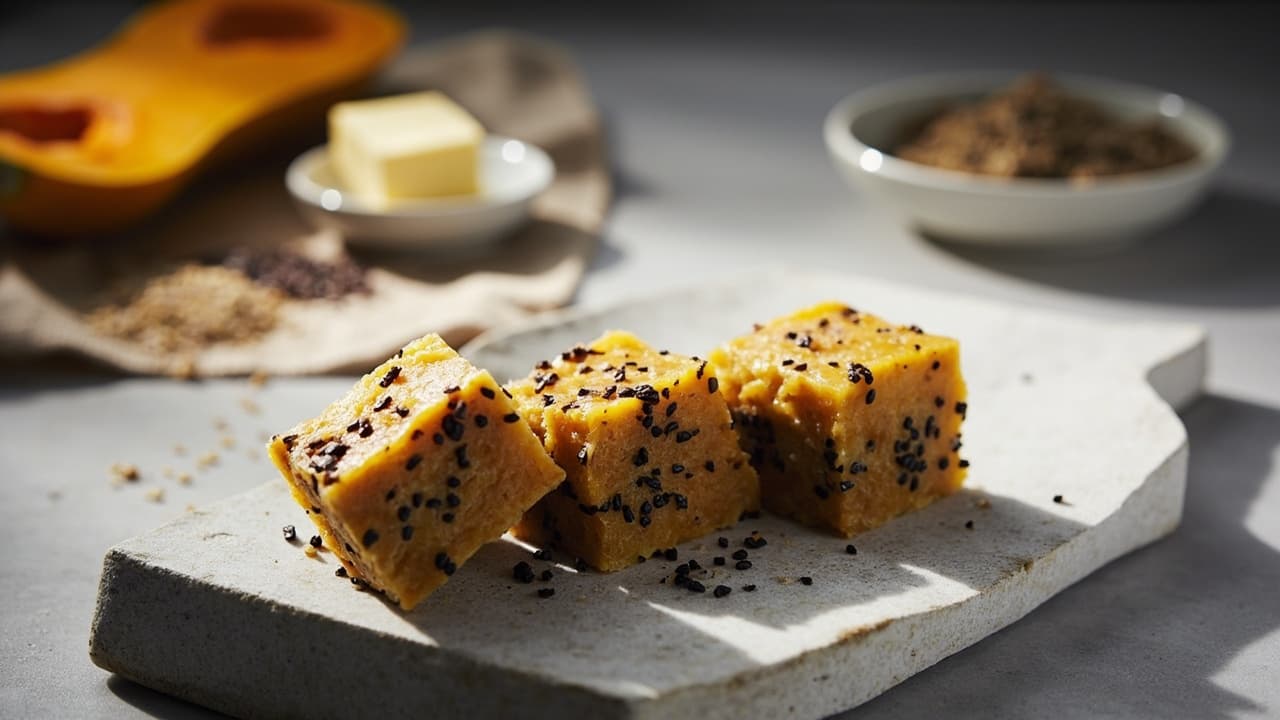
Butternut Squash and Black Sesame Mochi Bar
Brutalist mochi bars with roasted butternut squash and toasted black sesame — dense, chewy, and unapologetically textured.

Prep
20 min
Cook
28 min
Total
48 min
Method
1
Peel and cube the butternut squash into 2cm pieces. Toast sesame seeds in a dry pan over medium heat, 3-4 minutes, until fragrant and darkened — watch closely, they burn fast. Set aside half for garnish.
2
Steam or boil squash cubes 12-15 minutes until completely tender and no resistance at center. Drain thoroughly.
3
Mash squash while hot with 20g white sugar and salt. Press through a sieve for a smooth, dense paste. Set aside to cool slightly.
4
Grind white rice in a blender or food processor to a fine powder (rice flour). Combine with 50g white sugar.
5
Heat whole milk and 30g butter in a small pan until butter melts. Pour over rice flour mixture and stir vigorously until a thick, cohesive dough forms, about 2 minutes of mixing.
6
7
Spread the cooled squash paste evenly over the rice base. Crumble the remaining rice dough and scatter over the squash layer — do not press down.
8
Crush toasted sesame seeds with 15g white sugar and salt using a mortar or spice grinder until coarse and fragrant. Sprinkle evenly over the top layer.
9
Bake at 180C for 25-28 minutes until edges pull slightly from the pan and surface is set with golden spots where sesame has caramelized.
10
Cool in pan 10 minutes — the bars will firm as they cool. Run a bench scraper along edges, invert onto a board, then re-invert so sesame layer is facing up. Cut into 4 bars with a sharp edge.
11
Scatter reserved toasted sesame seeds over the top. Serve at room temperature — the chew peaks at 2-3 hours after baking.
C
Nutri-Score
Fair balance
A–E · lower is better · score 8
Calories
463
per serving
High in saturated fat · 10gCalorie-dense · 463 kcalLow salt · 97mg
Protein
8g
Carbs
73g
Fat
17g
Sat. fat
10g
Fiber
5g
Sugar
25g
Sodium
97mg
Dairy PresentGluten FreeAnti InflammatoryHeart HealthyBalanced Meal
Nutri-Score is a general nutritional-balance guide, not medical or dietary advice.
B
Environmental impact
Low impact
A–E · lower is better · includes estimates
kg CO2e
0.5
per serving
BCarbonAEU all-round· carbon sets the grade
Water
0.8m³
Land
19Pt
Runoff
0.05g P
White Rice drives 48% of this recipe’s estimated footprint.
Carbon from Poore & Nemecek 2018; water, land & runoff from Agribalyse — modelled averages for comparing recipes, not a measurement of your groceries.
Flavor Profile
5
Umami
5
Sweet
2
Salty
1
Sour
3
Bitter
0
Spicy
Textures
ChewyCrispyDenseSmooth
Aromas
DairyEarthyRoasted NuttyStarchy
Kitchen Equipment
Safety & Storage
Cooking Temperature
Monitor sesame seeds constantly while toasting—over medium heat they can burn in under a minute. Remove from pan immediately when fragrant and darkened.
Bake at 180C for full 25-28 minutes until edges pull from the pan and surface shows golden caramelized spots where sesame has developed.
Handling
Use caution when draining hot squash and handling the hot milk-butter mixture—these can cause severe burns.
Cross Contamination
Clean the spice grinder or mortar thoroughly between crushing sesame seeds and other uses to prevent allergen cross-contact.
Allergen Warning
This recipe contains milk and sesame. Do not serve to individuals with allergies to these allergens.
Storage
Bars peak in chew at 2-3 hours after baking when served at room temperature. Do not leave at room temperature for more than 4 hours total.
Shelf Life
Refrigerate leftovers in an airtight container and consume within 3 days for best quality and safety.
Equipment Safety
Cut bars with a sharp bench scraper or knife on a stable surface. The dense texture requires firm pressure—keep fingers clear of the cutting edge.
Pro Tips
Technique
Work the rice dough while it's still warm. Once it cools, it tightens up and becomes difficult to press evenly into the pan. You'll fight it the whole way, and nobody wins that fight.
Equipment
A fine-mesh sieve isn't optional for the squash paste — it's mandatory. Any lumps will create weak points in your layers, and these bars need to hold together with the structural integrity of poured concrete.
Storage
These bars peak at room temperature, 2-3 hours after baking. The chew is commitment, not convenience. Wrap tightly in beeswax wrap if you must store beyond that, but accept you'll lose something in the texture.
From the chef
I developed this because someone needed to explain to me why autumn desserts always had to be all soft edges and cinnamon. The butternut squash brings a dense, earthy sweetness that doesn't apologize for itself, and the black sesame isn't here for decoration — it's roasted until it means it. Together they make something that requires commitment. Good.
TagsMochiChewyBlack SesameBakedDenseBarVegetarian
AllergensMilkSesame
Source: generated · June 13, 2026