Water & Steam
Broth Simmering
Holding stock at a gentle near-boil for hours to extract flavor, body, and clarity from bones and aromatics.
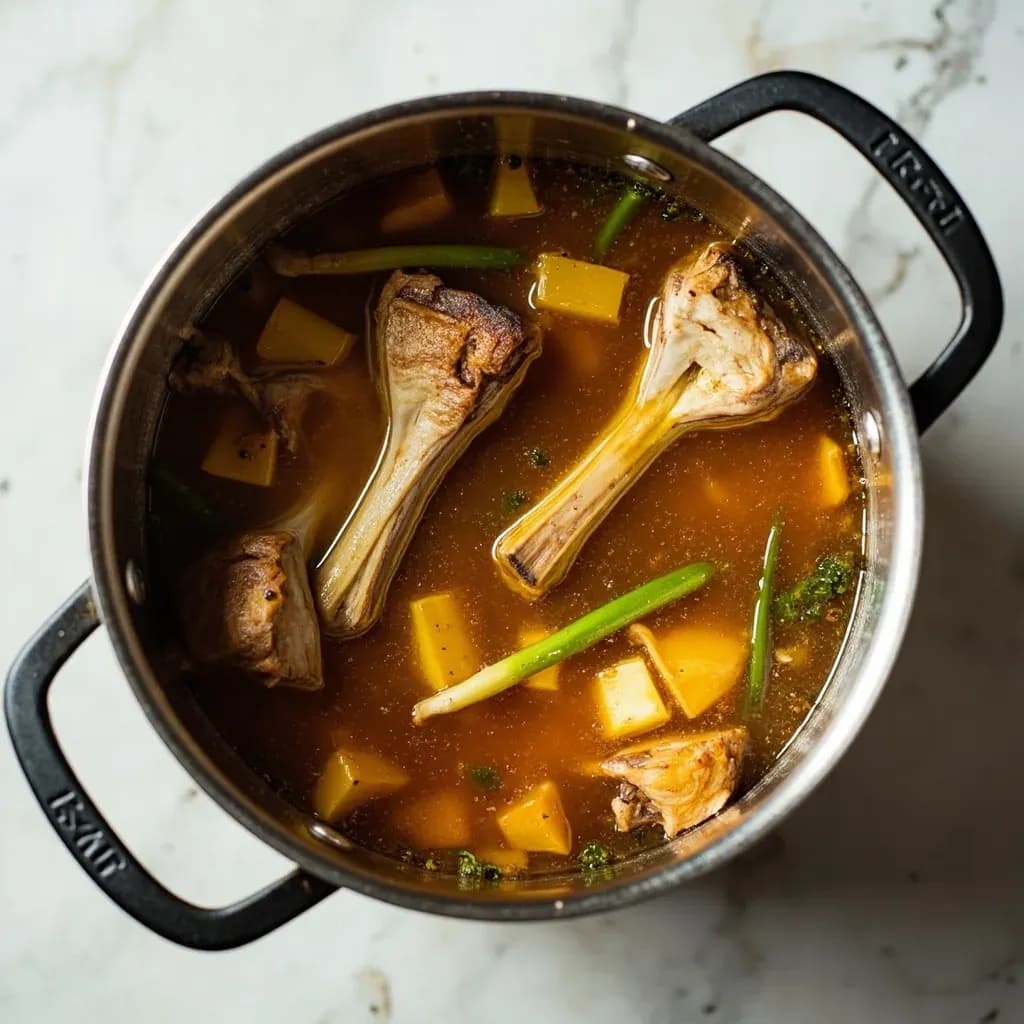
Broth simmering keeps a pot of water, bones, and aromatics at a steady, barely-bubbling temperature so collagen and flavor leach out slowly. A gentle simmer yields a clear, refined broth, while a hard rolling boil (as in tonkotsu) emulsifies fat and marrow into a cloudy, rich stock. The cook controls heat and skims regularly to steer the final texture.
Broth simmering is the controlled, low-heat extraction of flavor, body, and aroma from bones, meat trimmings, vegetables, and herbs in water. The technique is defined less by what goes into the pot than by how gently the liquid is held: just below a boil, between roughly 180°F and 205°F, with a surface that trembles and releases a bubble every second or two. That narrow window does two things at once. It coaxes collagen out of bones and converts it to gelatin, the protein that gives finished stock its silky body and the wobble of a properly made stock when chilled, and it keeps fat and proteins from being whipped into a permanent emulsion that clouds the liquid and gives it a greasy mouthfeel.
The depth of a finished stock — the difference between a thin cooking water and a proper fond that gels in the fridge — comes almost entirely from this combination of low temperature and time. A rolling boil ruins clarity in minutes, and the damage cannot be undone by straining, skimming, or even a clarifying raft. Conversely, an under-heated pot produces a clear but thin liquid that tastes of nothing. The technique also draws flavor from aromatics in waves: hardy vegetables and bay leaves give up their character over hours, while parsley, garlic, and thyme turn bitter and grassy if cooked too long. Simmering well is mostly watching the pot and refusing to let it boil.
A well-made stock is the foundation of classical and modern kitchens alike. Sauces, soups, risottos, braises, pilafs, and pan reductions all lean on it, and the difference between a restaurant-grade plate and a home-cooked one often starts here. Most professional kitchens keep a stockpot on a back burner for a half-day simmer, then skim, strain, cool, and freeze the result in usable portions so it is always within reach.
- Difficulty
- Easy
Types & varieties
Raw or blanched bones simmered from cold; pale, clean, delicate — base for veloutés and light sauces
Bones roasted until deep mahogany before simmering; deeper color and roasted-meat flavor — base for demi-glace, espagnole, and bordelaise
Roasted or raw chicken carcasses; light simmer; the workhorse of professional kitchens
Long, low simmer; relies on collagen-rich joints (knuckle, shank, neck) for body
Sweated aromatics plus fish bones; brief simmer only — clarifying and light
Mirepoix, mushrooms, leek greens, herbs; brief simmer to avoid bitterness
Acidulated simmer liquid for poaching fish or crustaceans, not a cooking stock
Long-simmered, often reused and re-seasoned; aromatics can include ginger, scallion, star anise, soy, and rock sugar
Stock clarified via a raft of egg white, ground meat, and mirepoix, gently simmered so the raft floats and traps impurities
How to do it
- 1
Choose and prep the bones
Pick bones appropriate to the stock you want: raw veal knuckles, beef shank, or oxtail for body; chicken backs and feet for poultry; fish frames for fumet. Roast bones for brown stock at 400–450°F until well colored, scraping up the fond. For white stock, rinse or briefly blanch bones and discard the cloudy first water.
- 2
Cover with cold water and bring up slowly
Place bones in a heavy-bottomed stockpot, cover with cold water by 1–2 inches, and set over medium heat. Bring up slowly — this lets proteins and impurities rise as a skimable scum rather than emulsifying into the liquid.
- 3
Skim the first boil
As the first bubbles form and a gray-white foam gathers at the surface, skim with a fine-mesh skimmer or flat-edge ladle. Work across the entire surface and discard the scum. Repeat as new foam rises — most impurities clear in the first 30–60 minutes.
- 4
Settle the simmer
Adjust the burner so the liquid holds at 180–205°F. You want occasional lazy bubbles and gentle steam, not a rolling boil. Boiling emulsifies fat and shears proteins into the liquid, clouding the stock permanently.
- 5
Add aromatics in waves
Add onion, carrot, celery, leek, bay, and peppercorn at the start (or after the first skim). Hold back garlic, parsley stems, thyme, and other delicate herbs for the last 20–30 minutes so they perfume the stock without turning bitter.
- 6
Hold and taste
Maintain the gentle simmer for the time appropriate to the stock: 30–60 minutes for vegetable, 20–45 minutes for fish, 3–4 hours for chicken, 6–10+ hours for gelatin-rich beef. Taste periodically with a clean spoon; the stock should taste rounded and savory, not flat or thin.
- 7
Strain while hot
Lift the bones with tongs or a spider, then pour the stock through a chinois or a colander lined with cheesecloth into a clean pot or heatproof container. Press the bones gently to release liquid; do not crush them, which forces sediment through.
- 8
Cool and store
Cool quickly in an ice bath to below 40°F. Refrigerate; once cold, lift off the solidified fat cap and reserve it for sautéing. Stock keeps 3–4 days refrigerated and 6 months frozen, or longer if pressure-canned.
The simmer line: why it matters
The entire craft of stock-making is the line between simmer and boil. Below about 205°F, proteins and fat float in or on the liquid, rise as a skimable foam, and can be lifted away. Above it, agitation breaks fat into tiny droplets and shears proteins into the broth, where they suspend as a permanent cloud. A consommé raft can rescue a stock that is merely hazy, but a stock that has been boiled hard will stay cloudy and greasy no matter what you do. A useful test: a lazy bubble every second or two at the surface, with steam rising steadily but no foam cap. If a gray-white cap builds and tumbles, the pot is boiling.
Time and gelatin: extracting body
Gelatin is what turns stock from a flavorful liquid into the quivering, sauce-thickening base of classic cuisine. It comes from collagen in bones, skin, tendons, and connective tissue, and it releases only with sustained, low heat. Chicken feet, pork trotters, veal knuckles, and beef shank are prized precisely because they are dense with collagen. Simmer time depends on the bone: a few hours for poultry, six to ten or more for rich beef stocks. Undershoot, and the result reads thin even when it tastes good; overshoot, and flavors flatten and aromatics turn muddy. A well-made stock is the one that, when chilled, sets to a soft jelly.
Adding aromatics in waves
Aromatics behave differently over a long simmer. Onion, carrot, celery, leek, bay leaf, and peppercorn give up their character slowly and benefit from being in the pot from the start (or after the first skim). Garlic, parsley stems, thyme, and other delicate herbs lose their top notes quickly and turn bitter or grassy if cooked for hours, so they go in during the last twenty to thirty minutes. Wine and tomato paste are usually added in brown stocks, sometimes caramelized with the bones. The result is a layered perfume rather than a stewed pot.
Judging the finished stock
A finished stock should smell savory and rounded, not boiled, not watery. Tasted warm on a clean spoon, it should taste of bone and aromatics with a faint, pleasant sweetness from the gelatin, not of vegetables past their prime. Aroma matters more than volume: a quart of fragrant stock is worth more than two quarts of bland. Strain while still hot, cool quickly, and watch what happens in the fridge. A clean, well-extracted stock will set to a soft gel and develop a thin, firm fat cap that protects it from oxidation. Lift that cap, strain again if needed, and the liquid beneath is ready to cook with.
Common uses
Tips & pitfalls
- Watch the pot, not the timer — a lazy bubble every second or two is the target; if a foam cap forms, the liquid is boiling.
- Start in cold water for a clearer stock; rapid heating drives proteins and impurities into suspension as fine particles.
- Skim early and often in the first hour; once the simmer settles, foam is mostly trapped and the liquid will clarify on its own.
- Avoid hard, sustained boils — agitation emulsifies fat into the liquid, creating permanent cloudiness and a greasy mouthfeel.
- For white stock, blanch or refresh bones first; for brown stock, roast them until the fond on the sheet pan is mahogany, not black.
- Add hardy aromatics (onion, carrot, celery, bay, peppercorn) at the start; add delicate herbs and garlic in the last 20–30 minutes so they perfume the stock without turning bitter.
- Tilt the pot lid a few degrees to allow steam to escape but slow evaporation — useful for very long simmers in dry kitchens.
- Do not salt during the simmer; salt concentrates as water reduces and will over-season any reduction made from the stock.
- Strain while hot through a chinois (or a colander lined with cheesecloth) — cooling stock gels the fat and makes straining slow and cloudy.
- Cool from 140°F to 70°F within two hours, then to 40°F within four more — use an ice bath, not a freezer, to avoid the danger zone.
- Hold finished stock overnight in the cool walk-in, then lift off the solidified fat cap and re-strain — the fat cap protects the stock from oxidation.
- Freeze in usable portions (1 cup, 1 quart) and top up the working stock as you cook to avoid repeatedly thawing a large batch.
Good to know
- Temperature range
- 180–205°F (82–96°C); surface should tremble with occasional lazy bubbles, not a rolling boil
- Boiling reference
- 212°F (100°C) at sea level — simmer runs roughly 7–30°F below the boil
- Typical duration
- 2–4 hours poultry; 4–6 hours veal/short beef bones; 6–10+ hours for gelatin-rich beef, oxtail, or shank
- Fish fumet duration
- 20–45 minutes — long simmers turn fish stock chalky and bitter
- Vegetable broth duration
- 30–60 minutes; longer draws bitterness from onion skins, brassicas, and bitter herbs
- Yield loss
- Roughly 10–25% volume loss per hour depending on pot surface area and lid use
- Start temperature
- Cold-water start is standard for clarity; hot-water start extracts more gelatin but more cloudiness
- Salt guidance
- Do not salt while simmering — salt concentrates as liquid reduces; season finished product
- Equipment
- Heavy-bottomed stockpot (8–16 qt), fine-mesh skimmer/spider, ladle, chinois or cheesecloth-lined strainer
- Difficulty
- Low; mostly patience and observation
Also called
simmering-broth · tonkotsu-boil · Stock Simmering
Dishes that rely on it
Related

Boil
Cook in vigorously bubbling liquid at full rolling heat

Simmer
Hold liquid at a gentle shimmer for tender, unhurried cooking

Poach
Cook gently in barely-trembling liquid for silky, tender results

Steam
Cook in rising vapor to keep color, nutrients, and shape intact

Blanch
Plunge briefly in boiling water, then shock cold to lock color

Braise
Sear, then cook slow in a little liquid until fall-apart tender

Stew
Simmer bite-sized pieces fully submerged into a rich, unified pot

Sous-Vide
Seal and cook in precise warm water for edge-to-edge doneness