Water & Steam
Making Stock
Simmering bones, vegetables, and aromatics in water to extract a flavorful base liquid.
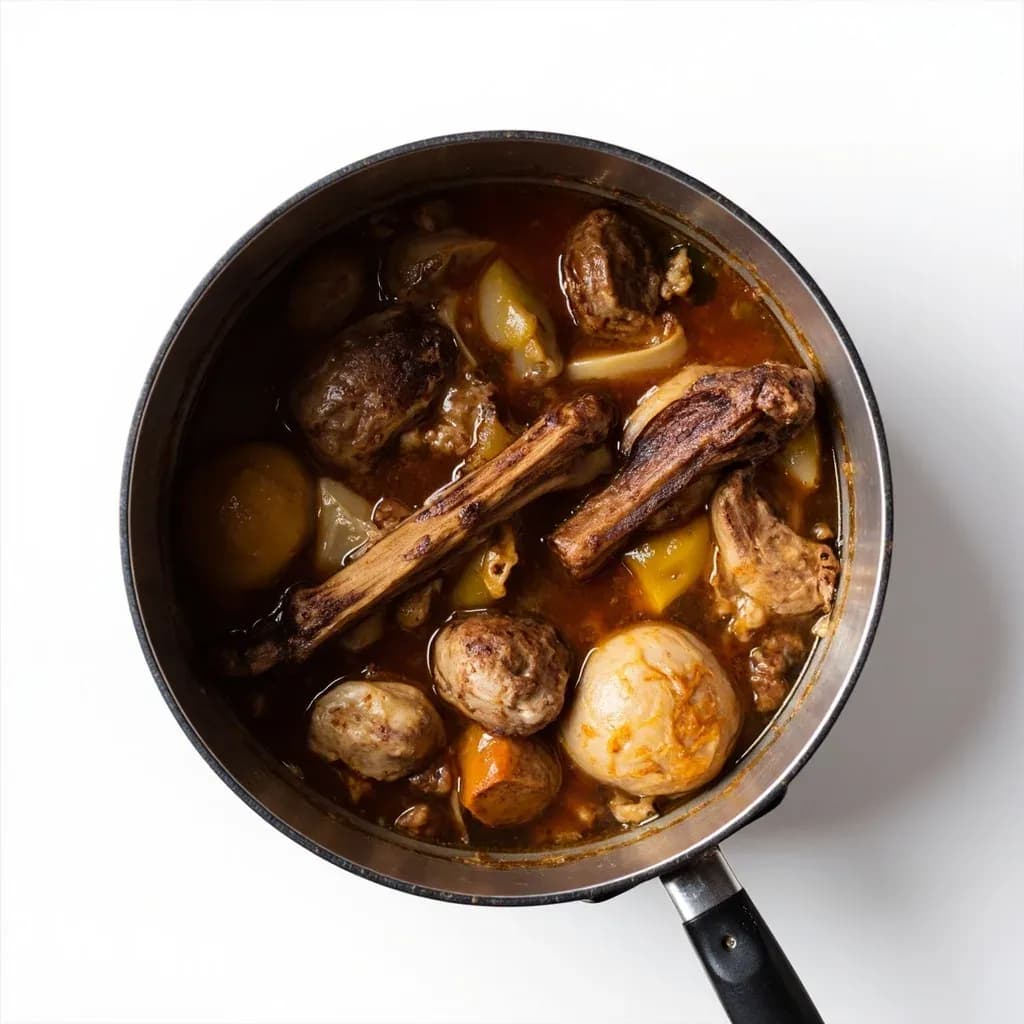
Making stock gently simmers bones, trimmings, aromatics, and water for hours to draw out gelatin, minerals, and savory depth, yielding a foundation for soups, sauces, and braises. Roasting the bones first gives a deeper brown stock, while raw bones make a lighter white stock. Keeping the liquid at a bare simmer and skimming impurities keeps the finished stock clear rather than cloudy.
Making stock is the quiet, unhurried technique that sits beneath virtually every great soup, sauce, braise, and risotto. The French call the resulting liquid a fond, and the method is the same whether the goal is a pale chicken velouté base or a deep demi-glace: bones, vegetables, and aromatics simmered long enough in water to surrender flavor, collagen, and minerals into a clear, full-bodied liquid. A well-made stock is thick with gelatin when cold, deeply savory at room temperature, and left unseasoned or only lightly salted so it can be reduced, fortified, or finished to suit whatever dish it joins.
The technique is gentle by design. Bones are covered with cold water, brought up slowly so impurities rise as skimmable scum, and held at a bare tremble — never a rolling boil — for hours. Time, not heat, does the work: collagen slowly dissolves into gelatin, marrow softens and releases richness, and the vegetables added near the end contribute sweetness and aromatic lift without turning sour. Professional cooks treat stock as a building block rather than a finished product, tailoring seasoning at the moment of use.
The payoff goes well beyond flavor. Long, gentle simmering of bones yields a liquid with real body and nutritional depth — gelatin, minerals, and amino acids that give sauces their gloss and soups their satisfying mouthfeel. That is why homemade stock tastes and feels unlike water simmered with vegetables, and why a few containers of good stock in the freezer are among the most useful ingredients a home cook can keep on hand.
- Difficulty
- Medium
Types & varieties
unroasted, often blanched bones; pale, clean flavor; base for blanquette, risotto, light sauces, velouté
roasted bones with tomato product; deep color and roasted flavor; base for espagnole, demi-glace, braises, jus
the everyday workhorse; raw or roasted carcasses, wings, backs, necks, and feet
long-simmered; prized for its gelatin body; foundation of classic French brown sauces
short simmer of fish bones, mirepoix, white wine, sometimes mushroom; delicate, never murky
no bones; mushrooms, leek greens, and tomato boost umami; brief simmer to avoid sourness
venison, rabbit, or wild-fowl bones; stronger, wilder flavor; pairs with brown-stock applications
acidic aromatic poaching liquid (wine, vinegar, lemon, herbs) for fish and seafood — a flavored cooking liquid rather than a true stock
How to do it
- 1
Choose and prepare the base
Select bones for the stock you want. White stock uses raw, trimmed bones; brown stock uses bones with some meat and connective tissue that will benefit from roasting. For fumet, use only lean, non-oily fish bones (sole, turbot, halibut, cod) — never oily fish like mackerel, sardines, or salmon. Rinse bones under cold water to wash off loose fragments and blood.
- 2
(Brown stock) Roast the bones
Spread bones on a sheet pan, optionally toss with a little tomato paste, and roast at 400–450°F / 200–230°C, turning once, until deeply browned — 30–45 minutes. Deglaze the pan with water or wine and add every drop to the stockpot; those drippings carry concentrated flavor.
- 3
(Optional) Blanch the bones for clarity
Cover bones with cold water, bring to a boil, simmer 10–15 minutes, drain, and rinse. This draws out blood and impurities and is worth doing for very clean white stock, consommé, or aspic.
- 4
Start in cold water
Place bones in a heavy stockpot and cover with cold water by 1–2 inches / 3–5 cm. A small splash of white wine or a teaspoon of vinegar helps the water draw collagen from the bones. Bring up to a simmer very gradually.
- 5
Skim the scum
As the temperature climbs through the first hour, gray-white foam and impurities rise to the surface. Skim with a flat spoon or fine-mesh skimmer and discard. Be patient — the stock will clear as impurities are removed.
- 6
Hold a gentle simmer
Adjust the heat so the surface barely trembles. A rolling boil emulsifies fat, clouds the stock, and produces a raw flavor. Top up with hot water as needed to keep bones submerged.
- 7
Add mirepoix and aromatics
Add the mirepoix in the last 45–60 minutes (last 1–2 hours for brown stock). Tie peppercorns, bay leaves, thyme, and parsley stems into a sachet d'épices or cheesecloth pouch and add at the same time. Add garlic in the final 30 minutes; reserve any additional wine for the same window so its flavor stays bright.
- 8
Simmer for the right time
Chicken stock: 3–6 hours. Beef/veal: 6–8 hours, longer for more body. Fish fumet: 20–45 minutes only. Vegetable stock: 30–60 minutes. The stock is done when it tastes rich, the bones feel soft and porous, and a small chilled portion gels.
- 9
Strain
Set a large colander over a clean pot and lift the bones out, letting them drain. Strain again through a fine-mesh chinois. For consommé-grade clarity, line the strainer with several layers of cheesecloth.
- 10
Cool quickly
Set the pot in an ice bath in the sink and stir occasionally. The goal is to drop below 40°F / 4°C within an hour, especially for meat stocks, to stay safely out of the food-safety danger zone.
- 11
Defat and store
Once fully chilled, the fat cap will be solid; lift it off in one piece (save it for sautéing or rendering). Pour stock into dated containers — quarts/liters for the fridge (3–4 days), or freeze in 1-cup portions, ice cube trays, or flat zip-top bags (up to 6 months). Label everything.
Why a gentle simmer matters
A rolling boil is the single most common mistake in stock-making, and it causes a cascade of problems. Vigorous movement emulsifies fat into the liquid, producing a cloudy, greasy stock with a raw, "boiled" flavor. It also agitates proteins into a fine suspension that won't settle, dulling clarity. The ideal temperature is just below a simmer — 180–185°F / 82–85°C — where convection is gentle enough for impurities to coagulate into skim-able scum, fat to render cleanly, and collagen to dissolve slowly without breaking apart. Patience is the technique.
- A cold-water start allows proteins and impurities to rise gradually as scum rather than seizing onto the bones.
- Skim often during the first 60–90 minutes; once the surface settles, the stock is largely self-clarifying.
- Top up with hot water only as needed — cold water drops the temperature and prolongs the danger zone.
Troubleshooting
When a stock doesn't behave as expected, the cause is usually one of a handful of things.
- Thin, non-gelling stock: needs more collagen-rich bones (feet, necks, knuckles, joints) or more time.
- Weak brown stock: bones weren't roasted deeply enough, or the simmer was too short.
- Cloudy, greasy stock: boiled too hard, or wasn't skimmed in the first hour.
- Bitter fish stock: bones were simmered too long, or included blood, gills, or oily fish.
- Sour vegetable stock: cooked past an hour; vegetables oxidize and turn acrid with prolonged heat.
- Muddy flavor in any stock: herbs and aromatics were added too early — keep them to the last 30–45 minutes.
Common uses
Tips & pitfalls
- Never boil — a hard boil emulsifies fat into the liquid, producing a cloudy, greasy, off-flavored stock.
- Start in cold water so proteins and impurities rise gradually as scum you can skim off rather than seizing onto the bones.
- Skim frequently during the first 60–90 minutes; once the surface settles, the stock is largely self-clarifying.
- For very clear white stock and consommé, blanch bones for 10–15 minutes, rinse, and start over in fresh water.
- Roast bones at 400–450°F / 200–230°C until well browned for brown stock, and deglaze the pan — those drippings are pure flavor.
- Add a splash of white wine or a teaspoon of vinegar early on to help pull collagen from the bones.
- Add a tablespoon of tomato paste when roasting bones to deepen color and umami in brown stock.
- Add herbs and the sachet d'épices (peppercorns, bay, thyme, parsley stems) only in the last 30–45 minutes — long cooking turns them bitter and hay-like.
- Save vegetable trim (carrot peels, celery tops, leek greens, parsley stems) in a freezer bag for stock.
- Cool stock as fast as possible: an ice bath in the sink brings a large pot below food-safety temps in under an hour.
- Degrease only after chilling — the fat cap lifts cleanly off a cold surface and carries less flavor than skimming hot.
- Reduce and freeze in 1-cup / 250 ml portions (muffin tins, silicone trays, flat zip-top bags) for grab-and-drop use later.
- If the stock is thin and won't gel, it needs more collagen-rich bones (feet, joints, neck, knuckles) or more simmer time.
- Fish bones must be clean and free of blood and gills, or the stock will taste metallic and cloudy.
Good to know
- French term
- fond (fond de volaille, fond de veau, fond de légumes)
- Core components
- bones, water, mirepoix (onion, carrot, celery), aromatics; sometimes tomato product, leeks, garlic
- Simmer target
- 180–185°F / 82–85°C, with only occasional bubbles breaking the surface
- Bone-to-water ratio
- roughly 1 lb (450 g) bones per 1 quart (1 L) water; bones should be comfortably covered
- Cooking times
- vegetable 30–60 min; fish fumet 20–45 min; chicken 3–6 hr; beef/veal 6–8 hr (some kitchens go to 12)
- Mirepoix ratio
- 2 parts onion : 1 part carrot : 1 part celery by weight
- Quality test
- properly made bone stock gels firmly when chilled, from extracted collagen
- Storage
- refrigerated up to 3–4 days; frozen up to 6 months in portioned containers
- Yield loss
- expect about 20–30% reduction in volume from simmer evaporation and absorption by the bones
- Difficulty
- low technique, high patience
Also called
Stock-Making · Húsleves Főzés · Wild Stock-Making · Broth-Making
Dishes that rely on it
Related

Boil
Cook in vigorously bubbling liquid at full rolling heat

Simmer
Hold liquid at a gentle shimmer for tender, unhurried cooking

Poach
Cook gently in barely-trembling liquid for silky, tender results

Steam
Cook in rising vapor to keep color, nutrients, and shape intact

Blanch
Plunge briefly in boiling water, then shock cold to lock color

Braise
Sear, then cook slow in a little liquid until fall-apart tender

Stew
Simmer bite-sized pieces fully submerged into a rich, unified pot

Sous-Vide
Seal and cook in precise warm water for edge-to-edge doneness