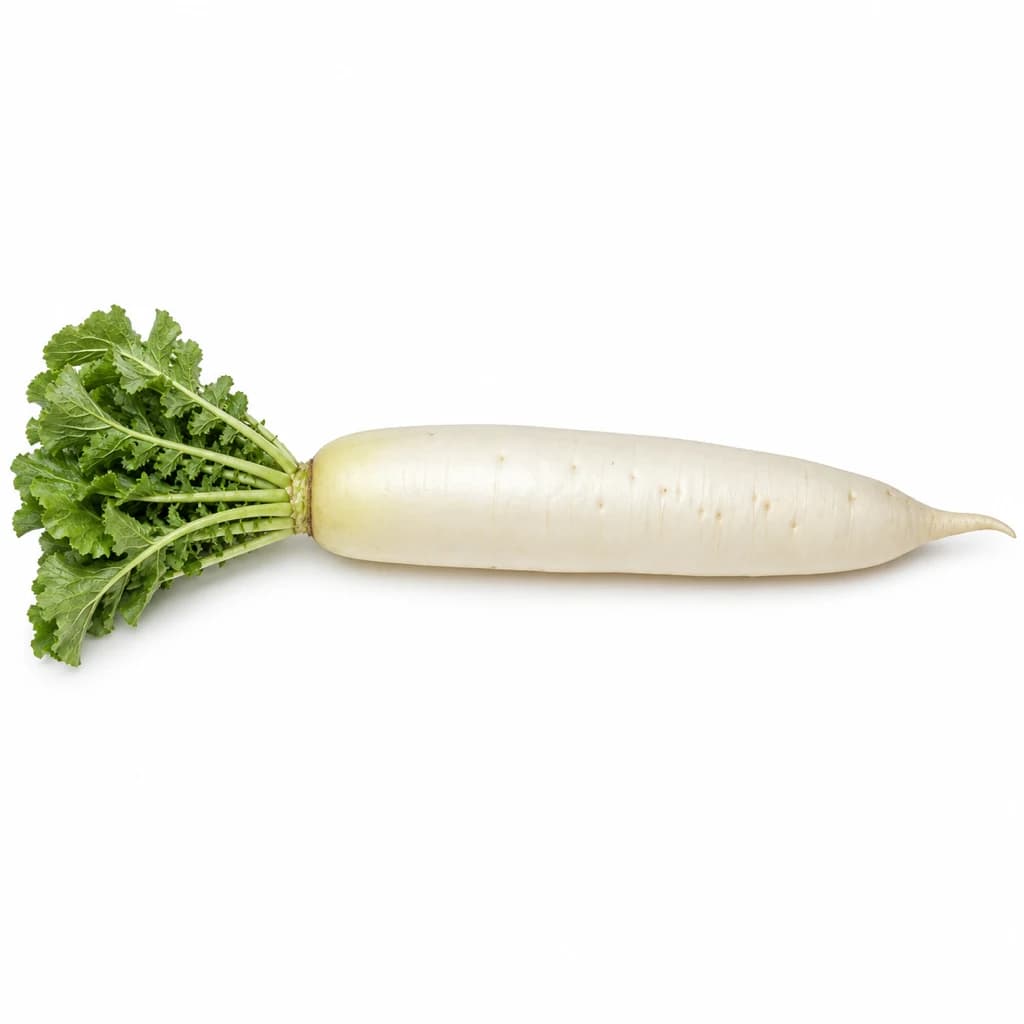
Natural form
Whole daikon radish showing its full elongated white form and green leaf crown.
Establishes the ingredient's unmistakable scale, shape, and color so readers can identify it at a market.
Produce
Daikon Radish
Large mild white radish eaten raw, pickled, simmered, or grated across East Asian cooking.
Daikon is a long, white winter radish with crisp, juicy flesh and a mild, slightly peppery flavor. It is grated as a condiment, pickled, simmered in broths, or shredded raw into salads throughout Japan, China, Korea, and Vietnam. When braised it turns sweet and translucent, while raw it stays crunchy and refreshing.
Daikon (Raphanus sativus var. longipinnatus) is a large, cylindrical white radish native to East Asia, where it has been cultivated for millennia in China, Japan, and Korea. Unlike small round radishes, daikon grows to 8–18 inches long and can weigh several pounds, with a mild, faintly sweet flavor and crisp texture that makes it unusually versatile—it can be eaten raw, pickled, simmered, or grated without overwhelming a dish. The vegetable behaves differently depending on preparation: raw it offers a subtle peppery bite that dissipates on the palate; cooked, it sweetens considerably and develops a tender but slightly resistant texture that absorbs surrounding flavors, making it a remarkable vehicle for broths and braises.
Daikon's significance across East Asian cuisines lies in this adaptability and its ability to perform structural work in a dish. Japanese cooking favors it raw, grated over noodles or quick-pickled as a palate cleanser; Korean cuisine builds bold fermented flavors around its denser cousin used in kimchi; Chinese cooking employs both fresh and dried forms, often in long-simmered preparations where the daikon enriches the broth as it cooks. The root is nutritionally notable—high in vitamin C and potassium—and contains raphanin and diastase enzymes that aid digestion and help tenderize other ingredients cooked alongside it. A single daikon can weigh 2–5 pounds, making it an economical and rewarding ingredient once you understand how to select, store, and prepare it properly.
- Measured in
- piece
- Storage
- Fridge
Types & varieties
Classic Japanese variety, 12–18 inches long; balanced texture ideal for pickling and cooking; most common in U.S. Asian markets
Longer, thinner variety; matures quickly; excellent for grating due to high water content
Traditional Kyoto variety; softer flesh ideal for takuan (yellow pickle); more tender than other varieties
Shorter and thicker than Japanese types; denser flesh preferred for kimchi fermentation; slightly more assertively flavored
Broad term for Chinese radish varieties; includes white, green-shouldered, or purple types; often more pungent than Japanese daikon
Small, round Japanese variety; traditionally grown in mountainous regions; prized for pickling
Buying and Storing
Select firm, heavy daikon without cracks, soft spots, or blemishes—heavier specimens indicate higher water content and better texture. Avoid any that feel light or hollow. Store unwashed in a loose plastic bag in the crisper drawer of your refrigerator for up to 2–3 weeks. Critically, do not store daikon near apples, pears, or other ethylene-producing fruit; the gas causes the daikon to turn bitter and develop off-flavors. If you purchase a whole daikon and only need a portion, cut what you need and store the remainder; the exposed cut surface will begin to dry and oxidize within a day or two.
- A whole daikon can weigh 2–5 pounds—buy one and plan multiple uses across several days
- Frozen daikon: slice and freeze for up to 3 months; best used directly from frozen in simmered dishes where texture loss is acceptable
Preparation Essentials
Always peel daikon before using—the skin is slightly bitter and noticeably tougher than the flesh. For raw applications like garnish, use a fine grater, a Benriner mandoline, or a food processor to produce fine shreds. Grated daikon oxidizes and becomes watery within minutes, so use it immediately or toss with a small amount of rice vinegar to stabilize the color and texture. For simmered dishes, cut daikon into large pieces—half-moons or thick wedges—because small cuts disintegrate into mush. Score the surface of large pieces in a shallow crosshatch pattern to help the interior absorb broth more efficiently.
- For salads and raw preparations: salt lightly and let sit 5 minutes, then squeeze out excess liquid—this tempers bitterness and prevents the dish from becoming watery
- When raw in salads: always salt first, then squeeze; never skip this step or the salad will flood with released water
Common uses
Tips & pitfalls
- Choose firm, heavy daikon without cracks, soft spots, or blemishes; heavier specimens indicate higher water content and better eating quality
- Always peel before using—the skin is slightly bitter and has a noticeably tougher texture than the flesh
- For grating: use a fine grater, Benriner mandoline, or food processor; serve grated daikon immediately or it will oxidize and become watery within minutes
- For simmered dishes: cut into large pieces (half-moons or thick wedges); small cuts disintegrate into mush; score the surface in a crosshatch pattern to help it absorb broth
- For pickling: salted daikon should be pressed and dried before submerging in seasoned brine; fermentation produces carbon dioxide—use weights to keep pieces fully submerged or they'll soften unevenly
- Common mistake: overcooking, which turns daikon mushy and bland; it should retain slight resistance even when fully cooked through
- To accelerate cooking in braises: add a small amount of rice washing water (suimuchi) or a pinch of sugar; daikon's natural enzymes also help tenderize other ingredients in the same pot
- Do not store daikon near apples or pears—ethylene gas causes measurable bitterness and off-flavors within days
Nutrition
Energy
59 kJ · per 100 g
Where the calories come from
Protein
1.1g
2% DV
Carbs
2.6g
1% DV
Fat
0.1g
0% DV
Fiber
1.4g
5% DV
Sodium
16mg
1% DV
Source · USDA FoodData Central · Radishes, white icicle, raw
View on FDC →In the shops
Matched grocery products
No matched grocery products for Daikon Radish yet.
Good to know
- Origin
- East Asia (cultivated in China, Japan, Korea for millennia)
- Classification
- Raphanus sativus var. longipinnatus; distinct from small round radishes
- Shape & Size
- Long cylindrical taproot, 8–18 inches long, 2–4 inches in diameter; can reach 2 feet and weigh several pounds
- Season
- Year-round; peak quality in fall and winter when roots are sweetest
- Flavor Raw
- Mild, faintly sweet, with a subtle peppery bite that diminishes quickly on the palate
- Flavor Cooked
- Sweetens considerably; develops tender but slightly resistant texture when simmered or braised
- Key Components
- Raphanin and diastase enzymes; high in vitamin C and potassium
- Storage
- Refrigerate unwashed in a plastic bag up to 2–3 weeks; keep away from ethylene-producing fruit (apples, pears) which cause bitterness
Substitutes
- Korean Radish — Acceptable substitute, though denser and more assertively flavored; increase quantity by 10–15% to approximate daikon's mildness
- Black Radish — Sharper flavor and rougher texture; requires significantly longer cooking; not suitable for raw applications
- Jicama — Similar crunch and mild sweetness when raw; cannot replicate cooked daikon's texture or flavor development; use only in salads and garnishes
- Turnip — Smaller and more assertively flavored; can work in cooked preparations but lacks daikon's characteristic mildness; peel generously
Pairs with
Also called
白萝卜 · Chinese Radish · White Radish · Daikon Radish · Mooli
Appears in these dishes
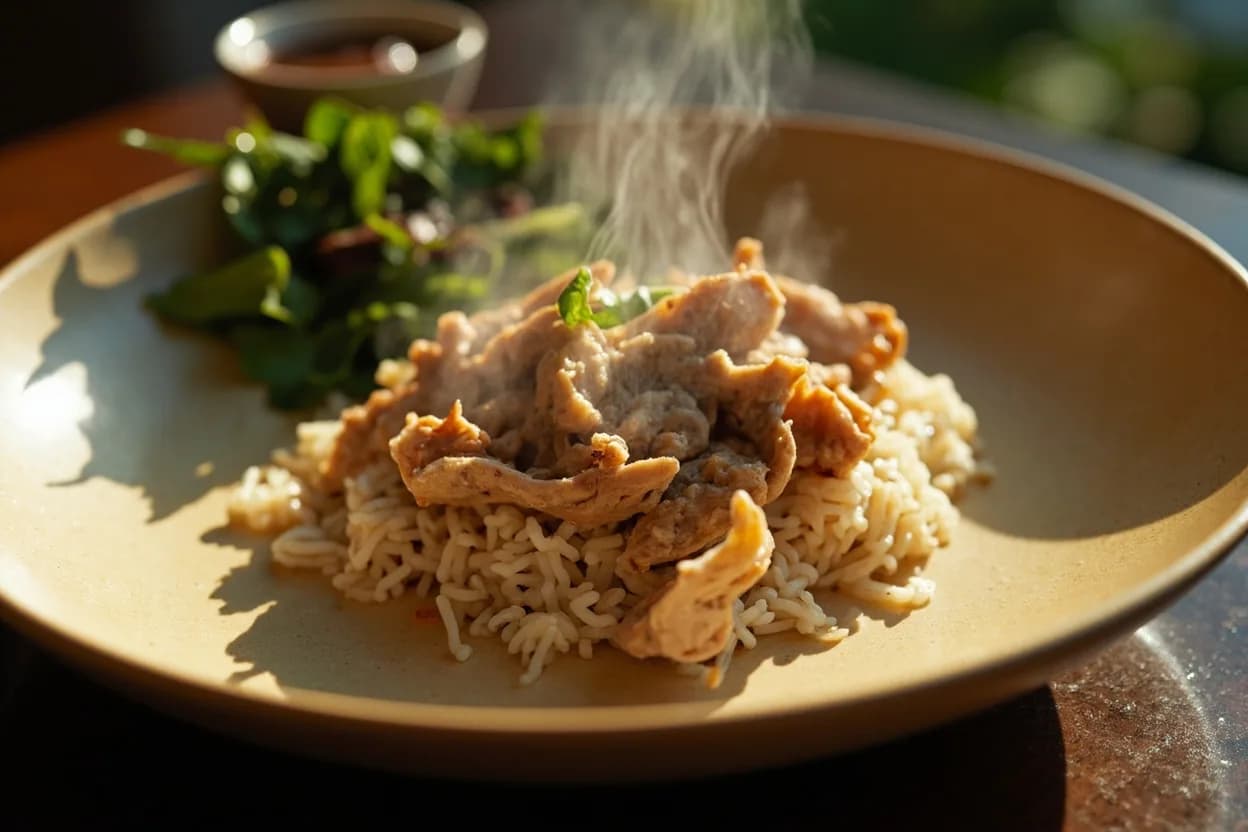
Related
Tomato
Juicy, sun-sweet fruit for sauces, salads, and slow-cooked depth
Yellow Onion
The aromatic backbone of soups, sofritos, and braises
Garlic
Pungent cloves that perfume nearly every savory dish
Lemon
Bright, acidic citrus that wakes up almost any dish
Potato
Humble, hearty staple — roast, mash, fry, or boil
Carrot
Sweet, crunchy root — raw, roasted, or the base of a sofrito
Cucumber
Cool, crisp, and watery — for salads, pickles, and tzatziki

Lettuce
Crisp leaves for salads, wraps, and a fresh crunch