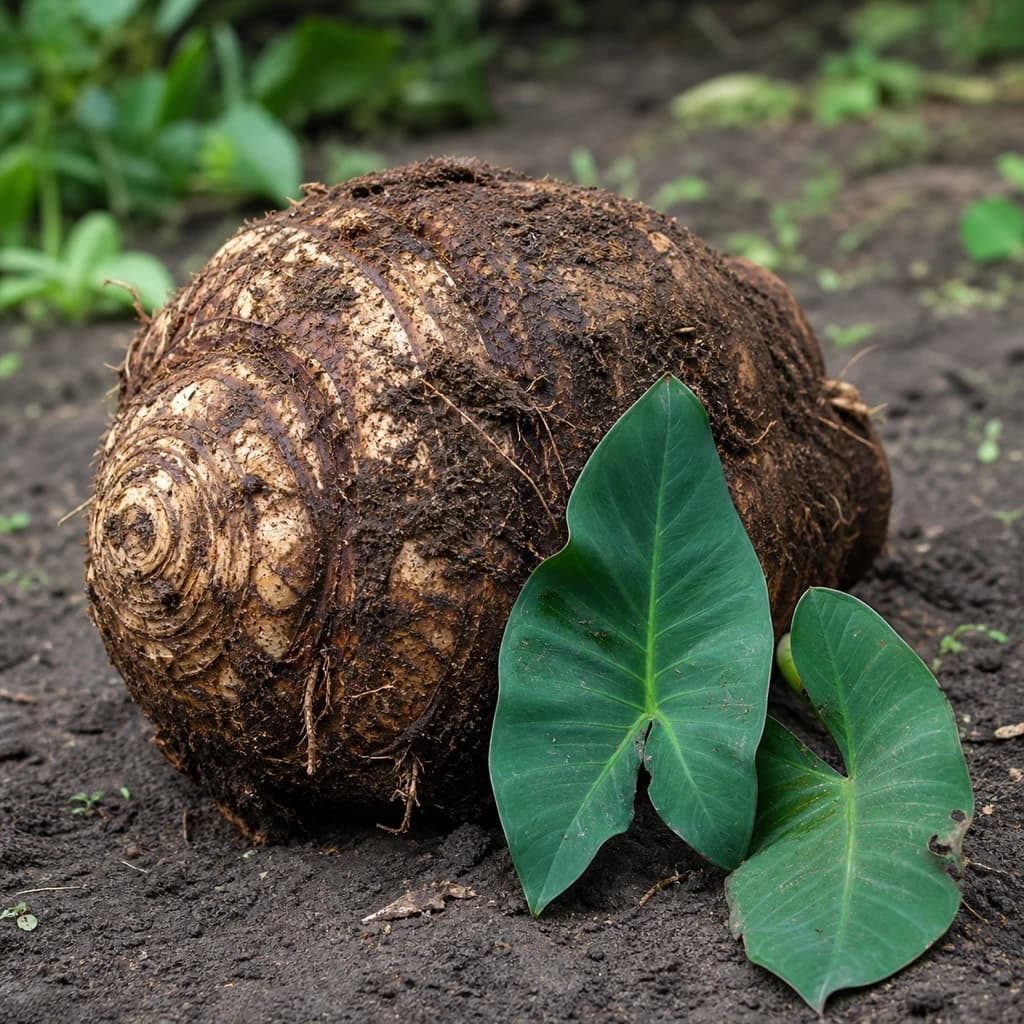
Natural form
A freshly harvested giant swamp taro corm, covered in rough brown fibrous skin, next to broad green leaves.
Shows the full unprocessed corm so readers can recognize the tuber's distinctive massive scale, rough texture, and fibrous exterior in its harvested state.
Produce
Giant Swamp Taro (Te Babai)
Large starchy Pacific wetland tuber, a staple food cultivated in pit gardens.
Giant swamp taro is a large starchy corm grown in flooded pits across the Pacific islands, especially Kiribati where it is called te babai. The dense tuber must be thoroughly cooked to break down its acrid calcium oxalate, then it is boiled, mashed or baked as a celebratory staple. It is a culturally important crop tied to atoll food security.
Giant Swamp Taro (Cyrtosperma merkusii), known as Te Babai in Kiribati and Pulaka in Tuvalu, is the principal starch staple of low-lying Pacific atolls where few crops can survive. Unlike common taro (Colocasia esculenta), which prefers well-drained soil, this species thrives in permanently waterlogged, often brackish conditions—growing in excavated pits that hold water year-round. The plant produces a single massive central corm (typically 2–10 kg, occasionally exceeding 20 kg) plus smaller offset cormels. The corm has a mildly nutty, earthy flavor that is less sweet than sweet potato and more neutral than yam, making it a versatile blank canvas for bold Pacific flavors. Cultivation is physically demanding (digging and maintaining deep pits), but the crop is remarkably resilient to cyclones and drought, which is why it remains a critical food security crop as climate change intensifies pressures on atoll agriculture. Te Babai occupies a unique cultural position: it is the prestige starch at ceremonial feasts (manibwai in Kiribati), served alongside coconut cream preparations, while everyday diets increasingly rely on imported rice. The entire plant is edible when properly prepared—the corm is the primary harvest, but young leaves and hearts are cooked as greens (called tarabe).
- Measured in
- g
- Storage
- Pantry
Types & varieties
The standard cultivated type; large corm, reliable yield in atoll conditions.
Shorter, more compact variety with darker leaf stems; grown in deeper pits; some report a slightly sweeter corm.
White-fleshed variety; paler corm interior with potentially finer texture.
Smaller, early-maturing variety; less common but useful for quicker harvest cycles.
Type with prominent purple spotting on leaf stems; corm quality traditionally considered excellent.
Cultivation and Harvesting
Growing giant swamp taro requires permanent standing water or waterlogged soil—a requirement that shapes the distinctive landscape of atoll communities. Farmers excavate deep pits (babai pits), sometimes 1–2 meters deep, which fill with rainwater and groundwater. The corms are planted in the pit bottom and left to mature for 12–18 months. Harvesting is labor-intensive: a long-handled digging tool or pole is needed to pry the massive corms from the saturated mud. One plant yields one central corm plus smaller side cormels (offsets) that can be replanted. The physical demands of this cultivation system have historically shaped settlement patterns and communal labor traditions on these islands.
- Pits must remain permanently waterlogged; the plant does not tolerate drought or well-drained conditions.
- Harvest by loosening soil around the corm with a long-handled tool, then lifting carefully to avoid breaking.
- Replant offset cormels immediately to maintain the pit's yield cycle.
Preparation and Cooking
The corm's tough, fibrous outer skin must be removed before cooking—use a heavy knife or axe, as standard vegetable peelers are inadequate against the coarse exterior. Cut the corm into manageable pieces (halves or quarters for large specimens) to ensure even cooking. The most traditional preparations involve prolonged cooking: boiling (minimum 30–45 minutes for pieces, longer for whole sections), baking in an underground oven (umu) for 1–2 hours, or roasting in-shell for 2–3 hours in a fire or 1.5–2 hours at 180°C (350°F). Test doneness by piercing with a skewer—the blade should slide through without resistance, and the cut surface should appear translucent and fully tender, not chalky or dense at the core. Undercooked corm will cause intense mouth and throat irritation from residual calcium oxalate crystals. Young leaves and hearts (tarabe) must also be cooked thoroughly—typically 15–20 minutes in boiling water or coconut cream—before serving as greens.
- Always split large corms before cooking to ensure the center cooks through.
- Never eat raw corm under any circumstances; irritation and swelling will result.
- Discard any batch that remains gritty or causes irritation after proper cooking time—indicates either insufficient cooking or high raphide content in that particular lot.
Traditional Fermentation and Storage
In some Pacific traditions, cooked babai is buried underground for weeks to ferment, developing a mildly sour, complex flavor. This technique both preserves the surplus harvest and creates a distinctive condiment used in small quantities to flavor other dishes. The fermented product has a tangy, slightly alcoholic quality similar to fermented cassava or certain preserved root vegetables in other cuisines. The starch can also be extracted, rinsed, and settled to produce a fine flour or pure starch powder, used for baking or as a thickening agent in sauces and desserts.
- Fermented babai is typically used in small amounts as a flavoring, not as a primary starch serving.
- Babai starch flour should be stored in an airtight container in a cool, dry place; it will keep for several months.
Common uses
Tips & pitfalls
- Always cook giant swamp taro thoroughly—minimum 30–45 minutes boiling or 1–2 hours in an underground oven—to eliminate calcium oxalate irritation and fully gelatinize the starch.
- Peel the tough outer skin with a heavy knife or axe before cooking; standard vegetable peelers cannot handle the coarse, fibrous exterior.
- Large corms cook unevenly. Split or quarter them before boiling to ensure the center becomes tender throughout—undercooked cores will be chalky and irritating.
- Test doneness by piercing with a skewer or knife: the blade should slide through with no resistance, and the cut surface should appear translucent, not chalky or dense.
- When roasting in-shell (like a baked potato), allow 2–3 hours in a moderately hot fire or 1.5–2 hours in a 180°C (350°F) oven for a 5+ kg corm.
- Do not attempt to eat raw corm—it causes intense itching and swelling in the mouth and throat from calcium oxalate raphides.
- If you experience mouth irritation after eating properly cooked babai, discard the remaining portion; some individual corms have higher raphide content and should not be consumed.
- If growing: the plants require permanent standing water or very wet soil; they do not tolerate drought or well-drained garden beds.
Nutrition
Energy
469 kJ · per 100 g
Where the calories come from
Protein
1.5g
3% DV
Carbs
26.5g
10% DV
Fat
0.2g
0% DV
Fiber
4.1g
15% DV
Sugars
0.4g
of which
Sodium
11mg
0% DV
Source · USDA FoodData Central · approx. Taro, raw
View on FDC →In the shops
Matched grocery products
No matched grocery products for Giant Swamp Taro (Te Babai) yet.
Good to know
- Scientific Name
- Cyrtosperma merkusii
- Regional Names
- Te Babai (Kiribati), Pulaka (Tuvalu), Simboro (Fiji)
- Part Used
- Subterranean corm (primary); young leaves and hearts as greens
- Typical Corm Size
- 2–10 kg; exceptional specimens exceed 20 kg
- Flavor Profile
- Mild, nutty, earthy; neutral starch base with less sweetness than sweet potato
- Toxicity
- Raw corm contains calcium oxalate raphides; requires thorough cooking (minimum 30–45 min boiling)
- Peak Harvest
- 12–18 months after planting; traditionally harvested as needed year-round
- Storage
- Whole corms keep 1–2 weeks in cool, shaded, dry conditions; leave in ground until use preferred
Substitutes
- Taro (Colocasia esculenta) — Most direct substitute; smaller corm but similar starchy texture and cooking behavior; widely available in Asian markets.
- Giant Swamp Taro from other Pacific islands — Essentially the same species (Cyrtosperma) under different local names; fully interchangeable in recipes.
- Sweet Potato — Not botanically related but serves the same starchy staple role; softer texture when cooked; use in similar proportions in stews or as a boiled side.
- Yam (Dioscorea species) — Comparable starchy tuber; firmer texture; works in boiled or fried preparations; adjust cooking times as yams may take longer.
- Cassava — Another starchy root that must be cooked (never raw); similar neutral flavor; good for fried chips or boiled starch dishes.
- Breadfruit — A different Pacific staple with similar cooking uses—roasted, fried, or stewed—but has a distinct breadier flavor and softer texture.
Pairs with
Also called
Te Babai · Babai · Pulaka
Appears in these dishes
Related

Tomato
Juicy, sun-sweet fruit for sauces, salads, and slow-cooked depth

Yellow Onion
The aromatic backbone of soups, sofritos, and braises

Garlic
Pungent cloves that perfume nearly every savory dish

Lemon
Bright, acidic citrus that wakes up almost any dish

Potato
Humble, hearty staple — roast, mash, fry, or boil

Carrot
Sweet, crunchy root — raw, roasted, or the base of a sofrito

Cucumber
Cool, crisp, and watery — for salads, pickles, and tzatziki

Lettuce
Crisp leaves for salads, wraps, and a fresh crunch