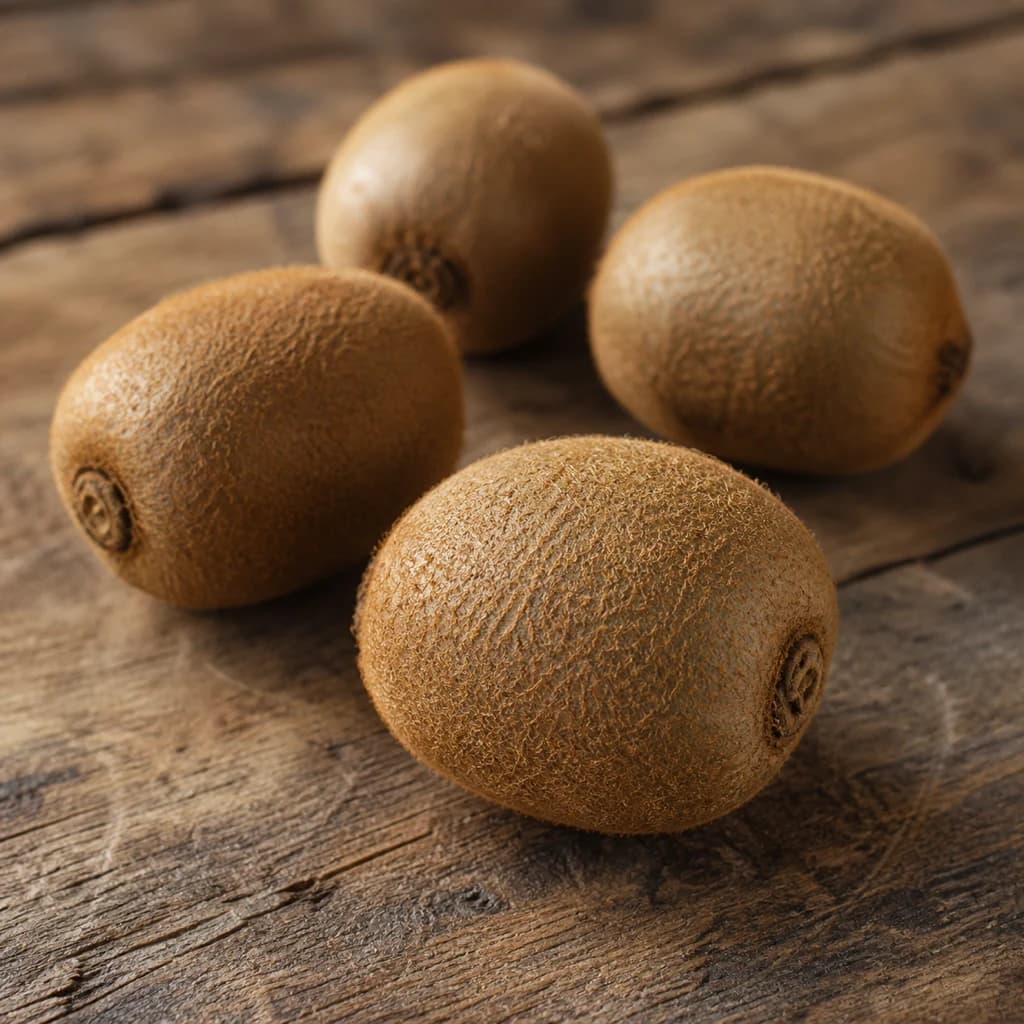
Natural form
Whole kiwifruit showing the characteristic fuzzy brown oval skin, slightly egg-shaped.
Teaches the reader to identify kiwifruit by its distinctive fuzzy brown exterior before any cutting or preparation.
Produce
Kiwifruit
Fuzzy brown fruit with bright green, black-seeded flesh that's sweet-tart and refreshing.
Kiwifruit is an egg-sized fruit with fuzzy brown skin and vivid green (or golden) flesh dotted with tiny edible black seeds. It is eaten fresh, sliced into fruit salads, blended into smoothies, or used as a colorful dessert garnish. Its sweet-tart flavor and enzyme actinidin also make it useful as a natural meat tenderizer.
Kiwifruit is the edible berry of several species of woody vines in the genus Actinidia, native to the Yangtze River valley in China where it grew wild for centuries. It entered Western markets in the early twentieth century under the uninspiring name "Chinese gooseberry" before New Zealand growers developed the commercial industry and renamed it after their national bird in the 1950s–60s. The modern kiwifruit industry is dominated by Zespri, a grower-owned cooperative that holds proprietary rights to the Sungold variety. The two principal commercial species are Actinidia deliciosa, the familiar fuzzy brown ellipsoidal fruit with bright emerald flesh, and Actinidia chinensis, the smooth-skinned golden variety with golden-yellow flesh. What distinguishes kiwifruit in the kitchen is the proteolytic enzyme actinidin, which drives several important culinary behaviors: it prevents gelatin from setting, causes fresh dairy to separate, and makes kiwifruit one of the few plant-based meat tenderizers. The flavor is bright and tropical, with a sweetness balanced by berry-like acidity that punches well above its modest size—75 to 100 grams per fruit—making even a single kiwifruit a significant flavor element on a plate.
- Measured in
- piece
- Storage
- Fridge
Types & varieties
The dominant commercial variety; fuzzy brown skin, bright green flesh, balanced sweet-tart flavor; ellipsoidal shape
Trademarked golden variety; smooth bronze skin, golden flesh, sweeter and lower acidity than Hayward; skin is edible but slightly bitter
Premium golden cultivar; smooth skin, very sweet with tropical notes; largely superseded by Sungold in commercial plantings
Compact, smooth-skinned A. arguta; self-pollinating; eaten whole with skin; slightly grape-like flavor
Emerging Chinese variety; greenish-yellow flesh with red blush at center; sweet, mild flavor
Elongated, early-season cultivar; darker green flesh; not widely grown commercially
The Actinidin Factor
Actinidin is the defining chemical property of kiwifruit, and understanding it prevents several common kitchen failures. This proteolytic enzyme cleaves protein chains, which means three things in practice: it prevents gelatin from setting (the enzyme breaks down the collagen proteins before they can gel), it causes fresh milk and cream to curdle (the enzyme denatures dairy proteins), and it is an effective meat tenderizer for tough cuts. Heat deactivates actinidin — blanching chopped kiwifruit for 60 seconds is sufficient — so cooked kiwifruit no longer poses the gelatin or dairy problems, though it will still tenderize meat. Raw kiwifruit used in salads will weep and become mushy within an hour of cutting due to enzymatic activity breaking down cell walls. This is not a flaw in freshness; it is chemistry. Plan accordingly.
- Blanch raw kiwifruit 60 seconds to deactivate actinidin for gelatin desserts
- Do not blend raw kiwifruit into fresh cream or milk unless the dish will be baked
- Dice and add kiwifruit to meat marinades 30 minutes before cooking for tenderizing effect
- Cut kiwifruit for salads immediately before serving, not ahead of time
Ripeness and Selection
A ripe kiwifruit yields slightly to gentle thumb pressure at the stem end and has a faint sweet fragrance. The flesh should feel slightly soft but not mushy. A fruit that is hard all the way through is unripe. Kiwifruit continues to ripen after picking, which means it is often sold firm. Speed ripening by placing unripe fruit in a paper bag with an apple or banana — the ethylene gas from the companion fruit accelerates the process significantly. Once ripe, refrigerate immediately and use within one to two weeks. Watch storage placement: kiwifruit produces its own ethylene gas, so storing ripe kiwifruit next to ethylene-sensitive produce like leafy greens, broccoli, or soft berries will cause them to deteriorate rapidly. For a smooth-skinned golden variety, look for a uniform golden color with no green blushing at the stem end.
- Firm kiwifruit: ripen at room temperature, 1–3 days
- Under-ripe kiwifruit can be used in cooked applications like compotes or chutneys
- Golden varieties ripen faster than fuzzy varieties and bruise more easily
Common uses
Tips & pitfalls
- Ripen unripe kiwifruit at room temperature in a paper bag with an apple or banana to concentrate ethylene gas and cut ripening time
- Test ripeness by pressing gently near the stem end — it should yield slightly; a hard stem-end means it needs more time
- Peel fuzzy varieties with a vegetable peeler or sharp paring knife; golden varieties have edible skin, though it carries a slight bitter note
- If using raw kiwifruit in gelatin-based desserts, blanch the chopped fruit for 60 seconds to deactivate actinidin before adding it
- Never blend raw kiwifruit into fresh cream or milk unless the dish will be baked or cooked — the actinidin will cause immediate curdling
- The actinidin makes kiwifruit an effective meat tenderizer: grate or thinly slice into marinades for 30 minutes before cooking, especially useful for tougher cuts
- Store ripe kiwifruit away from ethylene-sensitive produce — it produces ethylene gas that will accelerate ripening and spoilage of nearby fruits and vegetables
- Use a sharp knife for slicing kiwifruit; the delicate, seed-laden flesh crushes easily under dull blades
Nutrition
Energy
255 kJ · per 100 g
Where the calories come from
Protein
1.1g
2% DV
Carbs
14.7g
5% DV
Fat
0.5g
1% DV
Fiber
3g
11% DV
Sugars
9g
of which
Sodium
3mg
0% DV
Source · USDA FoodData Central · Kiwifruit, green, raw
View on FDC →In the shops
Matched grocery products
No matched grocery products for Kiwifruit yet.
Good to know
- Scientific name
- Actinidia deliciosa (fuzzy); Actinidia chinensis (golden)
- Peak season
- November–March (Northern Hemisphere); May–August (Southern Hemisphere)
- Flavor profile
- Sweet-tart; bright, tropical acidity with berry-like notes
- Key enzyme
- Actinidin — a potent proteolytic enzyme active in raw fruit
- Vitamin C
- ~20 mg per 100 g (33% daily value)
- Storage (ripe)
- Refrigerate; use within 1–2 weeks
- Storage (unripe)
- Room temperature; ripens in 1–3 days
- Ethylene
- Produces and is sensitive to ethylene gas; store away from other produce
Substitutes
- Strawberries — Similar berry-like sweetness and acidity; best in fresh applications and desserts
- Mango — Comparable tropical sweetness; different texture (fibrous); works in fruit salads and sauces
- Pineapple — Tropical acidity and sweetness; much firmer texture; good in salsas and savory applications
- Passion fruit — Similar tartness and tropical character; smaller seeds; more intense flavor; good for sauces and desserts
- Green apple (Granny Smith) — Provides tartness and crunch; lacks the tropical notes; acceptable in salads and salsas
Pairs with
Also called
Kiwi · Chinese Gooseberry
Appears in these dishes

Related
Tomato
Juicy, sun-sweet fruit for sauces, salads, and slow-cooked depth
Yellow Onion
The aromatic backbone of soups, sofritos, and braises
Garlic
Pungent cloves that perfume nearly every savory dish
Lemon
Bright, acidic citrus that wakes up almost any dish
Potato
Humble, hearty staple — roast, mash, fry, or boil
Carrot
Sweet, crunchy root — raw, roasted, or the base of a sofrito
Cucumber
Cool, crisp, and watery — for salads, pickles, and tzatziki

Lettuce
Crisp leaves for salads, wraps, and a fresh crunch