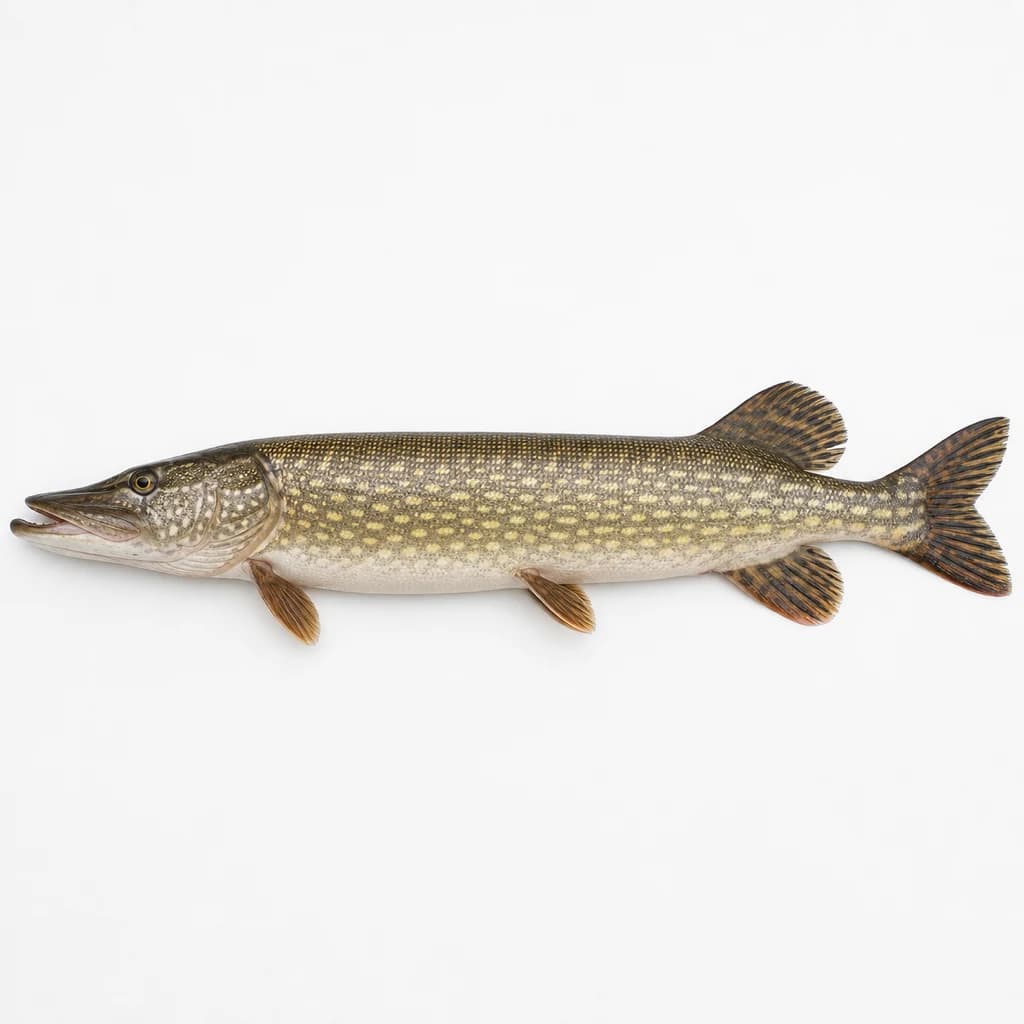
Natural form
Whole pike showing its elongated body, duck-bill snout, and mottled olive-green patterning.
Establishes the fish's unmistakable silhouette, coloration, and predatory features so readers can identify it in the wild or at market.
Proteins
Pike
Lean freshwater predatory fish, made into quenelles and fish dumplings.
Pike is a long, lean freshwater predator with firm white flesh but many fine Y-bones. Because of the bones it is often pureed and pushed through a sieve to make French quenelles or gefilte fish. When filleted carefully it can also be poached or baked, with a clean, mild flavor.
Pike is a lean, firm-fleshed freshwater predator prized in classical French and Central European cooking. Its mild, slightly sweet white flesh has a clean taste when sourced from cold, clear waters, though river-caught specimens can develop a muddy flavor that requires careful preparation. The fish is distinguished by its long, streamlined body and distinctive Y-shaped intermuscular bones that run the length of the fillet—removing these is the primary challenge that deters many home cooks, but it is a skill that opens up a versatile ingredient.
Northern Pike (Esox lucius) is the most commonly available species, found across lakes and rivers throughout the Northern Hemisphere. Its firm texture and high yield of lean meat make it exceptionally well-suited to preparations requiring the fish to hold together—quenelles, dumplings, mousses, and fish cakes all benefit from its dense, cohesive flesh. The fish absorbs rich sauces like Nantua butter and beurre blanc without becoming overpowering, making it a vehicle for elaborate French sauce work. Its abundance in many freshwater systems also makes it one of the more sustainable freshwater fish choices, particularly in regions with strong fisheries management.
Despite its potential, pike demands respect in the kitchen. The bones require patience to remove, the flesh must be soaked to eliminate muddy notes, and cooking must be precise—overcooking renders it dry and mealy. But when handled correctly, pike rewards the effort with a clean, versatile canvas for both classic and modern preparations.
- Measured in
- g
- Storage
- Fridge
Allergens
Types & varieties
Most widely available; ranges across North America and Europe; the standard culinary pike
Larger cousin prized by anglers; cleaner flavor, less muddy; firm flesh with larger flakes
Smaller member of the pike family; common in eastern North America; good flavor but very bony
Native to rivers of the Amur basin in Asia; similar to Northern Pike in culinary use
Technically a walleye relative, but often grouped with pike in European cooking; excellent for quenelles, milder, less bony
Small, found in eastern North American streams; underutilized but edible
Deboning Pike: A Practical Approach
The Y-bones are the defining prep challenge with pike. They run the length of the fillet, most prominent in the thickest section near the head end. Start with a sharp, flexible filleting knife and work along the natural lines of the flesh. For the boning step, use needle-nose pliers or tweezers to grip each bone firmly and pull at a slight angle, working from tail to head. Refrigerate fillets for 30 minutes before boning—the cold firms the flesh and makes the bones easier to locate and extract. After removing the obvious Y-bones, run your fingers firmly across the fillet to detect any remaining pin bones and extract those as well. A well-boned pike fillet should be completely free of resistance when you drag a clean finger across it.
- Chill fillets 30 minutes before boning for firmer flesh
- Work from tail to head when pulling Y-bones with pliers
- Run fingers across finished fillet to check for missed pin bones
- If serving whole, score the flesh at 1-inch intervals before cooking to cut through bones and make them easier to eat around
Selecting Pike at the Market
Look for clear, bright eyes and bright red or pink gills on whole fish. The flesh should spring back firmly when pressed and appear moist without being slimy. Avoid fish with sunken eyes, brown or gray gills, or flesh that leaves an indentation when pressed—this indicates age. Fresh pike should smell of clean water, not muddy or fishy. Fillets should have a translucent, glistening appearance. When purchasing frozen pike, ensure packaging is airtight and there is no visible freezer burn or ice crystals, which indicate dehydration.
- Clear eyes and red gills signal freshness
- Flesh that springs back indicates good texture
- Smell test: fresh pike smells like clean water
- Medium-sized fish (2–5 lbs) have the best flesh quality for cooking
Common uses
Tips & pitfalls
- Soak fillets in lightly salted cold water for 30–60 minutes before cooking to reduce muddy flavor—this is essential for river-caught pike
- The Y-bones are most prominent in the thickest part of the fillet; use tweezers or needle-nose pliers to remove them before cooking
- For forcemeats and quenelles, process flesh while very cold to achieve a smooth, cohesive paste
- Pike flesh has a high water content; salt the fish lightly 15 minutes before cooking to improve texture and reduce moisture
- Do not overcook—pike turns dry and mushy quickly; cook until just opaque throughout
- Large pike (over 10 lbs) have coarser, darker flesh; medium-sized fish (2–5 lbs) are preferred for most preparations
- A heavy 12-inch cast iron skillet at medium-high heat is ideal for pan-frying pike fillets
- Common mistake: skipping the soaking step, which leaves a muddy flavor that overwhelms the fish
Nutrition
Energy
368 kJ · per 100 g
Where the calories come from
Protein
19.3g
39% DV
Carbs
0g
0% DV
Fat
0.7g
1% DV
Fiber
0g
0% DV
Sugars
0g
of which
Sodium
39mg
2% DV
Source · USDA FoodData Central · approx. Fish, pike, northern, raw
View on FDC →In the shops
Matched grocery products
No matched grocery products for Pike yet.
Good to know
- Scientific Name
- Esox lucius (Northern Pike), with several other Esox species
- Origin
- Freshwater lakes, rivers, and streams across the Northern Hemisphere; native to Europe, North America, and parts of Asia
- Peak Season
- Late winter through early spring, during spawning season (February–April in temperate zones)
- Flavor Profile
- Mild, clean, slightly sweet white flesh; can develop a muddy taste if from murky waters
- Texture
- Firm, dense flakes; holds together well in preparations requiring binding
- Typical Size
- 1–5 lbs for market fish; can exceed 50 lbs, though large specimens have coarser texture
- Yield
- Approximately 40–45% usable meat after filleting and deboning
- Key Challenge
- Y-bones (intermuscular bones) running the length of the fillet; requires careful removal
Substitutes
- Zander — Best substitute for European preparations; cleaner flavor, less bony, excellent for quenelles
- Walleye — Similar mild flavor and firm texture; less bony than pike; works well in fish cakes and pan-frying
- Perch (Lake Perch) — Mild, sweet white flesh; excellent for pan-frying and fish preparations; smaller bones
- Cod — Reliable culinary substitute for most applications; firmer texture, no Y-bones, widely available frozen
- Halibut — Premium substitute with cleaner, sweeter flavor; expensive but excellent for special preparations
- Pollock — Budget substitute with similar texture; best for fish cakes and preparations where flavor is masked
Pairs with
Also called
Brochet · Hecht
Appears in these dishes
Related

Egg
The kitchen's everything ingredient — bind, leaven, enrich, or fry

Chicken Breast
Lean, quick-cooking white meat for everyday dinners

Ground Beef
Versatile minced beef for burgers, ragù, tacos, and meatballs

Pork Loin
Lean, tender roasting cut that stays juicy with care

Salmon
Rich, rosy fish that roasts, grills, or cures beautifully

Egg White
Pure protein that whips to airy peaks for meringue and more

Egg Yolk
Rich, golden yolk for custards, mayonnaise, and pasta

Quail Egg
Tiny, speckled eggs for garnishing and elegant bites