Stored
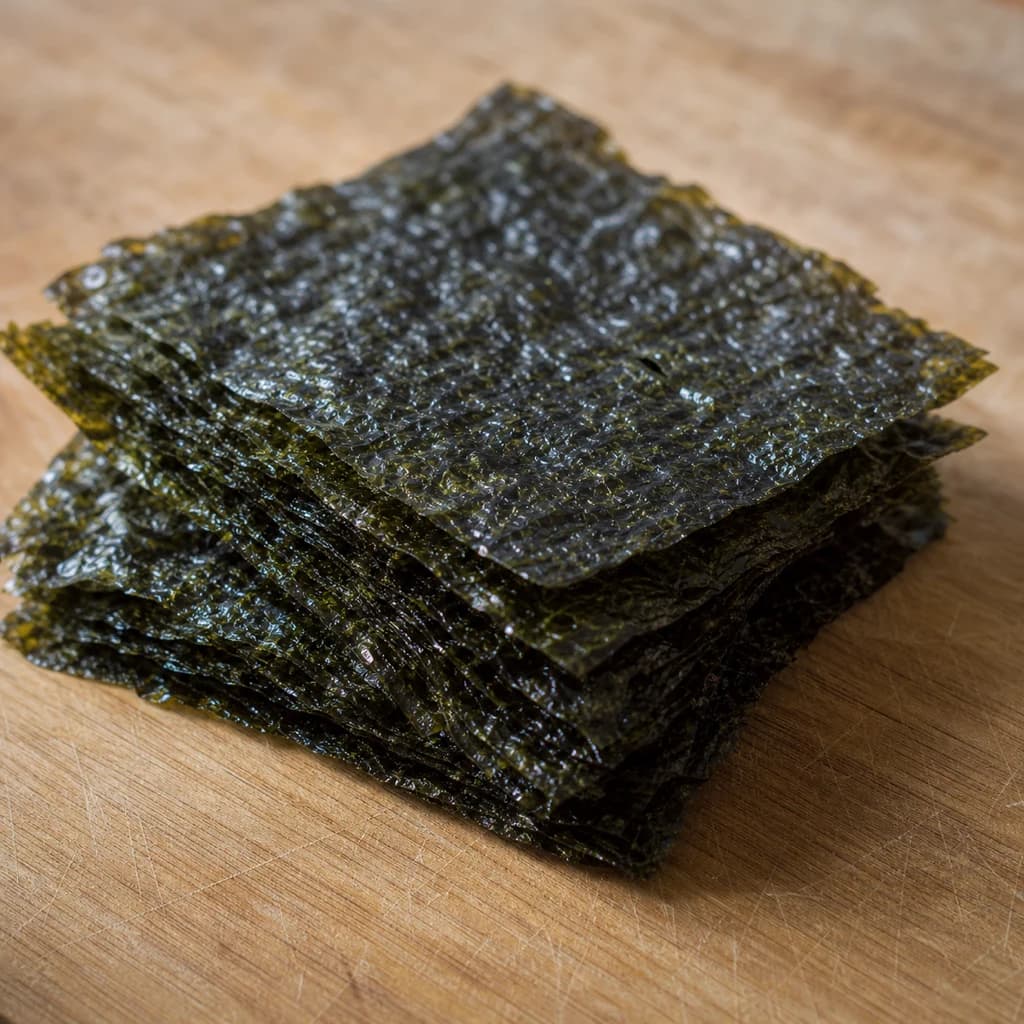
Dried laver sheets stacked in a loose bundle, showing their thin papery black-green texture.
The dried sheet form is how most people first encounter laver — teaching its color, translucency, and fragile papery structure establishes the ingredient's identity immediately.
Produce
Laver (Gim)
Thin, dried edible seaweed sheets used in Korean and Japanese cooking and as a snack.
Laver is a thin, papery edible seaweed, sold as dried sheets used to wrap rice in Korean gimbap and Japanese sushi, or toasted and salted as a crisp snack. It has a savory, oceanic, umami flavor that intensifies when roasted. The related miyeok is a different seaweed used for soups, while laver specifically refers to the flat pressed sheets.
Laver, known as gim in Korea and nori in Japan, is a dried edible seaweed produced from species of Porphyra—the same biological source processed differently for distinct culinary traditions. The production method is shared by both cultures: harvested seaweed is shredded, washed, pressed into thin uniform sheets, and dried—traditionally in the sun or via modern machine drying. The result is a paper-thin, dark green to black sheet that transforms to vibrant green when moistened or toasted. Its flavor is briny and mineral-rich with pronounced umami and a subtle sweetness, making it one of the most versatile and widely used seaweeds in East Asian cuisine.
The distinction between Korean gim and Japanese nori is cultural and culinary rather than botanical. Korean gim tends to be thinner, more fragile, and saltier—reflecting its use as a standalone snack and assertive flavoring in Korean cooking. Japanese nori emphasizes uniform sheet quality, structural integrity for sushi rolling, and a more refined, less aggressive flavor. For sushi purposes, Japanese nori graded A or B is preferred for its tear resistance and consistent texture. For Korean applications like kimbap and soup, any thin, high-quality gim or nori works well.
Laver's hygroscopic nature demands attention: once opened, sheets rapidly absorb moisture from kitchen air, losing crispness and becoming chewy and unworkable within days. Proper storage in an airtight container with a desiccant packet extends usability, but buying smaller quantities more frequently is the most reliable strategy for home cooks who use it only occasionally.
- Measured in
- g
- Storage
- Pantry
Types & varieties
Generally thinner and more fragile than Japanese nori; often has a slightly saltier, more intensely briny flavor; used for kimbap, soup, and snacking.
Pressed into more uniform, durable sheets; graded with AA or A1 as premium tiers, followed by A, B, and C; color (dark green/black), smooth glossy texture, and absence of holes determine grade; sold toasted or untoasted.
Heat-treated during processing for immediate use; preferred for sushi and rice bowls; crisper texture and deeper color.
Sold pale green; requires toasting at home; retains brighter color; used when a more delicate flavor is desired.
A specific grade designation; typically mid-range quality with sufficient strength to hold rice and fillings without tearing; 7-inch square sheets are standard.
Pressed thin sheets seasoned with sesame oil and salt; sold in individual rectangular pieces or rolls; popular as a standalone snack; already toasted, do not reheat.
Pre-cut or torn pieces for scattering over rice, soups, or noodle dishes; convenient for garnishing but lacks structural integrity for rolling.
Understanding Quality
Japanese nori carries a grading system that directly indicates quality and price. Grade AA or A1 represents the premium tier: sheets are uniformly dark green to near-black with a smooth, glossy surface, free of holes or yellowing at the edges, and they tear cleanly without crumbling. Grade B sheets are acceptable for most home cooking and remain the workhorse for everyday sushi. Grade C, while usable, may have visible imperfections, weaker structural integrity, and less consistent flavor. High-quality gim from Korea is similarly evaluated by visual uniformity and absence of damage, though the grading terminology differs. When purchasing for sushi, investing in at least Grade A or B nori prevents frustration during rolling—the sheets hold together properly and distribute evenly over rice without splitting.
- Premium sheets are uniformly dark green to near-black with a smooth, glossy surface and no visible holes or yellowing at the edges
- Grade A or B Japanese nori is worth the cost for sushi; the structural integrity prevents tearing during rolling
- Korean gim quality varies by producer; look for consistent thinness and intact sheets without breakage in the package
- Avoid sheets with visible moisture damage, off-colors, or a dull surface—these indicate age or improper storage
The Laver Market Today
While Japan remains the largest producer and exporter of premium-grade nori, Korean gim production has expanded significantly, with South Korea now a major global supplier of high-quality dried seaweed for both domestic use and export. China also cultivates and processes Porphyra species, primarily for the commodity market and processed food industry. Premium nori from Japan—particularly from regions like Ariake Bay in Kumamoto Prefecture—commands some of the highest prices and is considered a benchmark for quality. Korean gim producers have invested heavily in processing technology and have captured a significant share of the global market for edible seaweed, competing directly with Japanese producers on both quality and price.
- Japan, Korea, and China are the primary producing countries, with Japan leading in premium-grade production
- Korea has emerged as a major competitor in high-quality gim production, with significant export growth
- Traditional production methods like Japan's hemp-gijo (raffia net) technique persist alongside modern industrial processing
- Imported products labeled 'roasted seaweed' may contain unrelated species (Ulva, Monostroma) and lack structural integrity for sushi
Common uses
Tips & pitfalls
- Toast sheets briefly over an open flame or in a dry pan (10–15 seconds per side) just before use to intensify flavor and restore crispness—this is standard practice in Japanese sushi preparation
- Store opened packages in an airtight container with a desiccant packet; even brief exposure to kitchen humidity makes sheets chewy and difficult to handle
- Tear sheets with your hands along the grain rather than cutting with scissors—torn edges grip rice better than clean-cut edges for rolling
- For sushi, place nori shiny-side down on the bamboo mat; the matte side should face up for better rice adhesion
- When making kimbap, lightly toast Korean gim on each side over low heat—about 5–8 seconds per side; Korean gim is thinner and toasts faster than Japanese nori
- If sheets crack or break during rolling, they may be too dry; spritz very lightly with water on the matte side to restore flexibility
- Use within 1–2 weeks of opening a full package; buy smaller quantities more frequently rather than storing large opened boxes
- Pre-made seasoned snack sheets (sesame oil and salt) are already toasted and ready to eat—do not toast further or they become too brittle
- High humidity is the enemy: avoid storing near the stove, sink, or in humid climates without airtight protection
Nutrition
Energy
146 kJ · per 100 g
Where the calories come from
Protein
5.8g
12% DV
Carbs
5.1g
2% DV
Fat
0.3g
0% DV
Fiber
0.3g
1% DV
Sugars
0.5g
of which
Sodium
48mg
2% DV
Source · USDA FoodData Central · Seaweed, laver, raw
View on FDC →In the shops
Matched grocery products
No matched grocery products for Laver (Gim) yet.
Good to know
- Scientific name
- Porphyra yezoensis, Porphyra tenera, and related species
- Also called
- Nori (Japan), Gim (Korea), Zicai (China)
- Product form
- Paper-thin dried sheets, typically 18 × 21 cm or 7 × 8 inches
- Color
- Dark green to black when dried; bright green when moistened or toasted
- Flavor
- Briny, mineral-rich, umami-forward with subtle sweetness
- Primary producing countries
- Japan, Korea, China (cultivated in coastal waters)
- Harvest season
- Winter to early spring for most cultivated crops
- Shelf life
- 12–24 months sealed; 1–2 weeks once opened if stored airtight
Substitutes
- Dulse — Pacific or Atlantic dried red algae; similar sheet-like texture but has a reddish-purple color and smokier, more pronounced ocean flavor; not a direct substitute for wrapping but works for garnish.
- Kombu (dried kelp) — A different species (Saccharina japonica); much thicker, leathery texture; must be rehydrated and sliced thin; used for dashi stock and stews rather than as a wrapper; flavor is more umami-deep but less briny.
- Wakame (dried seaweed) — Thin, leafy green seaweed; swells significantly when rehydrated; unsuitable as a wrapper but acceptable for soups and salads where crumpling is appropriate.
- Toasted Seaweed Sheets (mixed species) — Imported products often labeled 'roasted seaweed' may be made from unrelated species (Ulva, Monostroma); acceptable for snacking and garnishing but may lack the structural integrity for sushi rolling.
Pairs with
Also called
Gim · Nori · Seaweed · Purple Laver
Appears in these dishes
Related
Tomato
Juicy, sun-sweet fruit for sauces, salads, and slow-cooked depth
Yellow Onion
The aromatic backbone of soups, sofritos, and braises
Garlic
Pungent cloves that perfume nearly every savory dish
Lemon
Bright, acidic citrus that wakes up almost any dish
Potato
Humble, hearty staple — roast, mash, fry, or boil
Carrot
Sweet, crunchy root — raw, roasted, or the base of a sofrito
Cucumber
Cool, crisp, and watery — for salads, pickles, and tzatziki

Lettuce
Crisp leaves for salads, wraps, and a fresh crunch