 Middle Eastern
Medium · Hot
Garlic Toum and Roasted Vegetables
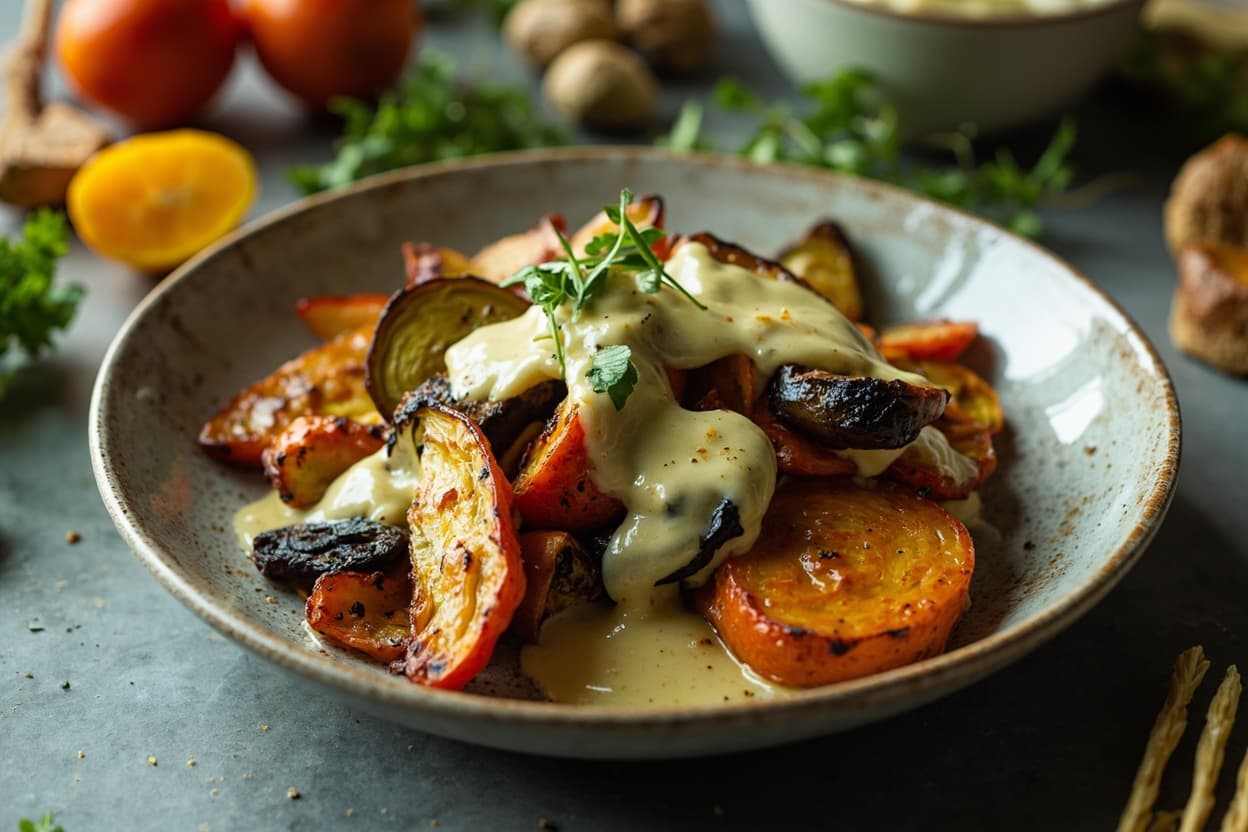
Crispy roasted vegetables bathed in a bold, emulsified garlic toum — because plain roasted vegetables are just vegetables waiting for permission to matter.

Prep
20 min
Cook
30 min
Total
50 min
Method
Build the Toum
1
With a mortar and pestle or in a food processor, pound the garlic cloves with salt into a smooth, fragrant paste.
3
Pour in the olive oil very slowly — drop by drop at first — while whisking vigorously or processing continuously to build the emulsion.
4
Continue adding oil in a thin stream until the toum becomes thick, white, and fluffy, like a cloud that happened to become delicious. Set aside.
Roast the Vegetables
5
Cut all vegetables into rough, mouth-friendly chunks — no need to be precious about size, just keep them similar so they roast evenly.
6
Toss the vegetables with olive oil, salt, and black-pepper on a large baking sheet until everything is glistening and coated.
7
Roast for 25-30 minutes, tossing halfway through, until the edges are caramelized and tender. You want color, not sadness.
Bring It Together
8
In a wide serving bowl or directly on a brass tray, spoon a generous pool of toum — this is not the time for restraint.
9
Heap the hot roasted vegetables on top and let the toum melt and swirl into the vegetable crevices.
A
Nutri-Score
Excellent balance
A–E · lower is better · score -3
Calories
611
per serving
Low sugar · 11g
Protein
6g
Carbs
35g
Fat
52g
Sat. fat
8g
Fiber
8g
Sugar
11g
Sodium
1119mg
Gluten FreeDairy FreeEgg FreeNut FreeHeart HealthyAnti InflammatoryLow Protein
Nutri-Score is a general nutritional-balance guide, not medical or dietary advice.
B
Environmental impact
Low impact
A–E · lower is better · includes estimates
kg CO2e
0.6
per serving
BCarbonAEU all-round· carbon sets the grade
Water
1.7m³
Land
41Pt
Runoff
0.08g P
olive-oil drives 36% of this recipe’s estimated footprint.
Carbon from Poore & Nemecek 2018; water, land & runoff from Agribalyse — modelled averages for comparing recipes, not a measurement of your groceries.
Flavor Profile
6
Umami
4
Sweet
5
Salty
3
Sour
1
Bitter
3
Spicy
Textures
CrispyTenderCreamy
Aromas
GarlickyHerbalRoasted
Kitchen Equipment
Techniques
Safety & Storage
High Risk Population
Toum contains raw garlic which poses a higher risk for young children, elderly individuals, and immunocompromised persons. Consider using roasted garlic instead for these populations.
Storage
Toum is a garlic-oil emulsion and is a high-risk food for bacterial growth. Store refrigerated in an airtight container for up to 1 week. Do not leave at room temperature for more than 2 hours.
Cross Contamination
Thoroughly sanitize all equipment (mortar/pestle, food processor, cutting boards) used for raw garlic before contact with other ingredients to prevent cross-contamination.
Handling
Add lemon juice to toum immediately before serving and keep refrigerated until service. The acid helps stabilize the emulsion and retards bacterial growth.
Cooking Temperature
Ensure vegetables are roasted at 400°F minimum to achieve proper caramelization and reduce surface bacteria. Internal vegetable temperature should reach at least 135°F.
Pro Tips
Technique
Pour your olive oil into the toum like you are threading a needle — slowly, steadily, with purpose. Rush it and your emulsion breaks, your toum weeps oil, and you cry into your roasted vegetables. I have seen it. The oil must be at room temperature and you must be patient, or go home.
Substitution
If you find yourself without a lemon, a splash of white wine vinegar will keep you in the game — but barely. The lemon is not optional in my grandmother's house, and it is not optional in mine. Find the lemon. Your vegetables are waiting to be rescued.
From the chef
Toum is what happens when garlic stops being a supporting player and takes the whole stage — built drop by patient drop of olive oil into an emulsified, cloud-white sauce that is bold, bright with lemon, and completely in charge. These roasted vegetables — potato, carrot, bell pepper, zucchini, onion, tomato — get their caramelized edges and then surrender entirely to it. You spoon a generous pool of toum into the bowl first, heap the hot vegetables on top, and let it melt into every crevice. Bring bread. Bring more bread. There is no such thing as too much toum on the table.
TagsGarlic ForwardRoasted VegetablesToum SauceVegetarianCommunal EatingMediterranean
Source: generated · June 9, 2026