 French
Easy · Hot
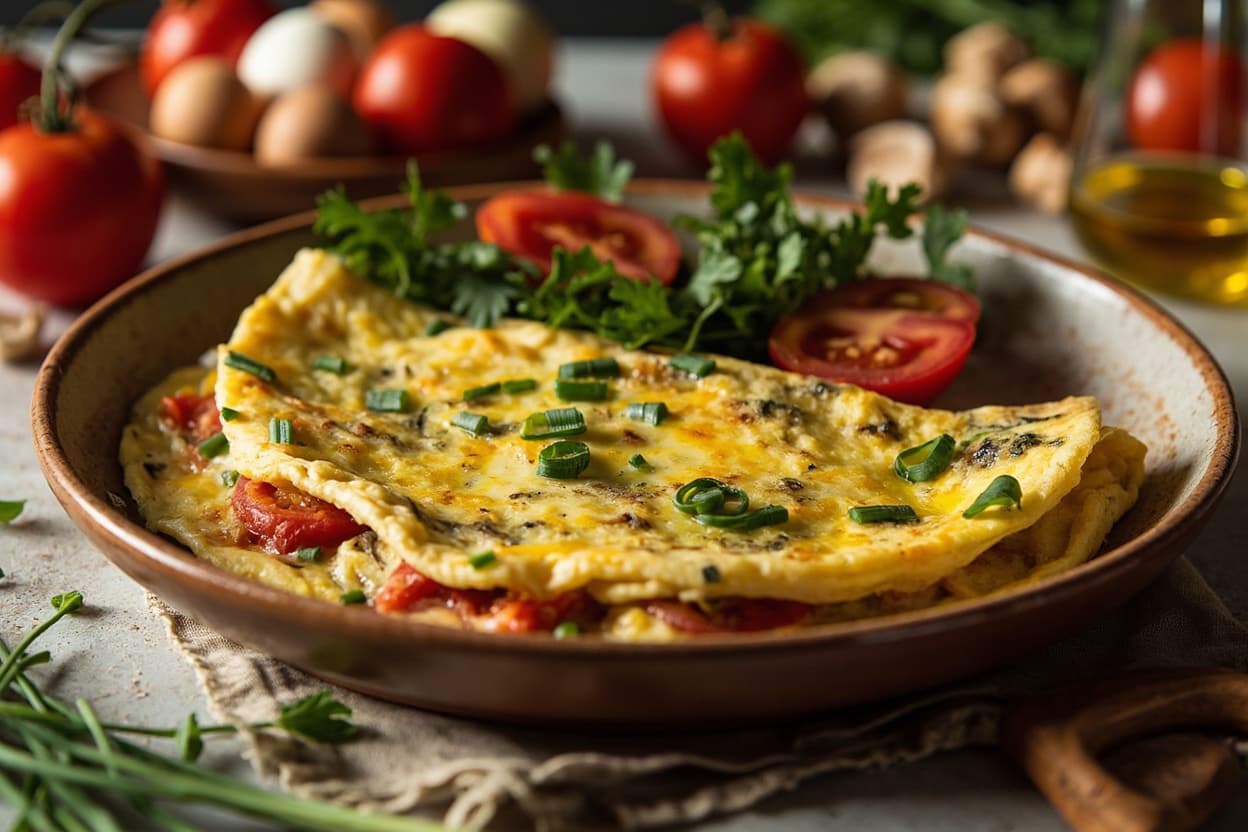
Herb Omelette with Tomato and Chives
Eggs beaten just enough, folded over a handful of parsley and chives in a pan slicked with olive oil — the kind of omelette that takes less time to make than to describe. Tomato, sliced and laid alongside, brings sweetness and a little acid. This is a midday kitchen meal, unpretentious and satisfying, the sort Margaux would eat standing at the counter between tasks.

Prep
10 min
Cook
15 min
Total
25 min
Method
Prepare the herbs and tomatoes
1
Make the herbed egg mixture
3
Crack the eggs into a bowl and add the heavy cream, the reserved chives, chopped parsley, thyme leaves, a pinch of salt, and a grind of black pepper. Whisk together with a fork until the eggs are well combined and slightly frothy.
Cook the tomato filling
4
Cook the omelette
6
7
Using a spatula, gently draw the set edges toward the centre, tilting the pan to let the raw egg flow to the open spaces. Continue this slow, patient movement for 2–3 minutes until the omelette is nearly set. Continue cooking until the surface is completely set with no glossy or runny portions remaining, or until an instant-read thermometer reads 160°F (71°C).
8
Dot the remaining butter around the edges of the omelette and fold it in half. Let it cook another 30 seconds, then fold again into a thick, soft parcel. Slide onto a warm plate.
To finish and serve
9
Spoon the warm tomato filling generously over the folded omelette, letting the juices run down the sides.
B
Nutri-Score
Good balance
A–E · lower is better · score 2
Calories
486
per serving
Source of protein · 22gLow sugar · 5gLow salt · 307mg
Protein
22g
Carbs
9g
Fat
41g
Sat. fat
14g
Fiber
2g
Sugar
5g
Sodium
307mg
Gluten FreeLow CarbLow SugarHeart HealthyDiabetes FriendlyWeight ManagementHigh ProteinBalanced Fat
Nutri-Score is a general nutritional-balance guide, not medical or dietary advice.
C
Environmental impact
Moderate impact
A–E · lower is better · includes estimates
kg CO2e
1.2
per serving
CCarbonAEU all-round· carbon sets the grade
Water
0.6m³
Land
41Pt
Runoff
0.1g P
large eggs drives 58% of this recipe’s estimated footprint.
Carbon from Poore & Nemecek 2018; water, land & runoff from Agribalyse — modelled averages for comparing recipes, not a measurement of your groceries.
Flavor Profile
5
Umami
4
Sweet
4
Salty
3
Sour
2
Bitter
0
Spicy
Textures
TenderSoftSilkyCreamy
Aromas
HerbalGarlickyFruityEarthy
Kitchen Equipment
Primary Tool
20cm SkilletCounter FootprintSmall
Safety & Storage
Cooking Temperature
Cook eggs until fully set with no glossy liquid remaining. Use thermometer to verify eggs reach 160°F (71°C) minimum when cooking for high-risk individuals.
High Risk Population
Pregnant women, young children, elderly, and immunocompromised individuals should only consume fully cooked eggs. Avoid recipes where eggs remain runny or underdone.
Handling
Crack eggs individually into a clean bowl before combining. Discard any eggs with cracked shells or unusual odor. Refrigerate eggs below 40°F (4°C) until ready to use.
Cross Contamination
Use separate cutting boards for raw eggs and fresh herbs. Sanitize all utensils and surfaces that contact raw eggs before using for ready-to-eat ingredients.
Storage
Refrigerate leftovers promptly within 2 hours of serving. Consume within 2 days when stored below 40°F (4°C). Reheat to 165°F (74°C) before eating.
Allergen Warning
This dish contains eggs and dairy (butter, cream). Verify all ingredient substitutions are allergen-free if serving to individuals with food allergies.
Pro Tips
Technique
The secret to a truly soft omelette is patience and low heat — let the eggs set slowly, drawing the edges toward the center and tilting so the raw mixture flows to the open pan. Rushing means rubbery eggs, and we are never in a hurry in Provence.
Substitution
If chervil or tarragon is what you have in the garden, use them instead of the parsley — the omelette welcomes whatever is fresh and fragrant.
From the chef
Soft eggs folded around chives and thyme, crowned with a warm tangle of garlicky tomatoes — this is an omelette that carries the garden in every bite. The herbs perfume the egg gently from inside, while the tomatoes cook down into a loose, fragrant sauce that pools over the fold and runs into the plate. It is the kind of midday meal that asks nothing of you except good olive oil and ripe fruit. Sometimes the simplest things are simply the best, and this is one of them.
TagsRemove Provencal
AllergensEggsMilk
Source: generated · May 30, 2026