Natural form
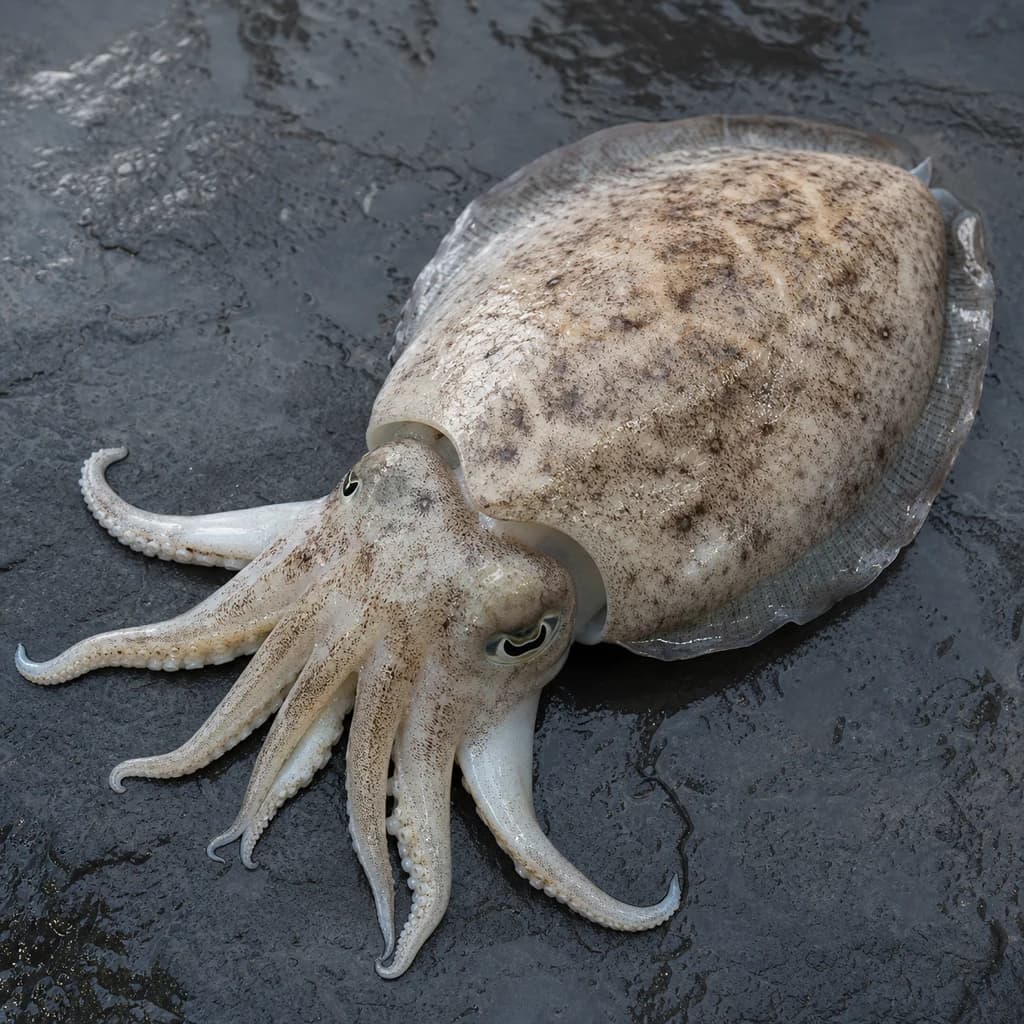
A whole fresh cuttlefish showing its pale mantle, tentacles, and distinctive W-shaped pupils.
Shows the reader exactly what a whole cuttlefish looks like before any preparation, including its defining physical features that distinguish it from squid.
Proteins
Cuttlefish (Seppia)
Tender cephalopod with sweet meat; its ink colors and flavors rice and pasta.
Cuttlefish is a cephalopod with firm, sweet white flesh similar to squid but meatier. It is grilled, braised, or stewed in Mediterranean cooking, and its black ink colors and seasons dishes like risotto al nero and squid-ink pasta. Quick high-heat cooking or long braising keeps it tender; in-between cooking turns it rubbery.
Cuttlefish (Sepia officinalis) is a cephalopod mollusk distinguished from its more common cousin, the squid, by an internal chalky plate called the cuttlebone, a thicker mantle, and notably sweeter, more delicate flesh. Found throughout the Northeast Atlantic, Mediterranean, and North Sea, it has been a staple of coastal Mediterranean, Dalmatian, and Venetian cuisines for centuries. Its mild, briny sweetness and tender texture—particularly in specimens under 500 grams—make it one of the most prized cephalopods for the table. The cuttlefish occupies a culinary middle ground between squid and octopus: more tender and subtly flavored than squid, yet quicker-cooking and less assertive than octopus.
The cuttlefish's most distinctive culinary asset is its ink sac, which yields 2–3 milliliters of rich black liquid per specimen. This ink—nero di seppia—is both a natural colorant and a deeply savory, slightly saline flavoring agent treasured in Venetian and Adriatic cooking. The ink has anticoagulant properties in its raw state, but this presents no concern in cooking. Unlike squid, which has a long, streamlined mantle, cuttlefish have a broader, rounder body with prominent fins running the length of the mantle and eight shorter arms plus two longer tentacles.
Cleaning cuttlefish requires attention but is straightforward: separate the head and tentacles, extract the innards while preserving the ink sac, remove the internal cuttlebone, and strip away the thin purple membrane. After cleaning, expect approximately 60–70 percent edible yield. The tentacles, fins, and mantle are all excellent eating, with the fins being particularly prized in Italian cuisine for their buttery texture. Fresh cuttlefish spoils quickly—use within one to two days, stored on ice in the refrigerator's coldest section.
- Measured in
- g
- Storage
- Fridge
Allergens
Types & varieties
Common cuttlefish; primary species in Mediterranean and Atlantic cuisine. Sweetest and most prized for the table.
Giant Australian cuttlefish; larger size, firm texture, excellent for grilling. Peak season June–August during spawning aggregation at Whyalla.
Elegant cuttlefish; smaller, more delicate, common in French and Spanish Atlantic cooking.
Pink cuttlefish; found in Mediterranean and Atlantic. Firm flesh, frequently used in Spanish cuisine.
Most cuttlefish in commerce are wild-caught. Farmed production is growing in China and Italy, producing a milder-flavored product.
Cuttlefish vs. Squid: Knowing the Difference
In English markets, cuttlefish and squid are frequently confused, but they are distinct genera with different culinary properties. True cuttlefish (Sepia) have an internal cuttlebone—a thin, white, chalky plate—that squid lack entirely. The cuttlefish mantle is broader and rounder, edged with prominent fins, while squid have a more streamlined, torpedo-shaped body. Cuttlefish meat is sweeter and more delicate; squid has a slightly firmer bite and more pronounced sea flavor. In Italian, seppia always refers to true cuttlefish while calamaro means squid. The two inks are interchangeable in cooking, but the textures are not: squid holds up better to extended cooking in stews, while cuttlefish excels in quick-cooked preparations where its tenderness can shine.
- Cuttlefish: internal cuttlebone, broader mantle, sweeter meat, tender texture
- Squid: no cuttlebone, streamlined body, firmer texture, more assertive flavor
- Ink is interchangeable between the two species
Working with Cuttlefish Ink
Fresh cuttlefish ink is a culinary treasure that elevates risotto, pasta, sauces, and even aioli. When extracting ink from a cleaned cuttlefish, pierce the ink sac carefully and strain the liquid through a fine-mesh sieve to remove any membrane fragments. Add fresh ink to dishes in the final 2–3 minutes of cooking—excessive heat degrades its delicate flavor and causes it to thicken and clump. Commercial bottled cuttlefish ink is a reliable alternative and is widely available at specialty food shops and online. The ink adds an intensely savory, slightly saline quality along with its dramatic black color. Some chefs add a small amount to seafood stocks for depth without affecting appearance.
- Strain fresh ink through fine-mesh sieve to remove membrane
- Add to dishes in last 2–3 minutes of cooking to preserve flavor
- Commercial bottled ink is a reliable substitute for fresh
Common uses
Tips & pitfalls
- Clean cuttlefish the same day you buy it: separate the head and tentacles, pull out the innards including the ink sac (set aside the ink), remove the cuttlebone, and peel off the thin purple membrane.
- Score the mantle with a crosshatch pattern (diamond cuts) before cooking—this prevents curling and helps heat penetrate evenly for uniform cooking.
- For tender results: cook small cuttlefish (under 20 cm) quickly, 1–2 minutes per side over high heat; braise larger ones low and slow for 30–45 minutes until fork-tender.
- For grilling whole small cuttlefish, blanch first for 30 seconds in boiling salted water, then pat dry and grill 2–3 minutes per side over high heat—this firms the flesh and prevents sticking.
- Do not discard the tentacles or fins—they have excellent flavor and texture; the fins are particularly prized in Italian cuisine for their buttery quality.
- Common mistake: overcooking, which turns cuttlefish rubbery. Remove from heat the moment the flesh turns uniformly opaque throughout.
- Store fresh cuttlefish on ice in the coldest part of the refrigerator, never frozen, for best texture. If freezing is necessary, blanch briefly first to preserve quality.
- The cuttlebone itself can be ground and added to seafood stocks for its mineral content—a rare but legitimate use in Mediterranean cooking.
Nutrition
Energy
331 kJ · per 100 g
Where the calories come from
Protein
16.2g
32% DV
Carbs
0.8g
0% DV
Fat
0.7g
1% DV
Fiber
0g
0% DV
Sodium
372mg
16% DV
Source · USDA FoodData Central · approx. Mollusks, cuttlefish, mixed species, raw
View on FDC →In the shops
Matched grocery products
No matched grocery products for Cuttlefish (Seppia) yet.
Good to know
- Scientific Name
- Sepia officinalis (common cuttlefish)
- Class
- Cephalopoda (mollusk family)
- Native Region
- Northeast Atlantic, Mediterranean Sea, North Sea
- Flavor
- Sweet, briny, mild; more delicate than squid or octopus
- Texture
- Tender when young (under 500 g); turns rubbery if overcooked
- Key Identifier
- Internal cuttlebone (thin white chalky plate) must be removed during cleaning
- Ink Yield
- 2–3 ml per specimen; ink sac is a prized culinary ingredient
- Edible Yield
- 60–70% after cleaning; tentacles and fins are all excellent eating
- Refrigerated Shelf Life
- 1–2 days fresh; up to 3 months frozen (blanch first)
Substitutes
- Squid (calamari) — Similar texture and mild sweetness; cook slightly longer than cuttlefish as it is more prone to toughening. Ink can be used interchangeably.
- Small octopus — Firmer, slightly more assertive flavor; requires longer cooking (30–45 minutes braised) to achieve tenderness. Not suitable for quick-cooked preparations.
- Frozen squid rings — Acceptable in a pinch for stews and braises; lack the sweetness and tenderness of fresh cuttlefish.
Pairs with
Also called
Seppia
Appears in these dishes
Related

Egg
The kitchen's everything ingredient — bind, leaven, enrich, or fry

Chicken Breast
Lean, quick-cooking white meat for everyday dinners

Ground Beef
Versatile minced beef for burgers, ragù, tacos, and meatballs

Pork Loin
Lean, tender roasting cut that stays juicy with care

Salmon
Rich, rosy fish that roasts, grills, or cures beautifully

Egg White
Pure protein that whips to airy peaks for meringue and more

Egg Yolk
Rich, golden yolk for custards, mayonnaise, and pasta

Quail Egg
Tiny, speckled eggs for garnishing and elegant bites