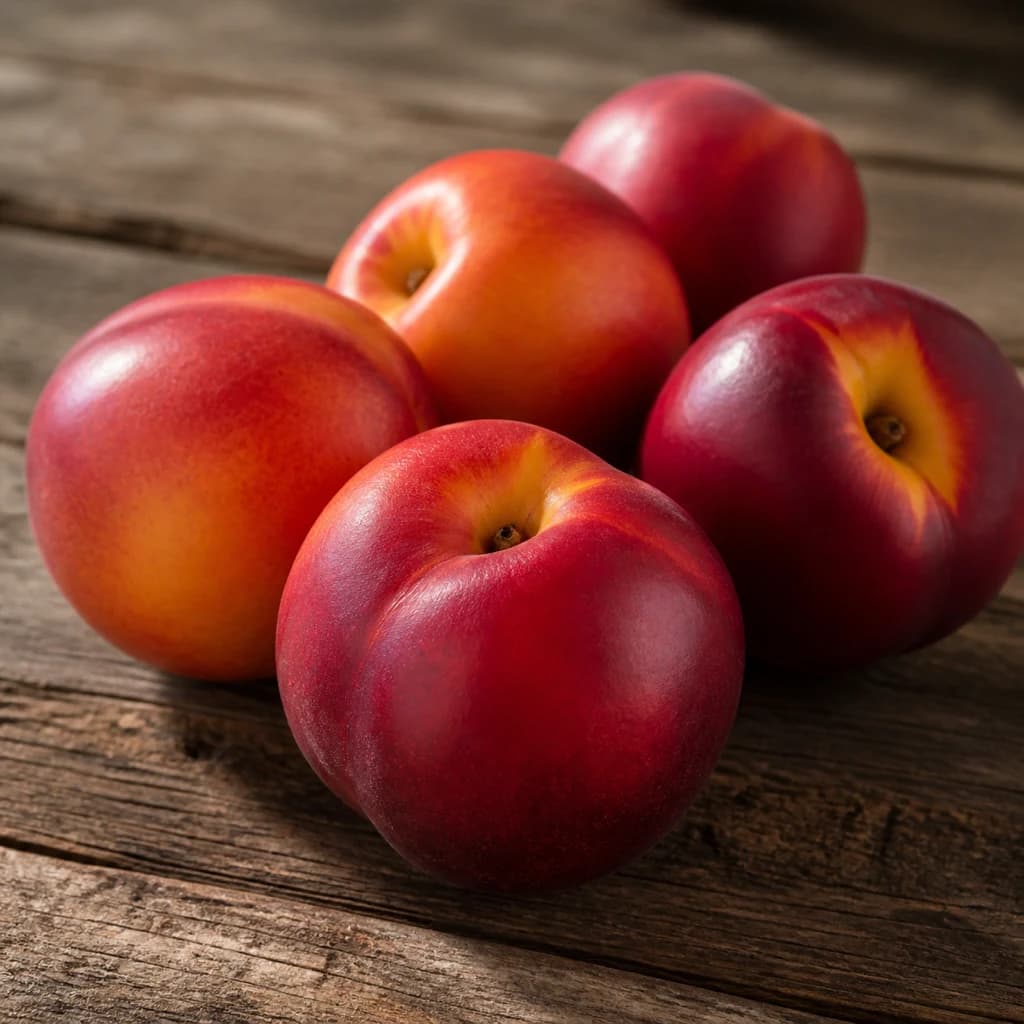
Natural form
Whole nectarines showing smooth, fuzz-free skin with deep red-orange blush.
Establishes the defining visual trait — smooth skin with vivid blush coloring — that distinguishes nectarines from peaches at a glance.
Produce
Nectarine
Smooth-skinned stone fruit, like a peach without fuzz, eaten fresh or grilled.
The nectarine is a smooth-skinned variety of peach with firm, juicy, sweet-tart flesh and no fuzz. It is eaten fresh, sliced into salads, grilled, or baked into tarts, crisps, and galettes. Both yellow-fleshed and white-fleshed types exist, and the fruit may be clingstone or freestone.
Nectarine is a variety of peach (Prunus persica var. nucipersica) distinguished by smooth skin rather than fuzz, the result of a recessive gene. The smooth skin offers a practical advantage over peaches for presentation purposes and makes the fruit easier to handle in the kitchen, though it also makes nectarines slightly more prone to bruising and more susceptible to brown rot during storage. The flavor profile matches the classic peach—sweet-tart, juicy, and aromatic—with flesh that ranges from firm and tangy in yellow varieties to honey-sweet and tender in white varieties. Nectarines cross-breed easily with peaches, meaning a tree grown from a peach pit may produce nectarines and vice versa. The fruit's name likely derives from "nectar," the mythological drink of the gods, a fitting tribute to its concentrated sweetness when fully ripe. Nearly all commercial nectarines in the United States are clingstone varieties grown for fresh market, while freestone varieties are primarily for home gardens and processing.
- Measured in
- piece
- Storage
- Fridge
Types & varieties
Firm, tangy-sweet flesh; freestone varieties like 'Fantasia,' 'Gold Mine,' and 'Flavortop' hold shape well for grilling and baking; most common commercial type
Lower acidity with honey-sweet flavor; varieties include 'Arctic Jay,' 'Snow King,' 'White Sun'; softer, more delicate texture makes them best eaten fresh rather than cooked
Distinctive flattened shape; available in white or yellow; very sweet with concentrated flavor; delicate skin bruises easily; increasingly found at farmers' markets
Common uses
Tips & pitfalls
- Select nectarines that give slightly to palm pressure at the shoulder; avoid fruit with green patches indicating underripeness or wrinkled skin signaling overripeness
- Ripen firm nectarines at room temperature in a single layer, never stacked, to prevent bruising of the smooth skin
- Refrigerate only fully ripe nectarines; cold temperatures irreversibly damage underripe fruit, leaving it hard and flavorless
- Wash fruit immediately before eating, not before storage, because surface moisture accelerates spoilage
- For grilling, halve and remove the pit, then grill cut-side down 2–3 minutes until caramelized; resist moving the fruit until ready to flip
- When baking, choose slightly underripe specimens for better structure retention; overripe nectarines collapse into mushy filling
- Blanch briefly in boiling water and shock in ice water to slip off skins cleanly for tarts, jams, or any recipe requiring skinless fruit
- To freeze, arrange sliced nectarines on a sheet pan until solid, then transfer to freezer bags; thawed texture softens considerably, making frozen fruit best for smoothies and baked goods where structure matters less
- The flesh oxidizes and browns slowly when exposed to air; a squeeze of lemon juice delays this if you're prepping ahead
Nutrition
Energy
184 kJ · per 100 g
Where the calories come from
Protein
1.1g
2% DV
Carbs
10.6g
4% DV
Fat
0.3g
0% DV
Fiber
1.7g
6% DV
Sugars
7.9g
of which
Sodium
0mg
0% DV
Source · USDA FoodData Central · Nectarines, raw
View on FDC →In the shops
Matched grocery products
No matched grocery products for Nectarine yet.
Good to know
- Scientific Name
- Prunus persica var. nucipersica (subsp. persica)
- Origin
- China; natural mutation of peach; California commercial production began early 20th century
- Peak Season
- Late June through August (Northern Hemisphere)
- Primary Producers
- China (world's largest), United States (California produces 95% of US crop), Italy, Spain, Greece
- Flesh Type
- Freestone (flesh separates easily from pit) or Clingstone (flesh adheres to pit)
- Color
- Yellow-fleshed (most common, tangy-sweet) or white-fleshed (sweeter, lower acid)
- pH Range
- 3.4–4.0 (moderately acidic)
- Sugar Content
- 10–15° Brix when ripe
- Shelf Life
- Unripe: 2–3 days room temperature; Ripe: up to 5 days refrigerated
Substitutes
- Peach — Nearly identical flavor and texture; peaches have fuzz but this doesn't affect cooked applications; use 1:1 ratio in any preparation
- Plum — Tarter and firmer with different textural qualities; acceptable in desserts, salads, and jams; freestone vs. clingstone distinction means different pit-removal technique
- Apricot — Smaller and more acidic; works in preserves and baked goods; reduce quantity by one-third due to size difference
- Blood Orange Segments — Provides color contrast in fresh salads; flavor is more citrus-forward and less sweet; acceptable when nectarines are out of season
Pairs with
Also called
Nectarines
Related

Tomato
Juicy, sun-sweet fruit for sauces, salads, and slow-cooked depth

Yellow Onion
The aromatic backbone of soups, sofritos, and braises

Garlic
Pungent cloves that perfume nearly every savory dish

Lemon
Bright, acidic citrus that wakes up almost any dish

Potato
Humble, hearty staple — roast, mash, fry, or boil

Carrot
Sweet, crunchy root — raw, roasted, or the base of a sofrito

Cucumber
Cool, crisp, and watery — for salads, pickles, and tzatziki

Lettuce
Crisp leaves for salads, wraps, and a fresh crunch