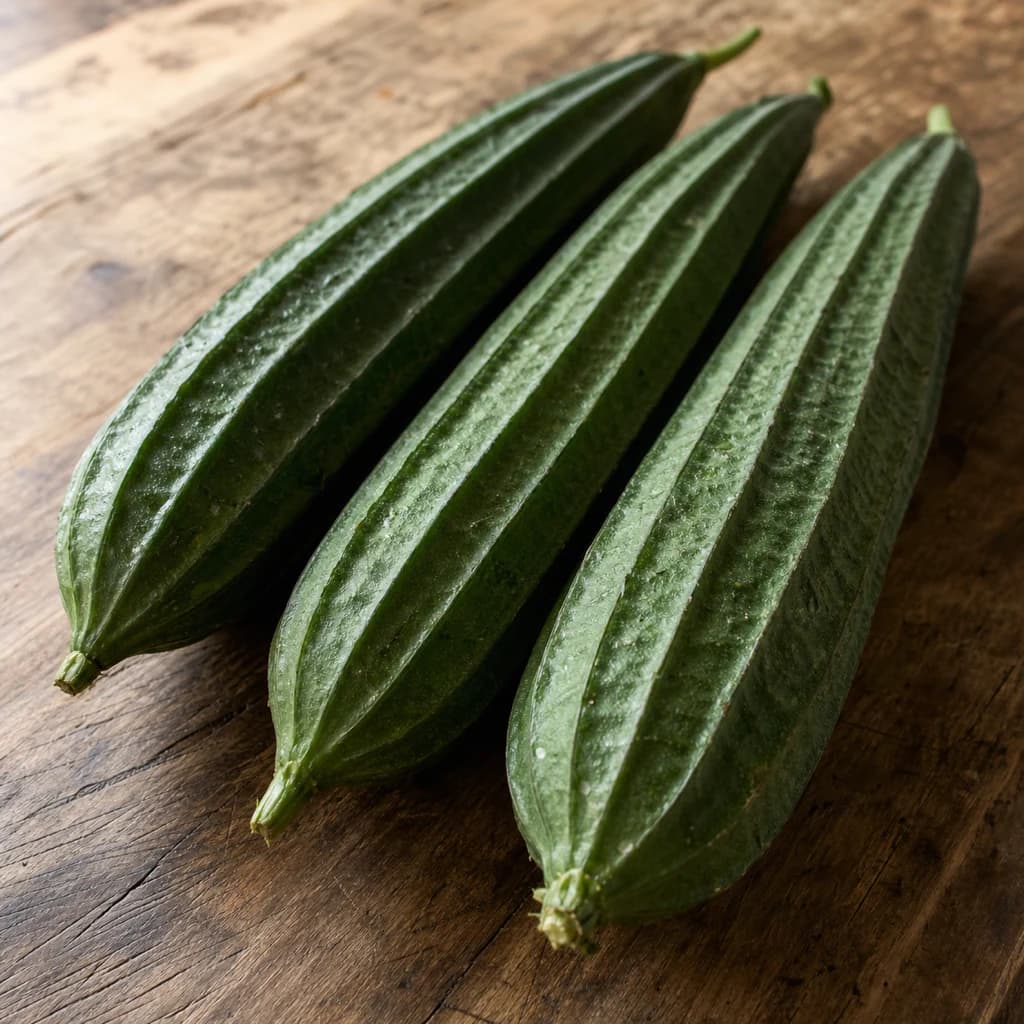
Natural form
Whole ridge gourds showing the sharp lengthwise ridges and dark green skin.
Teaches the reader the distinctive ridged exterior and elongated shape that makes ridge gourd unmistakable among gourds.
Produce
Ridge Gourd
Long ridged green gourd, peeled and cooked into mild South Asian curries.
Ridge gourd is a long dark-green vegetable with sharp lengthwise ridges and soft, spongy white flesh inside. The tough ridged skin is peeled before the gourd is cubed and cooked into mild Indian curries, dals and stir-fries, where it turns tender and absorbs spices. It has a delicate, slightly sweet flavor when young.
Ridge gourd is a warm-weather vegetable prized across South Asia for its mild, slightly sweet flavor and ability to absorb bold seasonings while retaining a pleasant tender-yet-firm texture. The distinctive longitudinal ribs running the length of the gourd give it both its name and a structure that cuts into attractive cross-sections. In Indian cuisine alone it appears in over a dozen regional preparations, from the coconut-laden kootu of Tamil Nadu to the masala subzi of North India, demonstrating its remarkable versatility.
The vegetable is harvested young, when the skin is tender enough to peel but still thin enough to manage easily, and the seeds are small and undeveloped. At this stage the flesh has a clean, neutral character similar to zucchini but with a slightly firmer bite and a faint vegetal sweetness that prevents it from tasting bland. As ridge gourd matures, the flesh becomes spongy and the seeds enlarge and toughen—a mature gourd is still useful but belongs to entirely different preparations like chutneys rather than cooked vegetable dishes. In Ayurvedic tradition, ridge gourd is considered cooling and light, making it a natural choice for summer meals alongside other gentle vegetables.
Ridge gourd (Luffa acutangula) and smooth luffa (Luffa cylindrica) are two distinct species in the Luffa genus. Smooth luffa, when harvested young, is also edible and resembles ridge gourd in flavor and texture. Mature smooth luffa develops the fibrous skeletal structure used as a natural sponge. The two species look similar in cross-section, which explains the occasional market confusion and the nickname "Chinese okra" that appears in some specialty produce contexts. When selecting ridge gourd, choose firm specimens with bright green color and tight, unblemished ridges; any yellowing indicates the gourd is moving past its prime and will cook differently—less sweet, more fibrous, with a softer, less structured result.
- Measured in
- piece
- Storage
- Fridge
Types & varieties
Most common variety; bright green with deep ridges, tender when young, mild flavor that takes on spices well
Elongated variety reaching up to 50 cm; particularly popular in North Indian cooking and stuffed preparations
Hybrid varieties bred for disease resistance and higher yield; taste and texture are comparable to traditional cultivars
Left to ripen fully; flesh becomes spongy and fibrous, unsuitable for curry but excellent for chutneys and traditional preparations in South India
Understanding Maturity
The single most important factor in cooking ridge gourd is selecting it at the right stage of maturity. Young ridge gourd—typically 15–25 cm long—has thin, pliable skin that peels easily, small seeds with no developed pulp, and flesh that holds its shape when cooked while becoming pleasantly tender. A mature ridge gourd (30 cm or longer) develops a thicker, tougher skin, large hard seeds, and flesh that becomes spongy and waterlogged in the pan.
You can identify a young ridge gourd by pressing gently: it should feel firm with no give, and the ridges should be tight and close together. The skin should be uniformly green without any yellowing, and there should be no soft spots. If the gourd feels heavy for its size, it has likely developed more water content than is desirable. For most cooked preparations, young is better. Reserve mature gourds specifically for chutney-making or traditional preparations that call for the fibrous texture.
- Young: firm, bright green, tight ridges, small seeds—use for curries, stir-fries, kootu
- Mature: longer, yellowing skin, large seeds, spongy flesh—reserve for chutneys only
- Avoid any gourd with soft spots, yellow patches, or that feels heavy and waterlogged
Preparation Technique
Proper prep work takes only a few minutes but makes the difference between a successful dish and a mushy one. First, wash the gourd thoroughly under cold running water, scrubbing gently to remove any residual soil or waxy coating from the skin. The ridges themselves can trap dirt.
Using a vegetable peeler or sharp knife, remove the skin entirely—this is non-negotiable even on young gourds, as the skin retains its structure and becomes unpleasant in the finished dish. Halve the gourd lengthwise, then use a spoon or the edge of a spoon to scrape out the seed cavity and the soft, spongy pulp surrounding the seeds. In very young specimens, the seeds may be tiny and soft enough to ignore, but it's still worth removing the pulp to prevent the dish from becoming watery.
Cut the prepared flesh into uniform pieces: 1–2 cm cubes for stews and curries, or 1 cm thick rounds for stir-fries. Uniformity matters more than shape—consistent size ensures even cooking and prevents some pieces from turning mushy while others remain underdone.
- Always peel—the skin never softens adequately during cooking
- Remove the seed cavity and surrounding pulp to prevent excess water
- Cut into uniform pieces for even cooking; inconsistent sizes cause uneven results
- Work quickly once cut—use within 1–2 days for best texture
Common uses
Tips & pitfalls
- Select firm, blemish-free gourds with bright green color and tight ridges; avoid any with soft spots, yellowing, or that feel heavy and waterlogged
- Always peel ridge gourd—the skin remains tough even after prolonged cooking and will ruin texture
- Remove seeds and the spongy pulp around them; in very young specimens seeds are tiny and nearly edible but the pulp still adds unwanted water
- Cut into uniform pieces for even cooking; smaller cubes cook faster and hold shape better than large chunks
- Cook quickly over medium-high heat to retain texture; overcooking produces mushy, waterlogged results with no structural integrity
- Season generously—ridge gourd's mild flavor needs bold seasoning to shine; under-seasoned ridge gourd tastes flat
- Add a squeeze of lemon or tamarind toward the end of cooking to brighten the dish and balance the mild sweetness
- When using in kootu, add the gourd after the dal is fully cooked; adding it too early causes the pieces to soften and break apart
- Pair with coconut, mustard seeds, and curry leaves for traditional South Indian flavor profiles that the vegetable was built for
- Store whole and unpeeled in the refrigerator for up to a week; once cut, use within 1–2 days for best quality
Nutrition
Energy
138 kJ · per 100 g
Where the calories come from
Protein
1.9g
4% DV
Carbs
7.5g
3% DV
Fat
0.2g
0% DV
Fiber
3.2g
11% DV
Sugars
1.5g
of which
Sodium
7mg
0% DV
Source · USDA FoodData Central · Okra, raw
View on FDC →In the shops
Matched grocery products
No matched grocery products for Ridge Gourd yet.
Good to know
- Scientific Name
- Luffa acutangula (angled ridge gourd)
- Family
- Cucurbitaceae (gourd family)
- Origin
- South Asia and Southeast Asia, cultivated for over 5,000 years
- Common Names
- Torai (Hindi), Peerkangai (Tamil), Beerakaya (Telugu), Jhinga (Bengali), Chinese okra, angled loofah
- Shape
- Cylindrical, 20–50 cm long, with 8–10 prominent longitudinal ribs/ridges
- Color
- Dark to light green when young; turns yellowish-tan when mature
- Flavor
- Mild, slightly sweet, neutral; absorbs accompanying flavors readily
- Peak Season
- Summer and monsoon in South Asia; year-round in tropical climates
- Edible Yield
- Approximately 65–70% after peeling and seeding
- Shelf Life
- 5–7 days refrigerated when firm and unblemished
Substitutes
- Bottle Gourd (Lauki/Doodhi) — Nearly identical mild flavor and cooking behavior; slightly softer texture overall; works well in North Indian preparations
- Zucchini — Comparable mild taste and similar cooking time; a reasonable Western substitute for stir-fries and sautéed preparations
- Chayote — Similar neutral flavor profile and firm-yet-tender texture when cooked; good one-to-one substitute in curries and stews
- Yellow Squash — Close in both texture and flavor; cook times are nearly identical; use in similar applications
- Bitter Gourd (Karela) — Only appropriate as a flavor contrast; texture and taste differ significantly and it will dominate the dish rather than blend in
Pairs with
Also called
Jhinga · Turai · Luffa · Chinese Okra
Related
Tomato
Juicy, sun-sweet fruit for sauces, salads, and slow-cooked depth
Yellow Onion
The aromatic backbone of soups, sofritos, and braises
Garlic
Pungent cloves that perfume nearly every savory dish
Lemon
Bright, acidic citrus that wakes up almost any dish
Potato
Humble, hearty staple — roast, mash, fry, or boil
Carrot
Sweet, crunchy root — raw, roasted, or the base of a sofrito
Cucumber
Cool, crisp, and watery — for salads, pickles, and tzatziki

Lettuce
Crisp leaves for salads, wraps, and a fresh crunch