 French
Medium · Warm
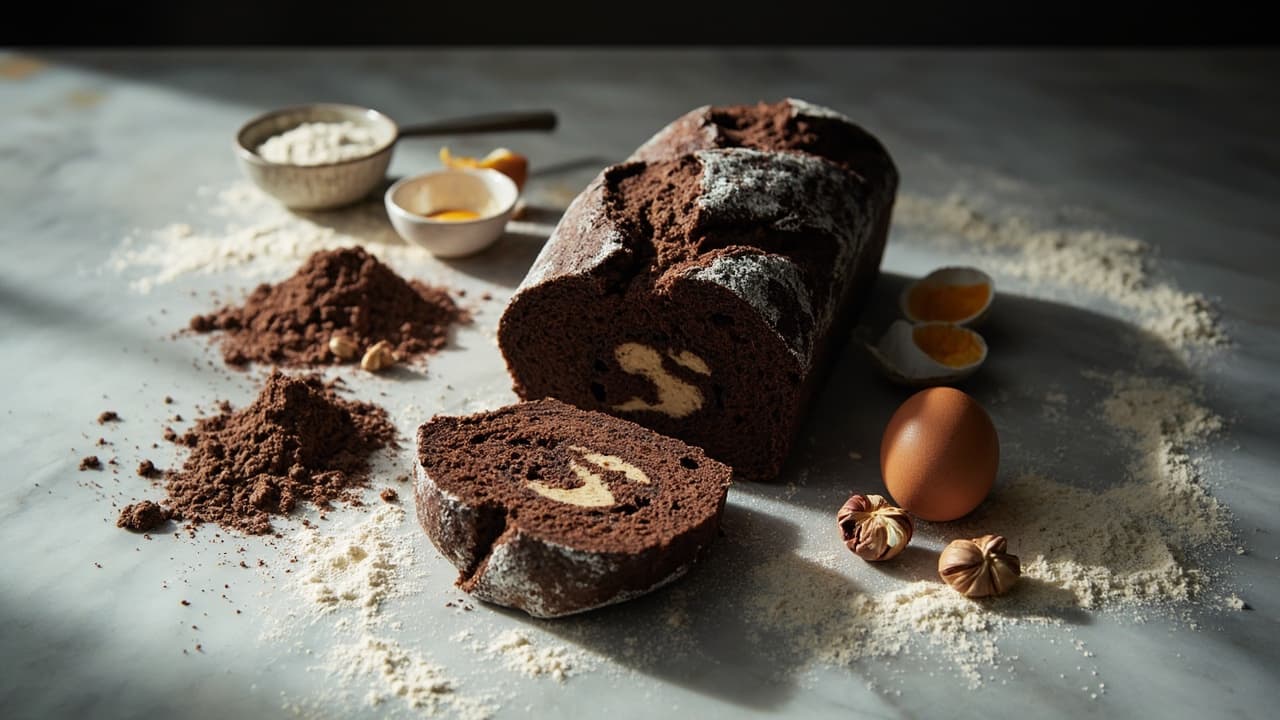
Dark Chocolate and Hazelnut Sourdough Loaf
A deep, richly flavored sourdough-style loaf with bittersweet cocoa and toasted hazelnuts woven through an open crumb. Cold-fermented for a complex, rounded sourness that lingers beautifully.

Prep
30 min
Cook
40 min
Rest
16h
Total
17h 10m
Method
Build the Levain
1
Combine the instant yeast and 60ml warm whole milk (about 37°C). Stir gently and let rest 5 minutes until the surface looks slightly frothy.
Mix the Dough
2
In a large bowl, whisk together the all-purpose flour, cocoa powder, and salt until evenly combined.
3
Add the levain mixture, remaining warm whole milk, softened butter, egg, and honey to the flour. Mix with a wooden spoon or stand mixer on low until a shaggy dough forms.
4
Turn the dough onto a clean surface and knead by hand for 10 minutes — or use a stand mixer on medium for 8 minutes — until smooth, elastic, and only slightly tacky. The dough should pass the windowpane test.
Bulk Fermentation with Stretch and Folds
5
Place the smooth dough in a lightly oiled bowl, cover with a damp cloth, and rest for 30 minutes (autolyse). The gluten will relax during this time.
6
Perform 4 sets of stretch and folds, one every 30 minutes, over the next 2 hours. To stretch and fold: grip one side of the dough, stretch it upward as high as it will extend without tearing, then fold it over the center. Rotate the bowl 90° and repeat three more times.
7
After the final fold, the dough should feel airy and show visible strength. The bulk fermentation is complete.
Add the Hazelnuts and Shape
8
Scatter the toasted hazelnuts over the fermented dough. Fold them in gently with a quarter fold, then a second quarter fold, until evenly distributed throughout.
9
On a lightly floured surface, shape the dough into a tight round boule by rolling the edges underneath with a bench scraper, building surface tension. The seam should be smooth and taut on top.
Cold Proof Overnight
10
Place the shaped dough seam-side up in a well-floured banneton or a bowl lined with a floured kitchen towel. Loosely cover with plastic wrap.
11
Refrigerate for 10–14 hours (overnight). The slow cold rise deepens the flavor and makes the dough easier to score before baking.
Bake
12
Place a Dutch oven with its lid on the middle rack and preheat the oven to 230°C for at least 45 minutes with the Dutch oven inside.
13
Carefully remove the hot Dutch oven. Tip the cold-proved dough from the banneton directly into the pot, seam-side down.
14
Brush the surface generously with the beaten egg wash. Score the top with a sharp lame or razor blade — a single confident arc or a cross works well.
15
Cover and bake for 25 minutes. The trapped steam creates a deep, caramelized crust. Remove the lid and bake a further 15 minutes uncovered until the loaf reads 95°C internal and the crust sounds hollow when tapped.
16
Transfer to a wire rack and resist cutting for at least 45 minutes. The crumb continues to set as it cools. Slice thick and serve warm.
B
Nutri-Score
Good balance
A–E · lower is better · score 2
Calories
756
per serving
Calorie-dense · 756 kcalSource of protein · 24g
Protein
24g
Carbs
107g
Fat
29g
Sat. fat
9g
Fiber
8g
Sugar
19g
Sodium
872mg
Nutri-Score is a general nutritional-balance guide, not medical or dietary advice.
C
Environmental impact
Moderate impact
A–E · lower is better · includes estimates
kg CO2e
1.1
per serving
CCarbonAEU all-round· carbon sets the grade
Water
0.4m³
Land
56Pt
Runoff
0.1g P
Cocoa Powder drives 42% of this recipe’s estimated footprint.
Carbon from Poore & Nemecek 2018; water, land & runoff from Agribalyse — modelled averages for comparing recipes, not a measurement of your groceries.
Flavor Profile
5
Umami
4
Sweet
5
Salty
4
Sour
6
Bitter
0
Spicy
Textures
CrispyTenderNuttyChewy
Aromas
CocoaNuttyCaramelizedYeasty
Kitchen Equipment
Primary Tool
Dutch OvenDutch OvenStand MixerWooden SpoonBench ScraperPastry BrushLadlePlastic WrapKitchen TowelBannetonParchment Paper
Counter FootprintMedium
Safety & Storage
Cooking Temperature
Bake at 230°C and ensure the loaf reaches 95°C internal temperature before removing from oven. The trapped steam from the covered Dutch oven is essential for proper crust development.
Handling
Use heat-resistant gloves when handling the Dutch oven at 230°C. The lid retains significant heat and can cause severe burns if touched directly.
Cross Contamination
Hazelnuts present a high cross-contamination risk for tree nut allergies. Clean all mixing bowls, stand mixer attachments, and baking surfaces thoroughly after handling hazelnuts before using for allergen-free preparations.
Storage
After cold proofing (10-14 hours at refrigerator temperature), the dough must be baked promptly. Do not leave cold-proved dough at room temperature for more than 30 minutes before baking.
High Risk Population
Raw flour contains potential bacteria and should not be consumed uncooked. This recipe requires proper baking to safe internal temperature. Young children, pregnant individuals, and immunocompromised persons should avoid tasting raw dough or batter.
Allergen Warning
This recipe contains milk, eggs, wheat (gluten), and tree nuts (hazelnuts). These allergens are present throughout multiple preparation stages and cannot be removed or reduced through cooking.
The cold fermentation step (10-14 hours) keeps dough at safe refrigerator temperatures. Ensure refrigerator maintains 4°C or below during overnight proofing to prevent bacterial growth.
Pro Tips
Technique
When you perform those stretch and folds, think of yourself as coaxing the dough to stand a little taller with each movement. The dough should feel alive under your hands—not fighting you, but responding. If it resists too sharply, let it rest five minutes and try again. The gluten needs those breaks to relax and strengthen properly.
Substitution
Don't have hazelnuts? Toasted almonds or walnuts work beautifully here, though they'll lend a different nuttiness. For a deeper chocolate punch, swap in a tablespoon of espresso powder alongside the cocoa—you won't taste the coffee, but it'll amplify every bittersweet note and make the chocolate sing.
Equipment
A Dutch oven is essential for trapping steam during the initial bake, creating that crackling caramelized crust you see on professional artisan loaves. No Dutch oven? Place a heavy baking sheet on the oven floor and pour a cup of boiling water into a pan when you close the oven door—the steam will still give you good oven spring and a respectable crust.
Time Saver
If 10-14 hours feels like too long to wait, you can cold proof for as little as 6-8 hours, but know that the sourness will be more gentle and the crumb slightly tighter. The long cold rise isn't just about flavor development—it also makes scoring the dough easier because the surface firms up beautifully.
Storage
This loaf keeps remarkably well at room temperature, wrapped in a clean kitchen towel for up to three days. The crust will stay crisp and the crumb stays soft. I like to slice it thick on the second day and toast the pieces lightly in a dry pan—the hazelnuts get all the more fragrant.
From the chef
I first baked this loaf on a grey November morning in Barcelona, when the market stalls were piled high with toasted hazelnuts and the air carried that unmistakable cold-ferment sweetness. This loaf isn't just dark chocolate and nuts—it's patience made tangible, the kind of bread that rewards you for letting time do its quiet work while you sleep. The Dutch oven does the heavy lifting for that shatteringly deep crust, and the cold overnight proof transforms what could be a simple sweet dough into something with real backbone and soul.
TagsArtisanSourdoughFermentedCocoaHazelnutDutch OvenCold FermentedOpen CrumbEnriched Dough
AllergensMilkEggsTree NutsWheat
Source: generated · June 10, 2026