 Japanese
Medium · Hot
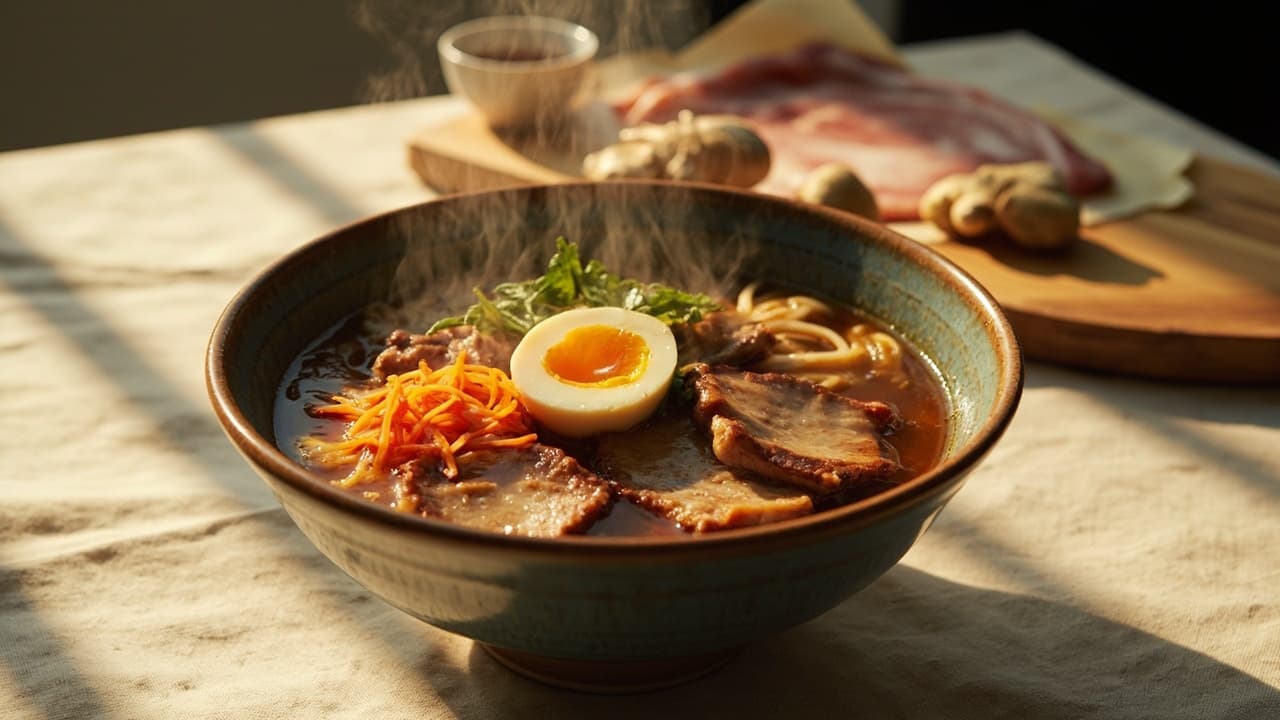
Slow-Braised Pork Belly Ramen with Soft-Boiled Egg
Tender pork belly braised for hours in a deeply savory soy-based glaze, served over silky ramen broth with a perfectly jammy soft-boiled egg. This is weekend cooking at its most meditative — patience transforms humble ingredients into something extraordinary.

Prep
15 min
Cook
3h
Rest
30 min
Total
3h 45m
Method
Braise the Pork Belly (Start 2.5 hours ahead)
1
Combine pork belly, soy sauce, brown sugar, water, garlic, ginger, and star anise in a heavy-bottomed pot. Bring to a gentle boil over medium-high heat.
2
Reduce heat to the lowest setting. Cover and braise for 90 to 120 minutes, turning the pork belly occasionally, until it is completely tender and yields easily to a fork.
3
Remove the pork belly and set aside. Strain and reserve the braising liquid. This glossy, intensely flavored sauce is your finishing glaze.
4
Slice the cooled pork belly into thick rounds, approximately 1 inch wide. Toss slices in the reserved braising liquid and marinate for at least 30 minutes to let the flavors deepen.
Prepare the Soft-Boiled Eggs
5
Bring a medium pot of water to a rolling boil. Carefully lower eggs into the boiling water using a spoon.
6
Cook for exactly 6 minutes and 30 seconds for a jammy, custard-like yolk with a tender white. Have an ice bath ready.
7
Transfer eggs directly to the ice bath. Rest for 5 minutes — this stops the carryover cooking and makes peeling effortless.
8
Gently tap each egg on the counter and roll to crack. Peel carefully and set aside. Halve just before assembly.
Build the Ramen Broth
9
In a large pot, combine chicken broth, soy sauce, and sesame oil. Add whole garlic cloves and fresh ginger slices.
10
Bring to a simmer over medium heat. Allow to gently bubble for 20 minutes, breathing in the fragrant steam. The broth should reduce slightly and meld into something far richer than its parts.
11
Strain out the garlic and ginger. Season with salt and black pepper. Keep at a low simmer until ready to serve.
Prepare Noodles and Vegetables
12
Cook spaghetti in a large pot of salted boiling water according to package directions, but stop 1 minute early — they will finish cooking in the hot broth. Drain immediately.
13
Slice mushrooms into thin rounds. Heat a splash of sesame oil in a skillet over medium-high heat. Sauté mushrooms for 5 to 7 minutes until golden and caramelized. Season lightly with salt. Set aside.
14
Using a vegetable peeler or sharp knife, cut carrots into thin julienne strips. Slice scallions on a bias into thin rounds, separating the white and green parts.
Assemble the Ramen Bowls
15
16
Divide the noodles equally among the bowls, nestling them into the broth.
17
Arrange braised pork belly slices standing upright around the bowl, exposing their glossy, lacquered surface. Place two egg halves, yolk side up, prominently visible.
18
Scatter sautéed mushrooms and julienne carrots across the top. Garnish with sliced scallions, using both white and green parts for layered flavor.
19
Drizzle each bowl with the remaining pork belly braising liquid for extra gloss and depth. Serve immediately while the broth is steaming and the egg yolk is still luminous.
D
Nutri-Score
Needs balance
A–E · lower is better · score 11
Calories
1275
per serving
High in saturated fat · 24gCalorie-dense · 1275 kcalLow sugar · 17g
Protein
34g
Carbs
97g
Fat
83g
Sat. fat
24g
Fiber
6g
Sugar
17g
Sodium
1681mg
High SodiumDiabetes CautionCardiovascular ConcernHigh ProteinComfort Food
Nutri-Score is a general nutritional-balance guide, not medical or dietary advice.
D
Environmental impact
High impact
A–E · lower is better · includes estimates
kg CO2e
2.1
per serving
DCarbon
Pork Belly drives 74% of this recipe’s estimated footprint.
Carbon from Poore & Nemecek 2018; water, land & runoff from Agribalyse — modelled averages for comparing recipes, not a measurement of your groceries.
Flavor Profile
9
Umami
4
Sweet
7
Salty
1
Sour
2
Bitter
3
Spicy
Textures
TenderSilkyChewyGlossy
Aromas
SavoryHerbalNuttyGarlickyMeaty
Kitchen Equipment
Primary Tool
Dutch OvenDutch OvenLarge StockpotMedium PotLarge Pot For NoodlesChef KnifeCutting BoardStrainerLadleSpoonVegetable PeelerMeasuring SpoonsMeasuring CupsIce Bath BowlAluminum FoilKitchen TowelTongs
Counter FootprintLarge
Techniques
Safety & Storage
Cooking Temperature
Soft-boiled eggs must be cooked for exactly 6 minutes 30 seconds at rolling boil to achieve safe jammy yolk while eliminating Salmonella risk.
Pork belly must braise until fork-tender; ensure braising liquid reaches simmering temperature throughout cooking to safely tenderize the meat.
All broth must be brought to a rolling boil and held at a simmer for at least 1 minute before serving to ensure safe serving temperature.
Cross Contamination
Use separate cutting boards and utensils for raw pork belly and ready-to-eat ingredients like soft-boiled eggs and vegetables.
Handling
Handle soft-boiled eggs gently during ice bath transfer and peeling; damaged eggs risk bacterial contamination and poor presentation.
Storage
Braised pork belly and ramen broth can be refrigerated separately in airtight containers for up to 4 days; reheat broth to boiling before serving.
Cooked spaghetti noodles should be used immediately or stored separately; they become gummy when refrigerated in broth longer than 24 hours.
High Risk Population
Eggs should be fully cooked and consumed immediately for immunocompromised individuals, pregnant women, young children, and elderly; runny yolks pose Salmonella risk for these groups.
Allergen Warning
This dish contains multiple allergens (eggs, soy, sesame, gluten); verify all diners have no allergies before serving and avoid cross-contact with allergen-free foods.
Pro Tips
Technique
The ice bath is non-negotiable — it stops the eggs from cooking the moment they leave the water, and that controlled rest is what creates that perfect custard-like yolk. When you peel them, do so gently under cool running water, and you will be rewarded with smooth, unblemished whites that hold their shape beautifully when halved.
Substitution
Fresh ramen noodles are ideal, but if you cannot find them, use fresh pappardelle or thick spaghetti instead — cook them one minute less than the package suggests, as they will continue to cook gently in the hot broth and you want them to retain that pleasant bite.
Noodle Substitution
Fresh ramen noodles contain kansui (alkaline minerals) that create the signature texture and flavor. If unavailable, substitute with fresh udon or fresh Chinese wheat noodles — do not use standard spaghetti as it lacks alkaline properties and will not deliver authentic ramen results.
From the chef
There is a particular kind of peace that settles over the kitchen when you commit to the long braise. Over the span of two hours, the pork belly transforms — tough and resistant in the beginning, gradually surrendering to the point where it yields completely to your fork, its fibers soaked through with soy, star anise, and the caramel depth of brown sugar. This ramen is an exercise in patience rewarded: the jammy egg yolk that bleeds into the broth, the lacquered pork that glistens under the steam, each bowl a small meditation on what time and attention can create.
TagsSlow CookedBraisedRamenPork BellySoft Boiled EggWeekend CookingComfort FoodUmami Rich
AllergensEggsSoySesameGluten
Source: generated · June 10, 2026