Baking
Finger Millet Flour (Kurakkan)
Reddish-brown gluten-free flour milled from finger millet for porridges, rotis and pittu.
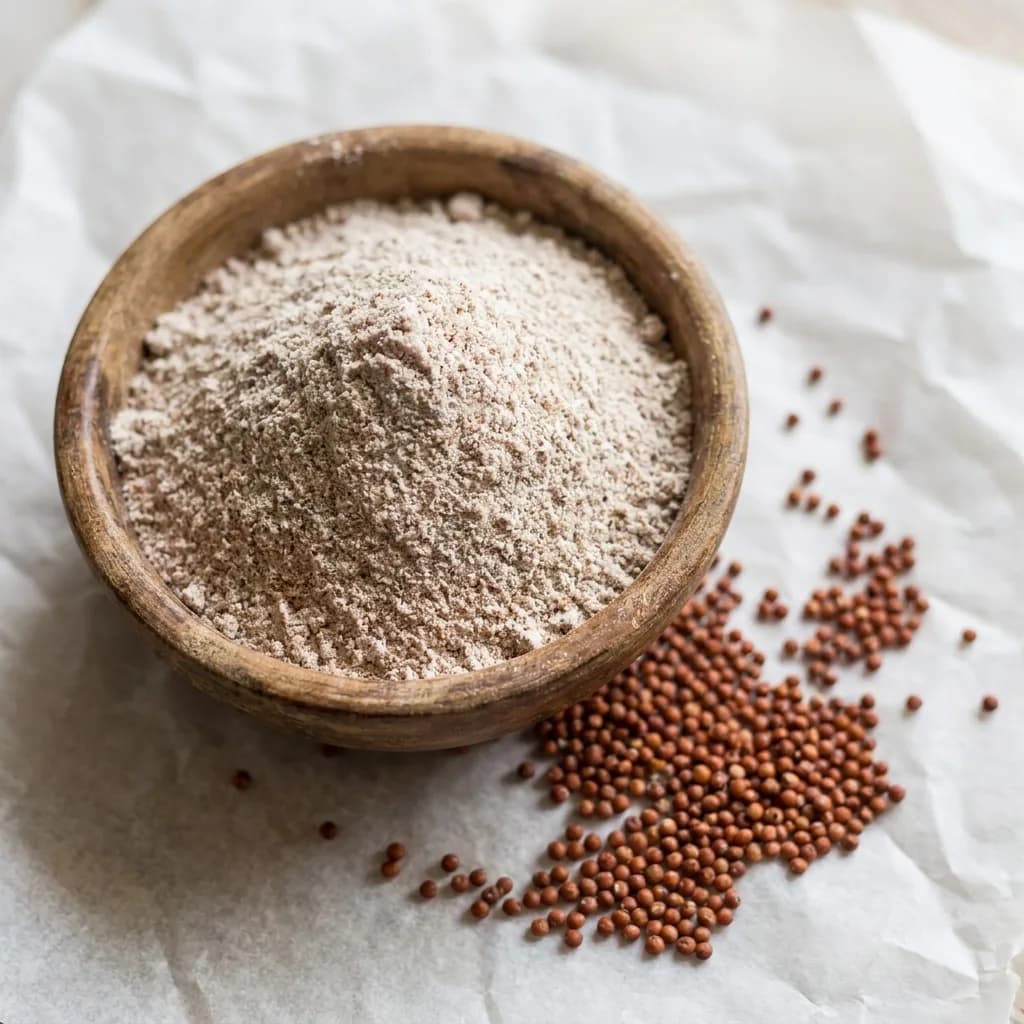
Finger millet flour, known as kurakkan in Sri Lanka and ragi flour in India, is ground from whole finger millet grains. It is used to make porridges, flatbreads, dosas, pittu and steamed cakes, often blended with rice flour or wheat. The flour is gluten-free with a distinctive earthy, faintly bitter taste and is valued for its high calcium content.
Finger millet flour, known as kurakkan in Sri Lanka and ragi across South India, is milled from the tiny seeds of Eleusine coracana — a cereal grain domesticated in East Africa around 2000 BCE before spreading eastward to the Indian subcontinent. The entire grain is typically ground to a fine, reddish-brown flour that retains the bran layer, giving it a distinctive color and much of its nutritional density. Unlike wheat flour, finger millet produces a dense, slightly crumbly dough that requires specific handling techniques to work successfully in flatbreads and porridges.
What sets finger millet apart is its exceptional calcium content — roughly three times that of rice or wheat — along with significant iron and a fiber profile dominated by insoluble fiber (approximately 3–5 g per 100g). The grain's hard seed coat and small size (1–2 mm) make it naturally resistant to pests in storage, though the same coat contributes antinutrients like phytic acid and tannins that mild processing (soaking or fermentation) can reduce. The flour has a pronounced nutty, slightly bitter quality that deepens when toasted, and it behaves quite differently from conventional baking flours: it lacks gluten and produces dense, crumbly textures that benefit from being combined with other flours or techniques that introduce binding and moisture.
In the regions where it remains a dietary staple — Karnataka and Tamil Nadu in India, Sri Lanka's highlands, Uganda, Kenya, and Nepal — kurakkan is valued not only for its hardiness as a crop but for its role in managing blood sugar and providing calcium in diets where dairy is scarce. The flour is a foundational ingredient in fermented batters, steamed preparations like pittu and mudde, and the daily roti. Its deep, earthy flavor and dense nutritional profile make it a serious cooking ingredient rather than merely a health-food substitute.
- Measured in
- g
- Storage
- Pantry
Types & varieties
Most common commercial variety; reddish-brown flour; strong, slightly bitter, nutty flavor
Slightly milder flavor than red; common in East African preparations
Lighter color flour; milder flavor; popular in some South Indian dishes
Higher anthocyanin content; used in specialty health foods
Term for finger millet in Sri Lanka; typically the red-brown type grown in highland regions
Handling Finger Millet Dough
Unlike wheat dough, kurakkan dough is naturally less elastic and prone to crumbling. The key is moisture management: mix the flour with hot (near-boiling) water to gelatinize the starches and create a workable consistency. Let the dough rest 5–10 minutes covered — this allows the flours to hydrate fully and reduces cracking when rolling. Keep your hands and work surface lightly oiled; the dough will be stickier than a wheat dough. For rotis that hold together better, blend kurakkan with rice flour in a 1:1 to 2:1 ratio.
- Mix with hot water, not cold, for a cohesive dough
- Rest the dough 5–10 minutes before shaping
- Oil your hands and rolling surface before working the dough
- Blend with rice flour for a less crumbly result
Health Considerations
Finger millet contains goitrogenic compounds that may interfere with thyroid hormone synthesis when consumed in very large quantities regularly. This is a particular concern in populations with iodine-deficient diets. Traditional preparation methods — soaking, fermenting, and repeated rinsing — reduce both the antinutrient load (phytic acid and tannins) and goitrogenic activity. If using finger millet as a primary dietary staple, ensure adequate iodine intake from other sources.
- Fermentation reduces antinutrients significantly
- Soaking overnight before cooking helps break down phytic acid
- Balance intake with iodine-rich foods if consuming daily
- Rotate with other grains to avoid over-reliance on any single staple
Common uses
Tips & pitfalls
- Toast the flour lightly in a dry pan before use to deepen the nutty flavor and reduce any raw grain taste — stir constantly as it browns quickly due to small particle size.
- For rotis, mix kurakkan flour with hot water first to create a stiff dough; let it rest 5–10 minutes before rolling to reduce crumbling.
- Oil your hands and the rolling surface when working kurakkan dough — it sticks more than wheat dough.
- When making pittu, steam the flour in layers with grated coconut and ensure the steamer is properly preheated.
- Sift the flour before cooking porridges to remove coarse particles for a smoother texture.
- Store in the freezer for extended shelf life (up to 2 years); cold storage also helps prevent weevil infestation.
- Combine kurakkan with rice flour (1:1 or 2:1 ratio) for a more pliable dough when making rotis.
- Do not overmix fermented batters — kurakkan ferments faster than rice-based batters due to higher amylase activity.
Nutrition
Nutrition
No USDA FoodData Central match for Finger Millet Flour (Kurakkan) yet. We surface a per-100 g profile once a generic whole-food entry is matched and verified.
In the shops
Matched grocery products
No matched grocery products for Finger Millet Flour (Kurakkan) yet.
Good to know
- Scientific name
- Eleusine coracana
- Origin
- East Africa, domesticated c. 2000 BCE; spread to India and Sri Lanka
- Color
- Reddish-brown when milled; retains outer bran layer
- Gluten status
- Naturally gluten-free
- Calcium content
- 300–350 mg per 100g (≈3× that of rice or wheat)
- Iron content
- 3–5 mg per 100g, higher than most common grains
- Fiber content
- Approximately 3–5 g per 100g, mostly insoluble
- Shelf life
- 6–12 months in airtight container; up to 2 years in freezer
- Key producing regions
- Karnataka and Tamil Nadu (India), Sri Lanka, Uganda, Kenya, Nepal
Substitutes
- Sorghum flour (Jowar) — Closest texture and neutral-nutty flavor; use 1:1 ratio in rotis and porridges
- Teff flour — Similar nutty, slightly sweet flavor; works in porridges and flatbreads; use 1:1 ratio
- Pearl millet flour (Bajra) — Comparable earthy flavor; slightly grittier texture; good for porridges and rotis
- Amaranth flour — Stronger, earthier flavor; best used in blends at 25–50% to avoid overpowering; works in porridges
- Brown rice flour — Milder flavor; lacks the calcium density; works in gluten-free baking blends
Pairs with
Also called
Kurakkan · Ragi Flour · Ragi Atta
Appears in these dishes
Related

All-Purpose Flour
The do-anything flour for bread, cakes, sauces, and dredging

Bread Flour
High-protein flour for chewy, well-risen breads
Whole Wheat Flour
Nutty, whole-grain flour for hearty breads and bakes
Cake Flour
Fine, low-protein flour for tender, delicate cakes
Almond Flour
Nutty, gluten-free flour for macarons and tender bakes

Baking Powder
All-in-one leavener for fluffy cakes, pancakes, and biscuits

Baking Soda
Pure leavener that needs acid to lift — and tenderize
Yeast
Living leaven that makes bread rise and dough come alive