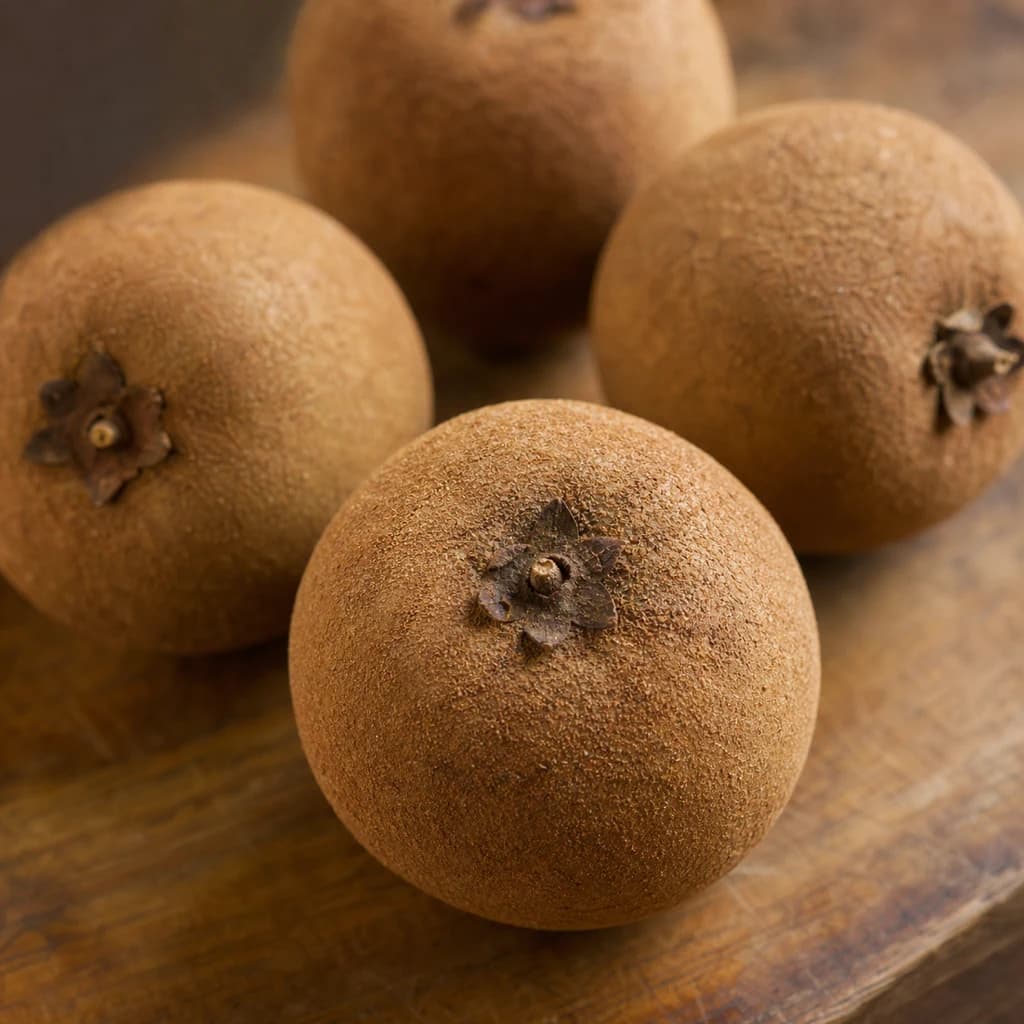
Natural form
Whole ripe naseberries showing their russeted brown skin and rounded shape.
Shows the fruit's identifying exterior — dull brown russeted skin, round-to-oval shape, and rough sandy texture that distinguish it from other tropical fruits.
Produce
Naseberry (Sapodilla)
Brown tropical fruit with grainy flesh tasting of malted brown sugar.
Naseberry, known elsewhere as sapodilla, is a round brown tropical fruit with soft, grainy, melting flesh. When fully ripe it is intensely sweet with a flavor like malted brown sugar or caramel pear, eaten fresh or blended into shakes and ice cream. Unripe fruit is astringent and inedible.
Naseberry, also called sapodilla, is a tropical fruit from the Sapotaceae family native to southern Mexico, Central America, and the Caribbean. The brown, kiwi-sized fruit has a thin, slightly rough skin that gives way to pale yellow to reddish-tan flesh with an intensely sweet, malty flavor often described as brown sugar, caramel, or toffee. The fruit's most distinctive characteristic is its grainy, gritty texture—a result of stone cells (sclereids) suspended throughout the flesh. This is not a flaw but a hallmark of fully ripe fruit. The naseberry name predominates in the Caribbean (Jamaica, Bahamas) and parts of South America, while sapodilla is more common in Southeast Asia, India, and commercial contexts worldwide. The tree itself is remarkable: it produces chicle, the milky latex that was the original base for chewing gum before synthetic alternatives. Ripeness is absolutely critical with naseberry—underripe fruit contains latex and saponins that cause severe mouth dryness and an astringent, puckering sensation. Once fully ripe, the fruit is one of the sweetest tropical fruits available, with a flavor complexity that rewards careful eating and thoughtful pairing.
- Measured in
- piece
- Storage
- Fridge
Types & varieties
Large, conical fruit from Guatemala; sweet with minimal astringency; popular commercial variety in Florida
Florida selection; intense brown-sugar sweetness; round fruit
Large, rounded Florida variety; excellent eating quality
Pear-shaped Florida variety; compact growth habit
Named selections producing fruit with fewer or no viable seeds
Cream-fleshed variety; very sweet; common in Mexico
Indian variety; large fruit, high yield
Indian variety; smaller fruit, traditionally grown in Maharashtra
Understanding Ripeness
This is the single most important skill for anyone working with naseberry. The difference between unripe and ripe is extreme: underripe fruit contains milky latex and saponins that cause immediate mouth-puckering dryness and irritation. Ripe fruit has no latex—the sugars have fully developed and the flesh softens. Test ripeness by pressing gently with your palm: the fruit should yield slightly and spring back, similar to a ripe avocado. A firm naseberry needs days at room temperature. A fruit that feels soft and mushy or has a fermented smell is past its prime. The skin darkens slightly as it ripens but this alone is unreliable—always test by touch.
- Firm fruit = days away from ready; leave at room temperature
- Slight yield to palm pressure = ready to eat or refrigerate for later
- Soft or wrinkled skin, fermented odor = overripe; still usable for cooking but not fresh eating
- Cracked skin = damaged; discard or use immediately in cooked preparations
The Gritty Texture Explained
The sandy, grainy texture that characterizes naseberry flesh comes from sclereids—woody stone cells scattered throughout the fruit's parenchyma tissue. This is not grit or contamination; it is a defining structural feature of the fruit. Some varieties have finer, less pronounced grit than others, and texture softens slightly when cooked. If the texture is objectionable for a particular preparation (smooth purees, for instance), the flesh can be pressed through a fine sieve to remove the worst of the grit, though some character will be lost. Accept this texture as part of what makes naseberry distinctive, and design preparations around it rather than against it.
- Gritty texture = normal, not a defect; indicates proper development of stone cells
- Varieties vary in grit intensity; Mexican Cream tends toward finer texture
- Cooking softens but does not eliminate the grit
- Straining removes grit but also removes character; use selectively
Common uses
Tips & pitfalls
- Select fruit that yields slightly to firm palm pressure—firm fruit is underripe and will be chalky and astringent
- Avoid fruit with cracked skin or any fermented, alcoholic odor
- Ripen at room temperature; once ripe, refrigerate immediately and use within 3–5 days
- Never eat unripe fruit—the latex is irritating and the flesh is intensely mouth-puckering
- Halve the fruit lengthwise and remove seeds with a spoon; seeds are hard, black, and glossy—do not bite down on them
- The gritty texture from sclereids is normal and desirable for fresh eating; embrace it
- For smoothies, freeze ripe flesh in chunks for an instant, no-ice-needed base
- When making preserves, add a squeeze of lime to balance the intense sweetness
- Excess ripe fruit can be mashed and frozen in portions for later use in baking or smoothies
- Store unripe fruit away from other fruits to prevent premature softening from ethylene gas
Nutrition
Energy
347 kJ · per 100 g
Where the calories come from
Protein
0.4g
1% DV
Carbs
20g
7% DV
Fat
1.1g
1% DV
Fiber
5.3g
19% DV
Sodium
12mg
1% DV
Source · USDA FoodData Central · Sapodilla, raw
View on FDC →In the shops
Matched grocery products
No matched grocery products for Naseberry (Sapodilla) yet.
Good to know
- Scientific name
- Manilkara zapota (syn. Achras zapota, Sapota zapotilla)
- Origin
- Southern Mexico, Central America, Caribbean
- Peak season
- Late winter to early spring (Florida, Caribbean); year-round in tropics
- Typical size
- 3–10 cm (1.2–4 in) diameter; 100–200 g (3.5–7 oz)
- Flavor
- Sweet, malty, brown sugar, caramel, toffee; dates or sweet potato-like
- Texture
- Grainy, gritty from sclereids (stone cells); ~75% edible flesh
- Seeds
- 1–6 hard, black, glossy seeds per fruit; remove with spoon
- pH (ripe)
- 5.5–6.5 (mildly acidic)
Substitutes
- Persimmon (Fuyu) — Similar grainy texture and honey sweetness; adjust for lower acidity and milder flavor
- Date — Comparable caramel-brown-sugar sweetness; softer texture; works well in preserves and desserts
- Brown sugar pear — For texture and sweet flavor; has similar grainy quality when ripe
- Tamarind paste — Only for savory uses—tropical, sweet-sour profile differs significantly; not a true substitute for sweet applications
Pairs with
Also called
Sapodilla · Chiku · Sapota
Related
Tomato
Juicy, sun-sweet fruit for sauces, salads, and slow-cooked depth
Yellow Onion
The aromatic backbone of soups, sofritos, and braises
Garlic
Pungent cloves that perfume nearly every savory dish
Lemon
Bright, acidic citrus that wakes up almost any dish
Potato
Humble, hearty staple — roast, mash, fry, or boil
Carrot
Sweet, crunchy root — raw, roasted, or the base of a sofrito
Cucumber
Cool, crisp, and watery — for salads, pickles, and tzatziki

Lettuce
Crisp leaves for salads, wraps, and a fresh crunch