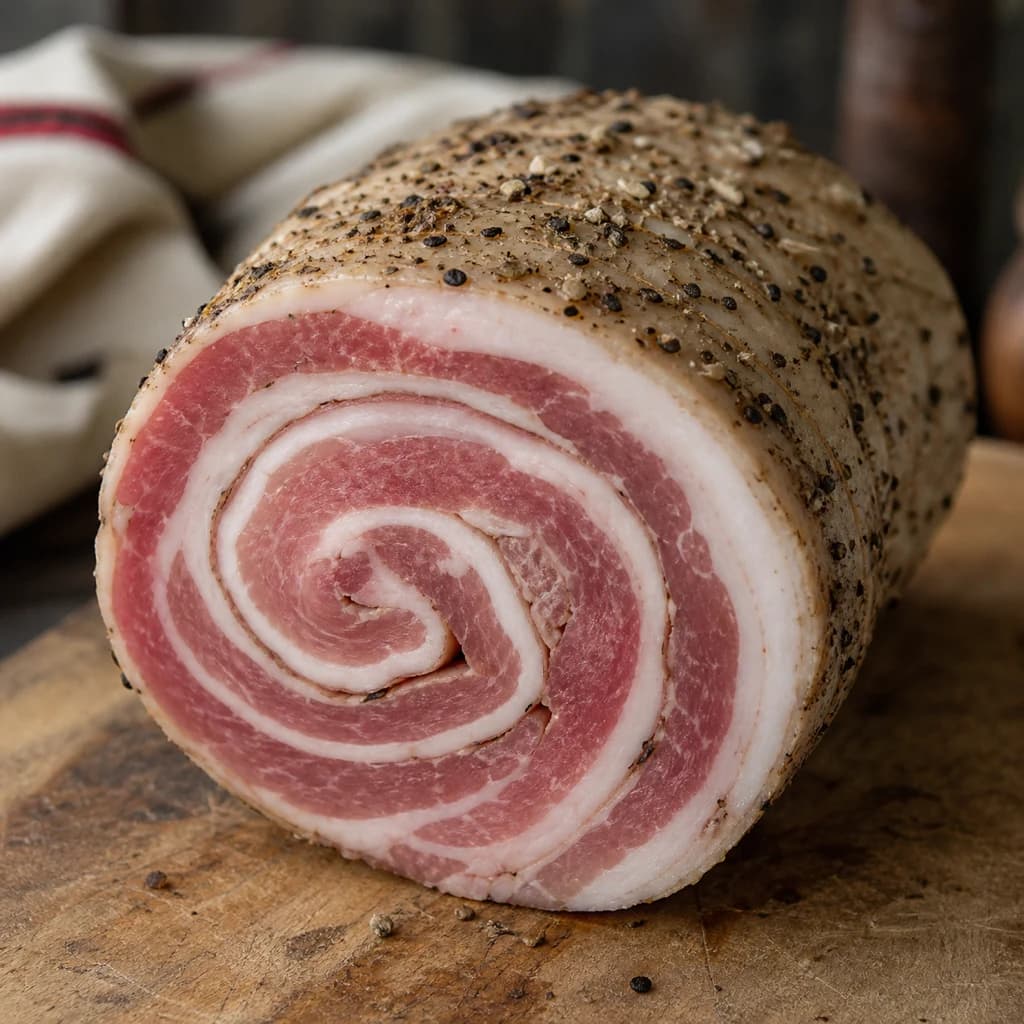
Natural form
A rolled pancetta log shows the tight spiral of cured pork belly before slicing.
The rolled cylinder form is pancetta's most distinctive and recognizable presentation, immediately distinguishing it from flat bacon.
Proteins
Pancetta
Italian salt-cured pork belly, diced and rendered to flavor pasta and sauces.
Pancetta is Italian pork belly cured with salt and spices, sometimes rolled and aged. Diced and rendered slowly, it lends savory, fatty depth to carbonara, amatriciana, soups, and braises. Unlike bacon it is typically cured rather than smoked, giving a cleaner, porkier flavor.
Pancetta is Italy's contribution to the cured pork pantry—a slab of pork belly that has been salt-cured with black pepper and often augmented with aromatics like juniper, fennel, garlic, or rosemary, then aged for a minimum of three to four weeks. Unlike bacon, it receives no smoking; its flavor comes entirely from the cure and the meat itself. The result is a deeply savory, porky product with a fat cap that renders smoothly when cooked, delivering both concentrated meat flavor and a substantial amount of cooking fat. In Italy, particularly in central regions like Lazio and Umbria, thin slices of raw rolled pancetta appear on antipasto plates, its flavors already developed by the curing process. Elsewhere in the kitchen, pancetta is treated as a building block: diced and rendered in a pan to create a flavored fat base for soffritto, sauces, and risottos; crisped to a golden finish as a pasta topping; or wrapped around roasts to baste them with pork fat as they cook.
The distinction between pancetta and bacon matters in the kitchen. Bacon's smoke flavor is not easily replicated, and when a recipe calls for pancetta specifically, the intent is usually to build a savory, peppery foundation without smoke competing with other flavors. Pancetta's fat content—roughly 50–60%—means it renders generously, and that fat becomes a cooking medium as much as a flavor agent. The two main forms, rolled (arrotolata) and flat (stesa or piatta), serve different purposes: rolled pancetta slices cleanly for raw service or quick crisping, while flat pancetta dices into uniform cubes that render evenly in a pan. Regional Italian varieties add complexity: Pancetta di Parma and Pancetta arrotolata di Guastalla carry PDO protection and represent particular curing traditions centered in Emilia-Romagna and Lombardy, while Pancetta bolognese is identifiable by its heavy pepper crust, traditional in ragù bolognese.
- Measured in
- g
- Storage
- Fridge
Types & varieties
Rolled pancetta; slices cleanly for raw service or crisping; denser, more uniform texture
Flat pancetta; cubes evenly for cooking applications; preferred when recipe calls for diced pancetta
From Parma region; seasoned primarily with black pepper; PDO designation authenticates origin and production method
Flat pancetta from Bologna; heavily pepper-crusted; traditional in ragù bolognese and Emilian cooking
Rolled Pancetta from Guastalla (Mantua province); PDO protected; seasoned with pepper and sometimes juniper
Traditional farmhouse-style; less standardized curing; regional variation in spice blends and techniques
Choosing Pancetta
Select rolled pancetta when the intent is thin slicing for raw service or quick crisping—it holds its shape and yields clean cuts. Choose flat pancetta when you need to dice it; the rectangular slab produces uniform cubes that render evenly in a pan, avoiding a mix of under- and over-cooked pieces. For ragù bolognese or preparations where pepper crust flavor matters, seek out Pancetta bolognese specifically. Avoid any product labeled 'affumicata' (smoked) if a recipe calls for pancetta—the smoke will dominate.
- Look for consistent pink color with white fat marbling throughout
- Avoid packages with excessive liquid or a grayish cast
- Check the ingredient list: should contain pork belly, salt, pepper, and minimal additives
- Vacuum-sealed packages have the longest shelf life
Rendering Pancetta Correctly
The goal in most cooked applications is to render the fat slowly so it melts into the pan and the meat crisps without burning. This requires medium-low heat and patience. High heat causes the exterior to seize and brown before the interior fat has melted, resulting in chewy, unevenly cooked pieces.
- Pat pancetta dry before cooking to reduce splattering
- Use a heavy skillet or Dutch oven for even heat distribution
- Render in the pan alone first—do not add aromatics or vegetables until fat is mostly melted
- Cook until edges are golden and crisp, then proceed with recipe
- Drain excess fat as needed for leaner preparations
Common uses
Tips & pitfalls
- Render pancetta over medium-low heat in a dry pan or with minimal added fat—pat the meat dry before cooking to prevent splattering.
- Do not parboil or blanch pancetta before cooking as you might with salt pork; it crisps directly from raw diced or sliced.
- For most cooked applications, render until the edges are crisp and golden, then add other ingredients in the order specified by the recipe.
- Drain excess rendered fat as needed—pancetta yields substantial fat that can overwhelm delicate preparations.
- When substituting for guanciale in Roman pasta dishes, note that pancetta is leaner and less porky; guanciale remains the authentic choice for carbonara and amatriciana.
- Store-bought pre-cubed pancetta is convenient but cubes are often uneven; hand-dicing a flat piece gives more control over size and ensures even rendering.
- Pancetta's flavor intensifies when cooked and reduced in volume; use sparingly as a seasoning rather than a main component.
- Reserve strained rendered fat for cooking—it functions like lard and adds depth to vegetables, potatoes, or eggs.
Nutrition
Energy
2741 kJ · per 100 g
Where the calories come from
Protein
6.4g
13% DV
Carbs
0g
0% DV
Fat
69.6g
89% DV
Fiber
0g
0% DV
Sugars
0g
of which
Sodium
25mg
1% DV
Source · USDA FoodData Central · Pork, fresh, variety meats and by-products, jowl, raw
View on FDC →In the shops
Matched grocery products
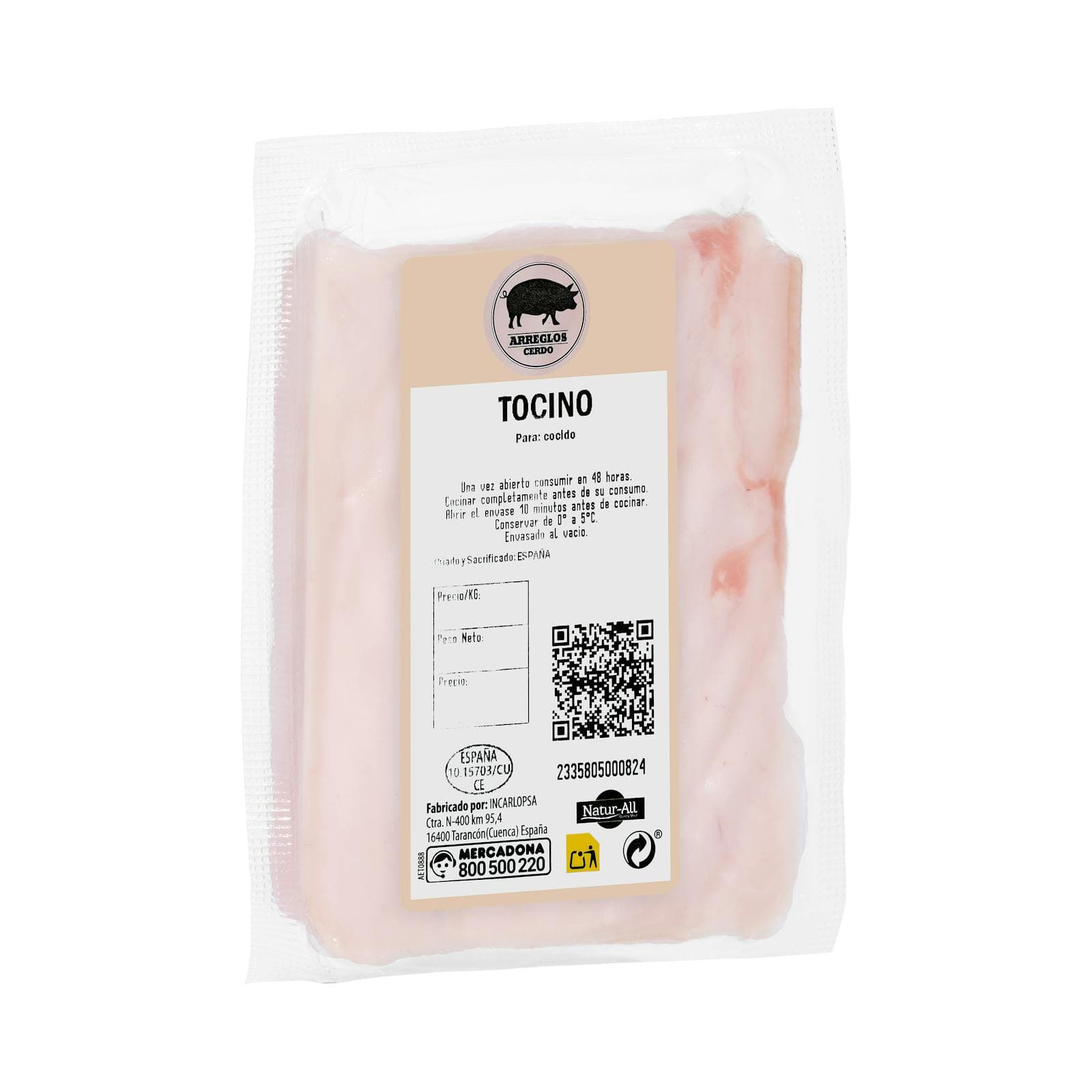 €1.48
€1.48Pork Fatback
190 g · Mercadona
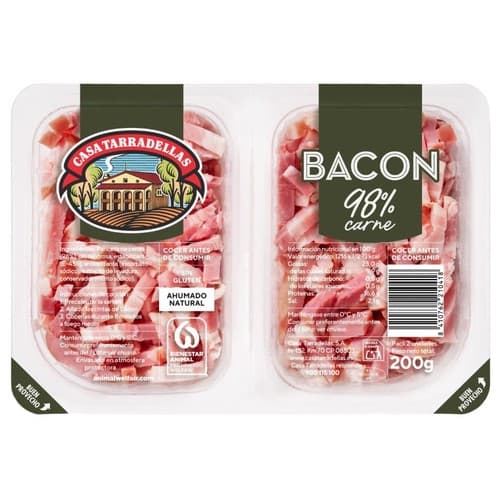 €1.99
€1.99Pork Bacon Strips
CASA TARRADELLAS · kg · Bonpreu
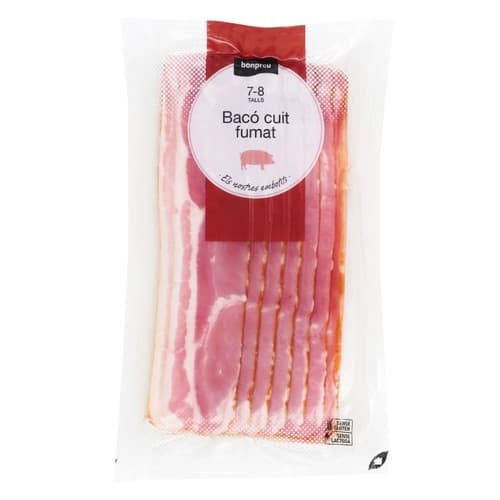 €1.85
€1.85Smoked Cooked Bacon
BONPREU · kg · Bonpreu
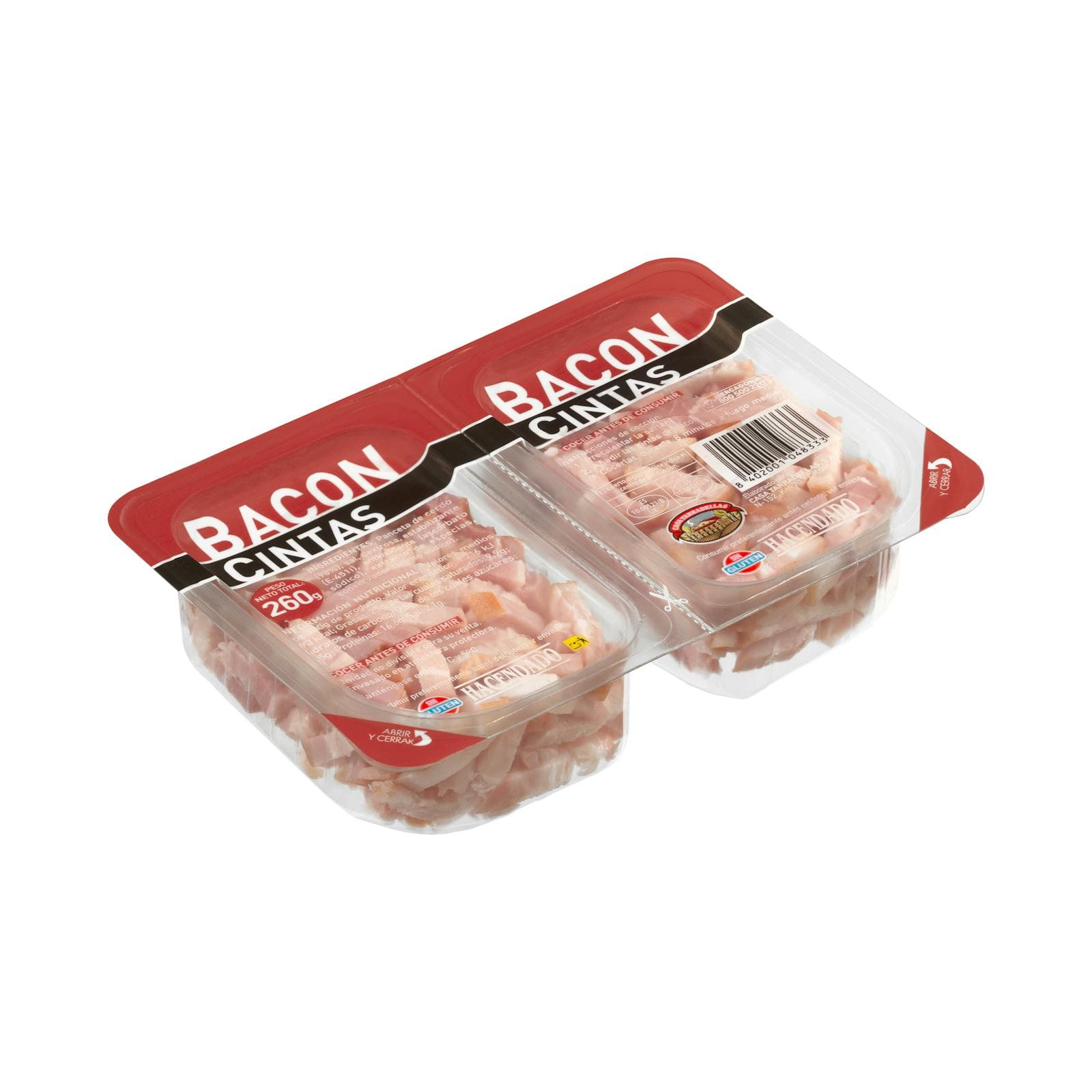 €2.20
€2.20Bacon Strips
Hacendado · 260 g · Mercadona
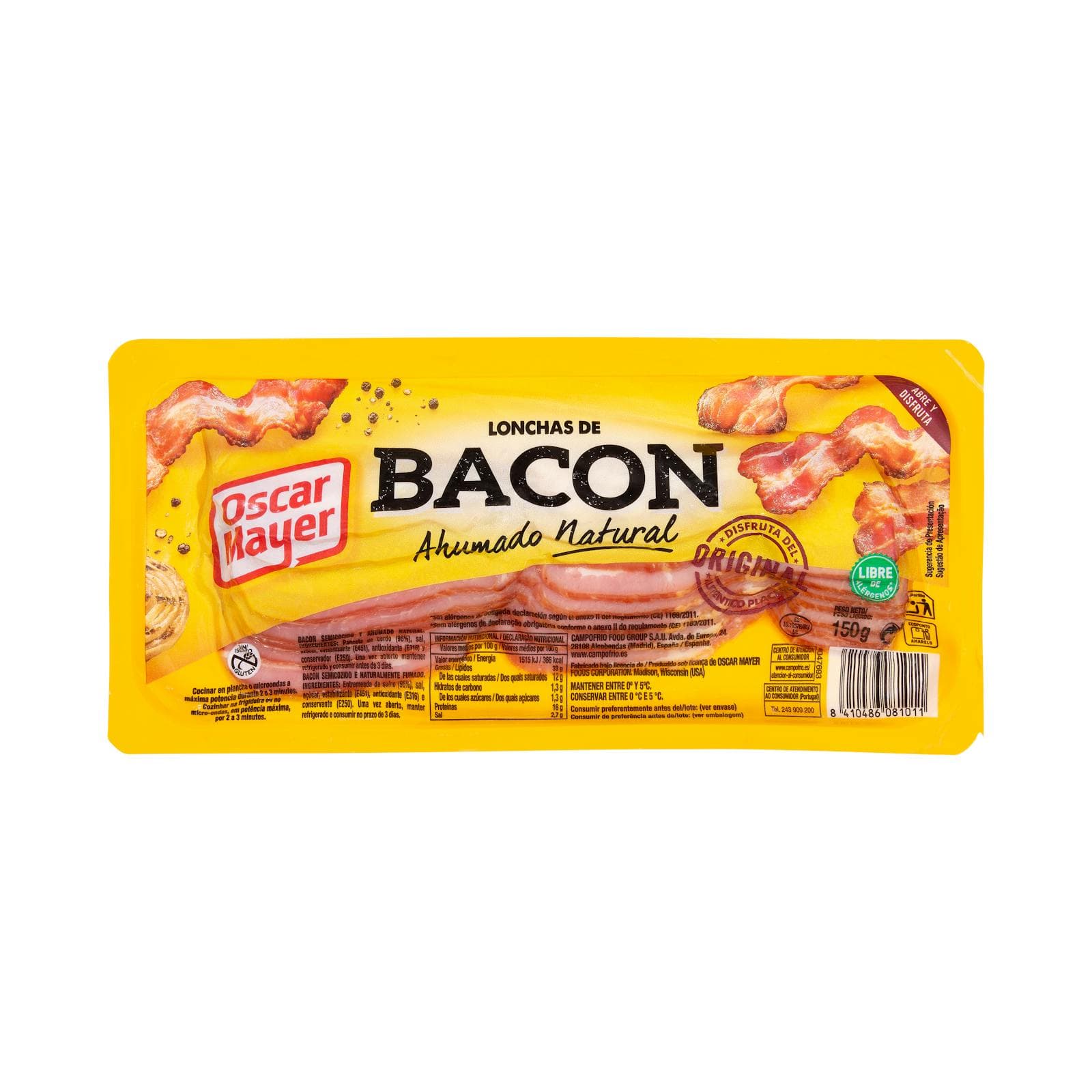 €2.35
€2.35Oscar Mayer Bacon Slices
Oscar Mayer · 150 g · Mercadona
 €2.89
€2.89Smoked Cooked Bacon Bonpreu
BONPREU · kg · Bonpreu
Good to know
- Origin
- Italy (Emilia-Romagna, Lombardy, Lazio, Umbria)
- Type
- Salt-cured pork belly, unsmoked
- Curing agents
- Salt, black pepper, sometimes juniper, fennel, garlic, or rosemary
- Curing time
- Minimum 3–4 weeks; longer for premium varieties
- Primary forms
- Rolled (arrotolata) or flat/rectangular (stesa)
- Fat content
- Approximately 50–60% fat by weight
- Color
- Pale pink to deep rose with white fat marbling
- Ready to eat
- Yes, when thinly sliced raw; more often cooked in non-Italian cuisines
- Shelf life (uncooked)
- Refrigerated: 2–3 weeks; vacuum-sealed: up to 6 months
- Shelf life (cooked)
- Refrigerated: up to 1 week; frozen: 1–2 months
- Yield
- Minimal shrinkage when diced; ~20–30% volume reduction when rendered to crisp
Substitutes
- Guanciale — Cured pork jowl; fattier and more intensely porky; the traditional choice for Roman pasta dishes; closest flavor match but harder to find outside Italy
- Bacon (smoked) — Contains smoke flavor that pancetta lacks; acceptable in most cooked applications but not for raw serving; reduce quantity as bacon is saltier
- Salt pork — Cured pork fat; lacks spice seasoning and porky flavor; best for rendering into cooking fat, not as a direct flavor substitute
- Lardo — Cured pork fatback; very mild flavor, primarily fat; not a substitute for pancetta's savory, seasoned character
- Prosciutto cotto — Cooked ham; completely different texture and fat content; will not render or crisp; not suitable as a cooking substitute
Pairs with
Also called
Italian Cured Pork Belly
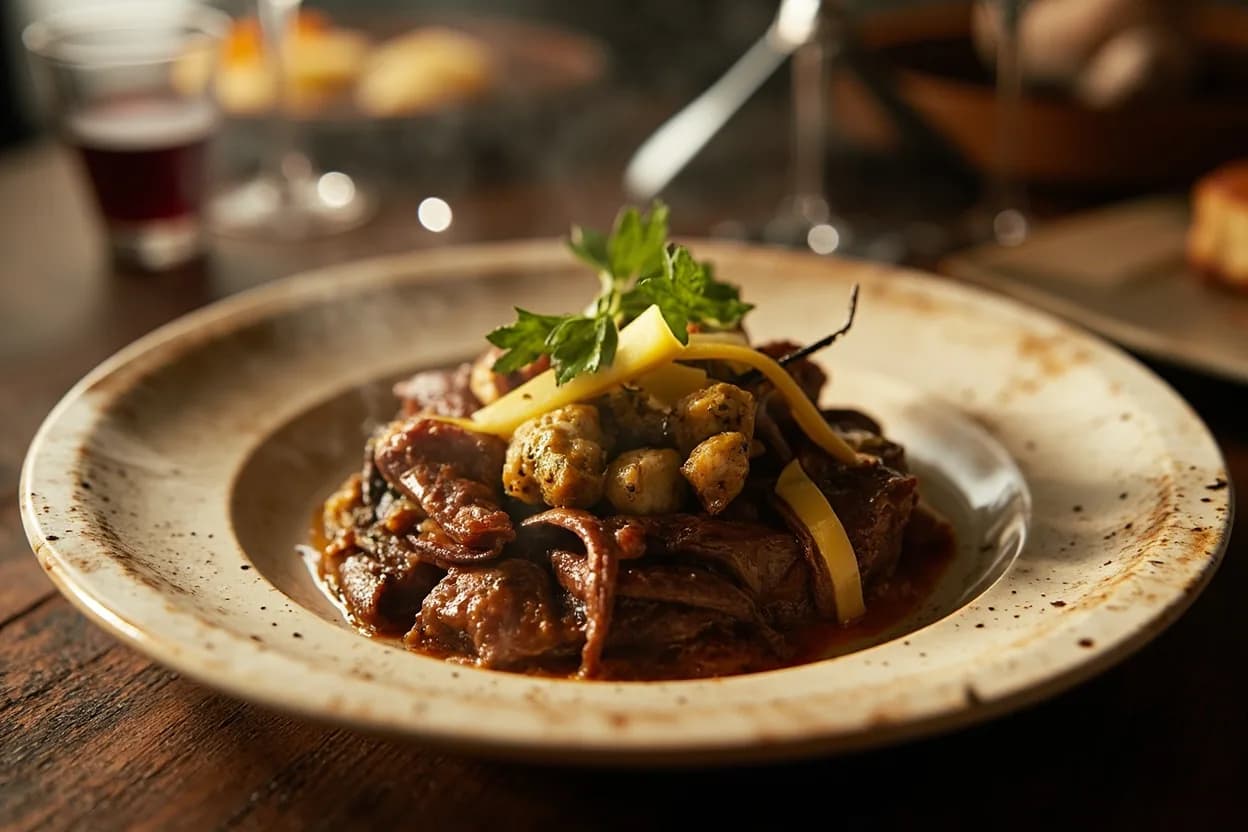
Appears in these dishes

Related

Egg
The kitchen's everything ingredient — bind, leaven, enrich, or fry

Chicken Breast
Lean, quick-cooking white meat for everyday dinners

Ground Beef
Versatile minced beef for burgers, ragù, tacos, and meatballs

Pork Loin
Lean, tender roasting cut that stays juicy with care

Salmon
Rich, rosy fish that roasts, grills, or cures beautifully

Egg White
Pure protein that whips to airy peaks for meringue and more

Egg Yolk
Rich, golden yolk for custards, mayonnaise, and pasta

Quail Egg
Tiny, speckled eggs for garnishing and elegant bites