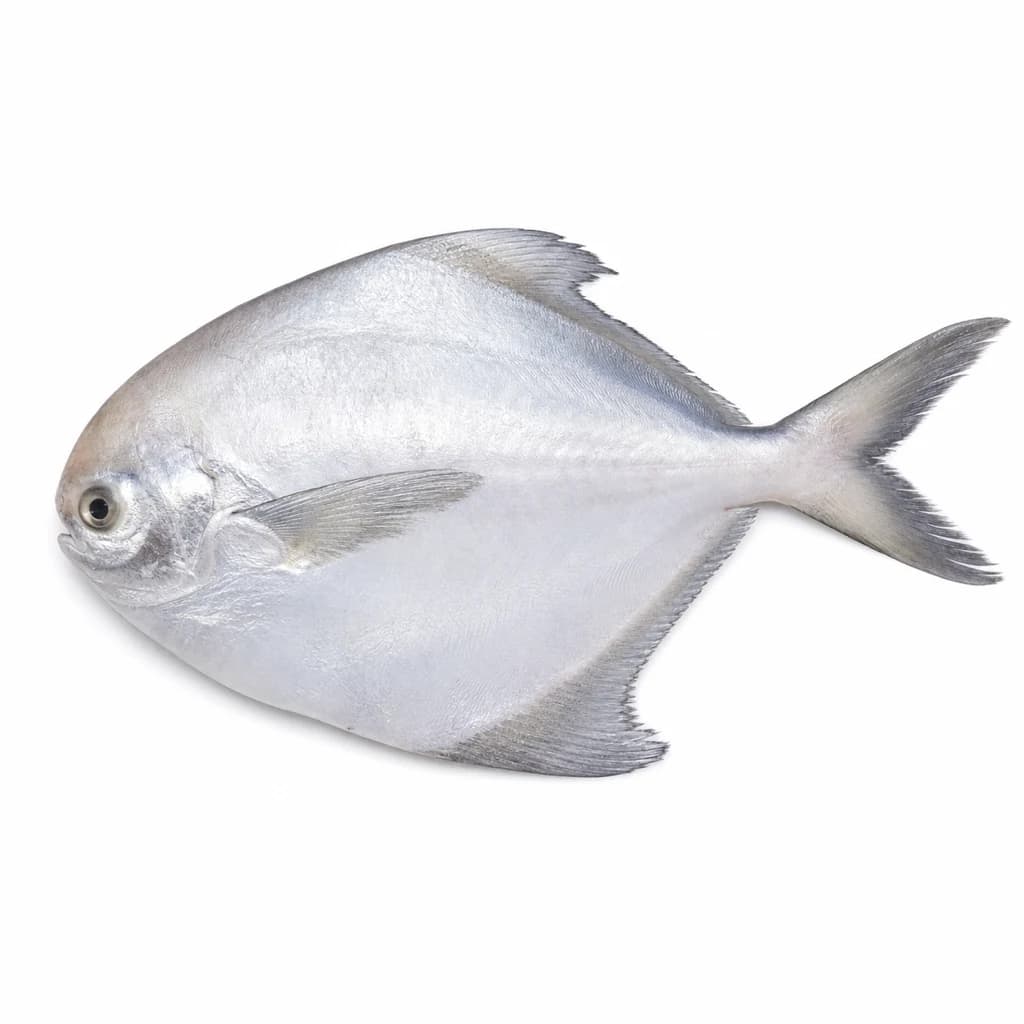
Natural form
Whole fresh pomfret showing its distinctive flat, disc-like silver body and forked tail.
Establishes the fish's unmistakable shape, size, and silvery coloration for instant identification.
Proteins
Pomfret
Flat, silvery saltwater fish with sweet white flesh, fried or curried whole.
Pomfret is a flat, round, silvery saltwater fish popular across South and Southeast Asia. Its tender, slightly sweet white flesh and easy bone structure make it ideal for frying whole, grilling, or simmering in coconut and tamarind curries. It is a festive favorite in Indian coastal cooking.
Pomfret (Pampus species) is a flatfish from the Stromateidae, or butterfish, family. Native to the Indo-Pacific, ranging from East Africa to Japan and Australia, it inhabits coastal waters and estuaries at depths of 30–150 meters. The fish is laterally compressed with a distinctive oval-to-diamond silhouette, covered in small, firmly attached scales over silvery-white to grey-brown skin. What makes pomfret indispensable in Asian coastal cuisines is its singular combination of manageable size (200–800 grams market weight), mild sweetness that accepts bold or subtle seasoning equally well, and a fine-textured, lean white flesh that flakes cleanly when cooked. The edible skin crisps beautifully when fried, providing textural contrast that many cooks deliberately preserve. With an edible yield of roughly 45–50%, pomfret offers excellent value and minimal waste, making it a practical daily protein in markets from Kerala to Hong Kong.
Pomfret occupies a privileged position in the kitchens of India, China, Southeast Asia, and East Africa precisely because it is hard to ruin yet rewarding when treated with confidence. Its delicate flesh—low in fat and fine in grain—cooks quickly and can dry out if overhandled, yet it holds together reasonably well in saucy curries. The fish's mildness is a feature, not a drawback: it serves as a canvas for turmeric and curry leaves in Indian fried preparations, for soy and ginger in Chinese steamed dishes, and for coconut milk in Keralan gravies. Fresh pomfret should smell of the sea, not ammonia; look for bright, clear, bulging eyes and bright red or pink gills. The flesh should spring back when pressed. Refrigerate on ice or in the coldest part of the fridge and use within one to two days for best quality.
- Measured in
- g
- Storage
- Fridge
Allergens
Types & varieties
Silvery-white with an oval body; considered the premium variety with the mildest flavor; prized in Chinese and Southeast Asian cuisines; commands higher prices than black pomfret.
Darker grey-brown coloring with a rounder body; more commonly available in South Asian markets; slightly stronger flavor than white pomfret; excellent fried whole or in curries.
Similar to white pomfret but slightly smaller; common in Hong Kong, Taiwan, and Southern Chinese markets; tender texture; excellent steamed.
Cleaning and Butchering
Pomfret requires careful cleaning due to its small, firmly attached scales. Use a fish scaler or the back of a blunt knife, working firmly from tail to head. Rinse thoroughly under cold running water. For whole preparations, leave the skin on—thin as it is, it crisps beautifully when fried and is entirely edible. For filleting, run a thin-bladed knife along the rib cage from head to tail on both sides, then lift the fillets free; the bones are few and large, making this straightforward even for home cooks.
- Work scales from tail to head using firm, overlapping strokes
- Rinse the body cavity well after gutting to remove any residual blood
- The skin adheres tightly—do not peel it; score it instead before cooking
- For stock, the frames and bones make an excellent base that adds subtle sweetness without clouding the broth
Regional Preparations
In India, white pomfret is called paplet and is the premium choice for restaurant service and special occasions. It is scored deeply on both sides, coated in turmeric paste and salt, then deep-fried until the skin blisters and crisps. In Kerala and coastal Karnataka, pomfret is braised in coconut milk with turmeric, chili, and curry leaves—a gentle cooking method that keeps the flesh moist. In Maharashtra, a tomato-based masala preparation is equally common. Chinese and Taiwanese cooks prefer steaming: the whole fish rests on a bed of julienned ginger and scallions, finished with a splash of light soy sauce and sesame oil. In Singapore and Malaysia, pomfret steamed with soy sauce is a hawker staple, sometimes finished with a drizzle of hot oil. In Hong Kong, black pomfret is frequently pan-fried with garlic and ginger.
- Indian fried pomfret: score, turmeric paste, salt, deep-fry at 180°C (355°F) 3–4 minutes per side
- Keralan coconut milk curry: simmer masala, add fish in last 8 minutes to prevent breaking
- Chinese steamed: steam over high heat 8–10 minutes depending on size
- Malaysian tamarind gravy: balance sweet, sour, and savory with the delicate fish as centerpiece
Common uses
Tips & pitfalls
- Select fresh pomfret by checking for bright, clear, bulging eyes and bright red or pink gills; the flesh should spring back firmly when pressed
- Avoid fish with a strong ammonia smell, sunken eyes, or dull, discolored flesh—these are clear signs the fish is not fresh
- The scales are small and firmly attached; use a scaler or the back of a knife, working from tail to head with firm, overlapping strokes
- Score the fish on both sides with 2–3 diagonal cuts per side before cooking—this helps heat penetrate evenly and prevents the skin from buckling during frying
- Do not overcook: pomfret flesh is delicate and becomes dry and tough quickly; it is done when the flesh turns opaque and just begins to flake, usually 3–4 minutes per side for a medium fish when pan-frying
- Pat the fish completely dry before frying—any surface moisture causes dangerous splattering and prevents proper browning
- For steaming, bring the liquid to a full boil before placing the fish in, then maintain a steady simmer; this ensures even, gentle cooking throughout
- In curry preparations, add the fish only in the last 8–10 minutes of cooking to prevent it from disintegrating
- The thin, silvery skin is edible and becomes pleasantly crispy when fried—do not peel it off before cooking
- Marinate with acidic ingredients like lemon or tamarind for no more than 20–30 minutes; acid begins to denature the delicate proteins and makes the flesh mushy
Nutrition
Energy
611 kJ · per 100 g
Where the calories come from
Protein
17.3g
35% DV
Carbs
0g
0% DV
Fat
8g
10% DV
Fiber
0g
0% DV
Sodium
89mg
4% DV
Source · USDA FoodData Central · Fish, butterfish, raw
View on FDC →In the shops
Matched grocery products
No matched grocery products for Pomfret yet.
Good to know
- Family
- Stromateidae (butterfish family)
- Flavor
- Mild, sweet, delicate; clean marine taste without strong fishiness
- Flesh
- Fine-textured, lean, white; flakes easily when cooked; low in fat
- Yield
- Approximately 45–50% edible meat after cleaning and cooking loss
- Typical Size
- 20–40 cm length; market weight 200–800 grams
- Season
- Best availability in winter and early spring; varies by region
- Storage
- Refrigerate on ice or in coldest part; use within 1–2 days; freeze only if necessary, well-wrapped, up to 1 month
- Origin
- Indo-Pacific: Indian Ocean to Western Pacific, East Africa to Japan and Australia
Substitutes
- Sole (Dover, Lemon, or Petrale) — Similar flat shape, delicate texture, and mild flavor; cook with the same methods; sole is slightly more expensive but nearly interchangeable
- Flounder — Comparable mild sweetness and flaky texture; widely available; works well fried, steamed, or in curries
- Butterfish (Pacific or Atlantic) — From the same Stromateidae family; nearly identical texture and flavor; can be used interchangeably in most preparations
- Branzino (European Sea Bass) — Different body shape but similar mild, sweet flavor and flaky texture; excellent for grilling and steaming; slightly firmer flesh stands up better to aggressive seasoning
- Pomano — Firm white flesh with mild flavor; holds up better in hearty curries than the more delicate pomfret; good substitute when pomfret is unavailable
- Mullet (Striped or Red) — Mild flavor and decent texture; works for frying and curries but has a slightly more pronounced fish taste
Pairs with
Also called
Butterfish · Paplet
Appears in these dishes
Related
Egg
The kitchen's everything ingredient — bind, leaven, enrich, or fry
Chicken Breast
Lean, quick-cooking white meat for everyday dinners

Ground Beef
Versatile minced beef for burgers, ragù, tacos, and meatballs
Pork Loin
Lean, tender roasting cut that stays juicy with care
Salmon
Rich, rosy fish that roasts, grills, or cures beautifully

Egg White
Pure protein that whips to airy peaks for meringue and more

Egg Yolk
Rich, golden yolk for custards, mayonnaise, and pasta

Quail Egg
Tiny, speckled eggs for garnishing and elegant bites